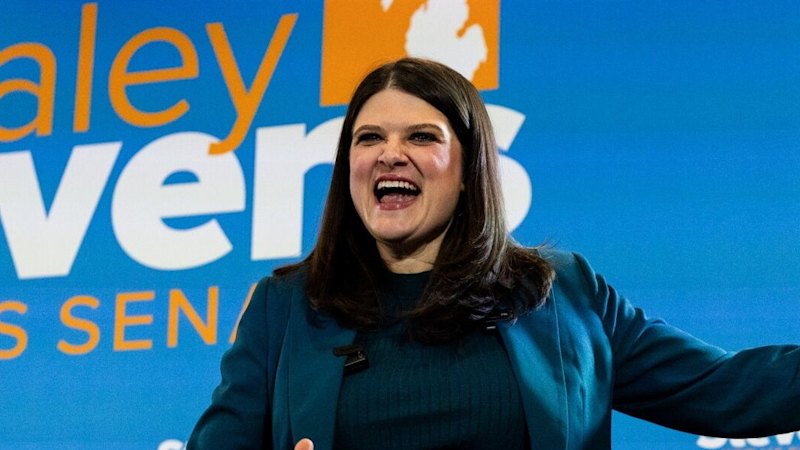
Intraparty friction in Michigan during the 2026 midterm cycle was not an accidental breakdown of campaign discipline, but the predictable structural output of an unresolved ideological and foreign-policy cleavage colliding with a high-stakes general election calendar. According to reporting by the Associated Press and PBS News, the conflict reached a public breaking point two days before the November 3 election when U.S. Representative Haley Stevens—who narrowly lost the August Democratic U.S. Senate primary to progressive physician and former Detroit health director Abdul El-Sayed—rescinded her prior support and endorsed Republican nominee Mike Rogers. While surface-level political commentary framed this split-screen event in Detroit as a sudden personal betrayal, an operational audit reveals a deeper set of institutional incentives, super PAC capital flows, and voter-alignment mechanics that nearly destabilized the party's statewide machinery—and ultimately failed to overturn the structural advantage of nationalized midterm turnout.
The Structural Drivers of the Primary Hangover
Political coalitions rely on a sequential two-stage game: an intraparty selection phase that rewards base mobilization, followed by a general election consolidation phase that requires elite consensus. When the ideological or policy distance between primary factions exceeds the perceived cost of losing to the opposing party, the consolidation mechanism fails. In Michigan's 2026 Senate race to succeed retiring Senator Gary Peters, three compounding variables prevented post-primary equilibrium.
- Asymmetric Outside Capital Injection: During the August primary, tens of millions of dollars in external independent expenditures entered the contest, notably from super PACs affiliated with the American Israel Public Affairs Committee (AIPAC) backing Stevens. High-volume outside spending alters candidate incentives by nationalizing local primaries around single-issue litmus tests, leaving behind institutional scar tissue that cannot be resolved through standard party unity events.
- Unreconciled Foreign Policy Cleavages: Reporting from The Guardian and the Associated Press highlights that the core policy dispute centered on U.S. military aid and the conflict in Gaza—an issue carrying acute electoral salience in Michigan due to the state's large Arab American, Muslim, and Jewish constituencies. Because neither faction could concede ground without alienating its core donors or grassroots organizers, the primary debate remained active into late October.
- Third-Party Spoiler Signaling: The late-October deployment of attack advertisements by external groups such as Rebellion PAC—which targeted Stevens despite El-Sayed publicly disavowing the ad and stating he disagreed with its contents—created a verification problem. In modern campaign environments where candidates cannot legally coordinate with or control independent expenditures, aggrieved primary losers often treat outside attacks as proxy warfare sanctioned by the nominee.
Elite Defection Versus Institutional Discipline
The operational breakdown during the final weekend of the campaign illustrates how elite signaling functions under extreme polarization. According to the Associated Press, U.S. Representative Debbie Dingell attempted to engineer a traditional coalition-repair event at a Detroit church featuring El-Sayed, Stevens, and U.S. Representative Jim Clyburn. Instead, after El-Sayed's campaign advised Stevens to stay away from events to prevent distractions following public comments by Stevens's fiancé stating he would vote for Rogers, Stevens appeared at Perfecting Church alongside Republican nominee Mike Rogers while El-Sayed campaigned miles away with Clyburn, Dingell, Maryland Senator Angela Alsobrooks, and state Senator Mallory McMorrow.
This split-screen triggered immediate institutional counter-measures from national party leadership, demonstrating how centralized party apparatuses enforce boundary lines when a sitting member defects:
- National Leadership Censure: Senate Democratic Leader Chuck Schumer, who had backed Stevens during the August primary, immediately denounced her endorsement of Rogers as a betrayal. Former House Speaker Nancy Pelosi and former President Barack Obama similarly reinforced El-Sayed's legitimacy through public endorsements and joint appearances in Detroit.
- Ideological Coalition Bridging: To prevent progressive alienation while reassuring institutional Democrats, the party deployed cross-factional validators. Senator Bernie Sanders and Representative Alexandria Ocasio-Cortez rallied with El-Sayed in Grand Rapids and Lansing, while Vice President Kamala Harris and Senator Elizabeth Warren joined him on the trail to anchor him within the mainstream Democratic apparatus.
- Down-Ballot Insulation: Michigan Democrats separated the Senate messaging friction from other statewide and congressional contests. Gubernatorial nominee Jocelyn Benson and U.S. House candidates across competitive districts maintained distinct operational tracks, preventing the Senate dispute from contaminating local field operations.
Empirical Impact on Voter Behavior and Election Outcomes
A rigorous evaluation of intraparty conflict requires measuring whether elite endorsements actually alter voter utility functions or merely generate media noise. In Michigan's November 3 general election, empirical outcomes demonstrate that macro-level nationalized voting behavior overwhelmed micro-level elite defection.
According to certified and near-complete election returns reported by Bridge Michigan, Abdul El-Sayed defeated Mike Rogers with 52.5% of the vote (2,520,895 votes) to Rogers's 45.5% (2,181,111 votes)—a seven-percentage-point margin that closely tracked pre-election polling by the Glengariff Group for WDIV and The Detroit News. Pollster Richard Czuba noted that Stevens's late endorsement of Rogers had no statistically significant impact on the final result, observing that El-Sayed met his necessary performance benchmarks in suburban Oakland County—the exact geographic base Stevens represented in Congress.
Three structural mechanisms explain why the elite fracture failed to flip the seat:
- Negative Partisanship Dominance: In a midterm environment where voters treated the election as a direct referendum on President Donald Trump's second term, partisan attachment operated as a hard ceiling against cross-party voting. Voters inclined toward Democratic policy outcomes refused to back a Republican nominee who would shift Senate majority control, regardless of a former primary rival's endorsement.
- Symmetric GOP Coalition Friction: Republicans experienced simultaneous internal fractures that neutralized any potential wedge advantage. According to The Washington Post, Mike Rogers faced election-eve criticism from antiabortion movement leaders, while aggressive rhetoric targeting El-Sayed from President Trump and Vice President JD Vance consolidated Democratic turnout rather than peeling away moderate suburbanites.
- Broad Statewide Wave Dynamics: The Democratic coalition's structural strength across Michigan was confirmed down-ballot. Beyond El-Sayed's Senate victory and Jocelyn Benson's win over John James in the gubernatorial race, CBS Detroit reported that Democrats flipped three Republican-held U.S. House seats—the 4th, 7th, and 10th congressional districts—while state Senator Jeremy Moss held Stevens's vacated 11th district and state Representative Donovan McKinney won the 13th district after unseating incumbent Shri Thanedar in the August primary.
Limitations of Coalition Management Strategies
While Michigan Democrats absorbed the shock of an eleventh-hour elite defection in 2026, treating that outcome as proof that intraparty warfare carries zero electoral cost is a severe analytical error. The 2026 result depended on favorable national midterm headwinds that shielded the nominee from marginal vote loss.
In a neutral or unfavorable national environment—such as a presidential election year or a midterm where the party holds the White House—a 1% to 2% defection among suburban moderates or disaffected primary voters in Oakland and Macomb counties would flip a statewide race. Furthermore, public cross-party endorsements erode long-term institutional trust, complicating future legislative whip counts and fundraising coordination between the progressive and moderate wings of the party. Relying on external wave dynamics to paper over unresolved policy fissures is not a repeatable operational model.
Strategic Protocol for Post-Primary Consolidation
To prevent primary fractures from metastasizing into general election liabilities in future battleground cycles, party leadership and campaign strategists must replace ad-hoc unity photo-ops with binding structural protocols immediately following primary certification:
- Enforce Immediate Independent Expenditure Disarmament: Within 48 hours of primary certification, state party chairs and national committee leadership must require all aligned super PACs and ideological advocacy groups to sign non-aggression agreements prohibiting paid media against any certified party nominee.
- Decouple Sub-Coalition Turnout Operations: Rather than forcing ideologically incompatible primary rivals onto the same stage—which creates high-risk split-screen opportunities—campaigns should assign former rivals to segmented voter-contact lanes where their specific credibility maximizes turnout without requiring joint appearances.
- Establish Pre-Primary Loyalty Escrow: State parties should condition access to coordinated campaign voter files, shared field offices, and joint fundraising committees on written post-primary endorsement commitments, imposing immediate institutional exclusion from party infrastructure on any officeholder who breaks ranks.
For a contemporaneous look at the primary tensions leading up to the general election, see Haley Stevens Demands Apology, El-Sayed Hits Back, which captures the public dispute between the two campaigns days before voters went to the polls.