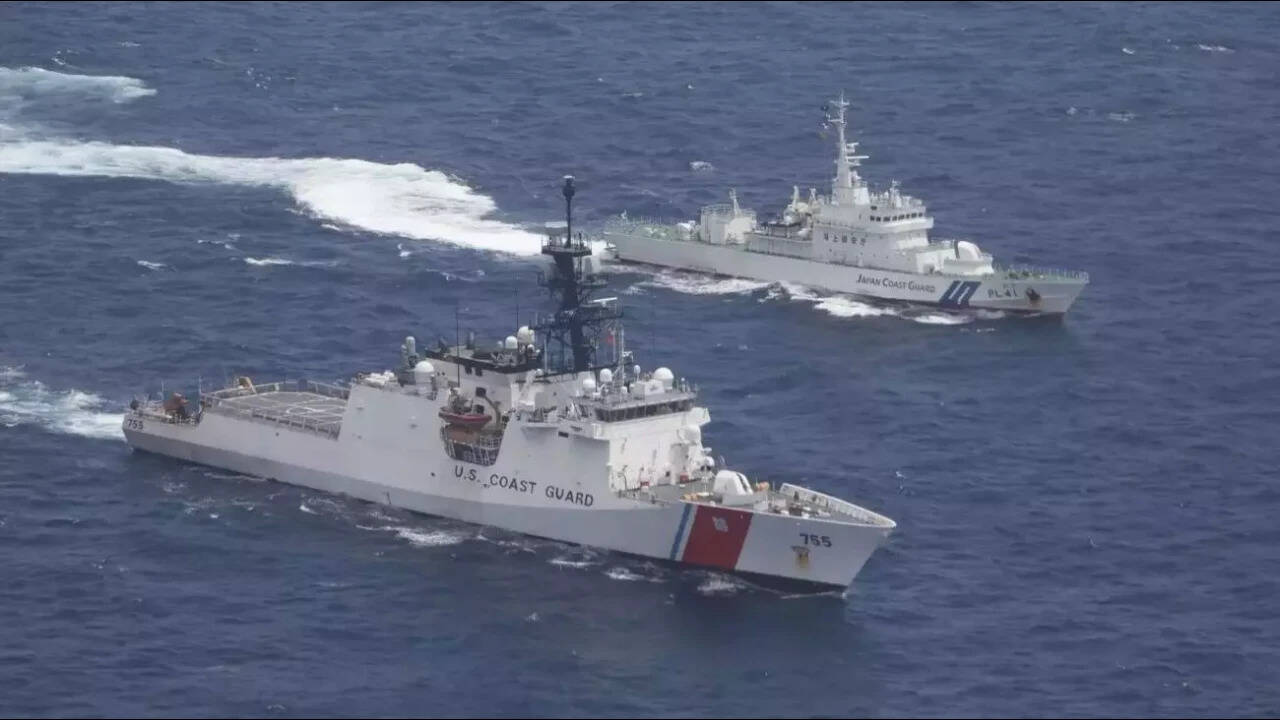
When the China Coast Guard deployed hulls into the deep waters east of Taiwan on June 1, 2026, it was not a routine show of force. The deployment of a flotilla to intercept the maritime periphery near Orchid Island represents a calculated, preemptive maneuver designed to block a new legal firewall being built by Tokyo and Manila.
Days earlier, Philippine President Ferdinand Marcos Jr. and Japanese Prime Minister Sanae Takaichi stood together in Tokyo to announce formal negotiations to delimit the maritime boundaries of their respective exclusive economic zones and continental shelves. Beijing reacted instantly. By declaring the talks "illegal, null, and void," and putting hulls in the water to prove it, China has signaled that it will not tolerate a bilateral legal settlement in the strategically critical Philippine Sea.
This confrontation is no longer just about the shallow reefs of the South China Sea or the disputed rocks of the East China Sea. This is about the vast, deep-water corridor where those two flashpoints meet.
The Convergence Zone
For years, maritime friction in East Asia was neatly categorized. You had the East China Sea dispute, centered on the Japanese-administered Senkaku Islands, which Beijing claims as the Diaoyu Islands. Then you had the South China Sea, where China uses its sweeping historical claims to bully Southeast Asian neighbors over features like Scarborough Shoal and Second Thomas Shoal.
Those two theaters are no longer separate.
By initiating maritime delimitation talks, Japan and the Philippines are attempting to connect their legal geography. The geography dictates the high stakes. Japan’s southernmost inhabited islands, including Yonaguni and the Miyako chain, sit just north of Taiwan. The northernmost islands of the Philippines, the Batanes province, sit just south of it. Draw a line eastward from Taiwan into the Philippine Sea, and you find the overlapping maritime aspirations of Tokyo and Manila.
[East China Sea / Japan]
         |
     [Yonaguni]
         |
     [TAIWAN]  <--->  [China Coast Guard Patrol Area, June 2026]
         |
     [Batanes]
         |
[South China Sea / Philippines]
When Japan and the Philippines negotiate where their exclusive economic zones meet in these waters, they are attempting to establish a continuous, internationally recognized legal regime stretching from the Japanese archipelago down to the Philippine mainlands. For Beijing, this is an unacceptable containment strategy. If Tokyo and Manila successfully draw a clean legal border, it formalizes a cooperative security arc directly across the eastern flank of Taiwan.
Beijing Law Enforcement Illusion
The choice of the China Coast Guard, rather than the People's Liberation Army Navy, for the eastern Taiwan patrol is an intentional legal gambit. Beijing is applying its domestic law enforcement playbook to international waters.
The mechanism is simple but aggressive. By framing the deployment as a "law enforcement patrol," China asserts administrative jurisdiction over the area. The underlying message is clear: China considers these waters its own domestic space.
"This is a necessary action taken in response to Japan and the Philippines unilaterally announcing the initiation of maritime boundary delimitation negotiations in the waters east of China's Taiwan island," stated Jiang Lue, a spokesperson for the China Coast Guard.
This is a distortion of the United Nations Convention on the Law of Sea. Under international law, a state cannot claim an exclusive economic zone or a continental shelf over an area unless it stems from recognized sovereign territory. China claims these waters by treating Taiwan as a province of the People's Republic of China, arguing that the maritime rights extending eastward from Taiwan belong exclusively to Beijing.
However, Taiwan operates as an independent state with its own coast guard, which quickly tracked and intercepted the two Chinese vessels operating southeast of Orchid Island. The presence of only two Chinese ships indicates that the operation was not a military blockade, but a symbolic legal marker. China is inserting its presence into the record so that it can later claim it actively exercised jurisdiction over the zone, disrupting any legal certainty that Japan and the Philippines hope to achieve.
The First Island Chain Chokepoint
To understand why this specific patch of ocean matters so much to China, one must look below the surface. The waters east of Taiwan are exceptionally deep, offering an ideal corridor for submarines.
The People's Liberation Army Navy has long felt constrained by the First Island Chain, the network of islands stretching from Japan through Taiwan to the Philippines. During a conflict, Western forces could theoretically seal the narrow straits—such as the Bashi Channel or the Miyako Strait—bottling up Chinese vessels in the semi-enclosed seas closer to the mainland.
If China can normalize its military and coast guard dominance in the waters east of Taiwan, it cracks the First Island Chain wide open. It secures unhindered access to the deep Pacific. This would allow Chinese ballistic missile submarines to deploy undetected into deep-water bastions, directly altering the nuclear deterrent balance with the United States.
Furthermore, an established Chinese presence here isolates Taiwan. In the event of a cross-strait conflict, Taiwan’s eastern ports, like Hualien and Suao, are its lifeline to the world. They are the locations where Western reinforcement or resupply would realistically arrive. By operating coast guard vessels east of the island under the guise of daily law enforcement, Beijing is practicing the operational routines required to cut off those lifelines entirely.
Manila Strategic Pivot
The decision by Manila to enter boundary talks with Japan marks a massive departure from past Philippine foreign policy, which often avoided provoking Beijing on broader regional issues. Under the Marcos administration, the Philippines has realized that defensive operations inside the South China Sea are insufficient if the country remains exposed on its northern and eastern flanks.
Manila is pursuing a web of overlapping security arrangements. The country recently signed a Reciprocal Access Agreement with Japan, creating a framework for mutual military deployments and joint exercises. Delimiting the maritime boundary is the legal foundation for this security architecture. It defines exactly where Philippine responsibility ends and Japanese responsibility begins, making intelligence sharing, maritime patrols, and joint tracking of Chinese naval assets far more efficient.
This strategy is not without risk for Manila. The country's coast guard is already stretched thin, facing daily water-cannon attacks and dangerous maneuvering by Chinese vessels at Sabina Shoal and Second Thomas Shoal. Opening a diplomatic and operational front to the north and east risks overextending the bureau's limited fleet, an asymmetry Beijing is eager to exploit.
The Flaw in the Allied Strategy
While the alignment between Tokyo, Manila, and Taipei appears formidable on paper, it contains a structural vulnerability.
Taiwan is the missing link.
Because of diplomatic isolation, Taiwan cannot openly participate in the maritime delimitation talks between Japan and the Philippines, despite sitting directly between them. This creates a legal disconnect. Japan and the Philippines can agree on where their respective zones meet in the open ocean, but they cannot legally account for Taiwan’s maritime projections without engaging Taipei directly.
China exploits this isolation. By claiming to represent Taiwan's maritime interests, Beijing injects itself into the middle of the geography, using its coast guard to physically disrupt the continuity of the allied arc. Taipei is left in the awkward position of independently defending its waters around Orchid Island while cheering on a bilateral negotiation from which it is excluded.
The June 2026 patrols demonstrate that Beijing will use grey-zone coercion to prevent its neighbors from institutionalizing a rules-based order around its periphery. For Japan and the Philippines, the solution cannot be limited to drawing lines on a map in Tokyo conference rooms. If they intend to establish legal certainty in the Western Pacific, their coast guards and navies must be prepared to match Chinese hulls in the deep water, showing that administrative lines are backed by the political will to enforce them.