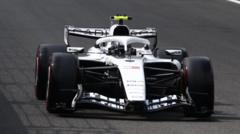
The American footprint in Formula One is an awkward, sprawling, and expensive experiment. With the Cadillac Formula 1 Team struggling through a scoreless maiden campaign and Haas clinging to the middle of the pack, the narrative of a stateside takeover has hit a wall of cold, hard reality. Fans were promised an era of domestic dominance. Instead, they are witnessing a masterclass in how difficult it is to buy victory in a sport that rewards decades of institutional inertia over massive infusions of capital.
For Cadillac, the 2026 entry was supposed to be a signal of intent. Backed by General Motors and TWG Global, the team arrived with a staggering 450 million dollar expansion fee and a roster of seasoned veterans like Valtteri Bottas and Sergio Perez. Yet, sitting at the bottom of the constructors' championship with zero points, the team is currently an object lesson in the limitations of ambition. Bringing in big names and deep pockets does not circumvent the grueling physics of the grid.
The primary issue facing the newcomers is not just the car. It is the culture of the paddock. Formula One is a guild-like ecosystem where the advantage lies with teams that have spent years refining their internal software, aerodynamic simulations, and supply chain logistics. Cadillac is attempting to build this from scratch while competing against entities like Mercedes and Ferrari that have functioned as cohesive units for generations. Every race weekend is a brutal diagnostic test. Reliability issues have plagued the garage since the lights went out in March, and the recent mid-season leadership shuffle—replacing Graeme Lowdon with Marcin Budkowski—is a frantic attempt to find a rhythm that should have been established years ago.
Meanwhile, Gene Haas stands as the counterpoint to the Cadillac model. After entering the series in 2016, his team carved out a niche by effectively outsourcing much of its development to Ferrari. This strategy, while controversial among purists, allowed them to exist as a lean operation. They never promised to be a title contender. They promised to be a participant. While Cadillac is currently burning through cash to build its own chassis and engine facilities in North Carolina and Silverstone, Haas has spent a decade perfecting the art of survival.
Comparing the two reveals a fundamental divide in how American interests view the sport. The Cadillac project is a corporate crusade. It is designed to showcase engineering prowess and drive technical innovation back into GM's consumer brands. It is heavy, structured, and under immense pressure to deliver results that justify the massive investment. Haas, by contrast, is a boutique operation. It is nimble, often under-resourced, and perpetually battling the perception that it is merely a satellite for larger manufacturers.
The irony is that both teams are currently failing to capture the imagination of the American audience in the way the league executives hoped. The casual viewer in the United States wants to see an American flag on the podium. They want the drama of a victory lap. What they are getting instead is a technical battle at the back of the grid that feels increasingly disconnected from the prestige of the championship.
There is a significant hurdle regarding the engine transition. While Cadillac currently relies on external power unit supply, they are racing toward a 2029 deadline to manufacture their own. This is a massive engineering undertaking. Developing a bespoke hybrid power unit requires a level of integration that most automotive giants struggle to achieve in a five-year window, let alone in the middle of a high-pressure sporting schedule. If they cannot stabilize their current chassis performance, the focus on 2029 begins to look less like a vision and more like an exit strategy.
The reliance on veterans like Bottas and Perez is another fascinating tactical choice. It suggests that the team knows its weaknesses. They cannot afford to spend time teaching a rookie how to navigate the circus of a Grand Prix weekend. They need data. They need feedback. They need drivers who can identify exactly why the car is underperforming without needing to be told. It is a desperate bid for stability. Whether that strategy pays off remains to be seen, but for now, the data indicates that no amount of pedigree can compensate for a lack of track time and organizational maturity.
Haas, for its part, remains the scrappy survivor. Their seventh-place standing in the constructors' championship is a testament to the fact that persistence can be a substitute for raw power. They know their limitations, they play within the rules of the budget cap, and they rarely make the kind of high-stakes, high-failure gambles that have defined the early days of the Cadillac venture.
The sport itself is changing, and the barrier to entry has never been higher. As Formula One continues to prioritize stable, long-term manufacturer involvement, the window for these independent or semi-independent American teams to make an impact is closing. The sport has moved past the era of the plucky outsider. It is now a domain for massive, vertically integrated corporations that control every variable from the fuel in the tank to the software in the steering wheel.
For Cadillac, the path forward is narrow. They must demonstrate that they can finish races before they can think about winning them. They must integrate their disparate bases in Indiana, North Carolina, and the UK into a singular, functioning nervous system. Most importantly, they must manage expectations. If they continue to struggle, the boardroom in Detroit will eventually start asking if the marketing value of an F1 logo is worth the price of a winless season.
Racing is not about potential. It is about performance under pressure. The next twelve months will decide if these American efforts are a genuine contribution to the history of the sport or merely an expensive footnote in a European-dominated chronicle. The money has been spent. The drivers are in the seats. The engineering teams are working double shifts. At this level, there is nowhere left to hide. The results will either arrive, or they will be replaced by the next set of promises.