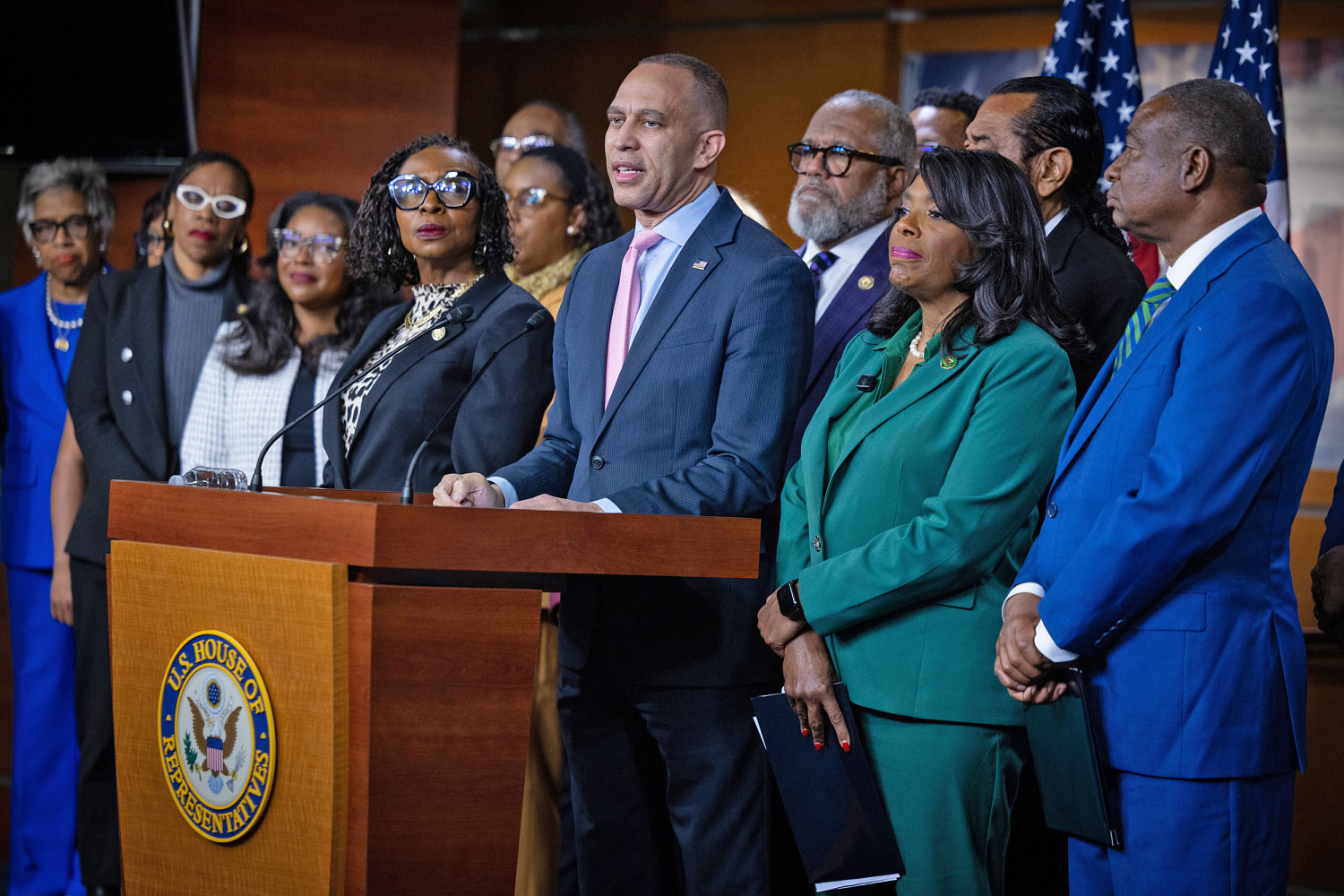
The mapmakers are coming for the Congressional Black Caucus (CBC), and they aren't using hoods or fire hoses this time. They are using high-speed algorithms and "communities of interest" legal theories to dismantle decades of representation. At the current rate of redistricting maneuvers, nearly one-third of the CBC faces an existential threat through the dilution of their voting blocs or the outright elimination of their districts. This isn't a fluke of geography. It is a precise, surgical strike on the most stable voting bloc in the American legislature.
While the public focus remains on the high-drama floor votes in Washington, the real power shifts are happening in windowless rooms in state capitals. These redistricting battles are often framed as simple partisan warfare—Democrats versus Republicans—but that narrative ignores a more uncomfortable reality. The survival of Black representation is frequently traded away by both parties when the math of "swing districts" or "incumbent protection" demands a sacrifice.
The Geometry of Disenfranchisement
Redistricting used to be a messy, human process. Today, it is an automated execution. Using sophisticated GIS software, partisan operatives can test millions of map iterations in seconds to find the one that most efficiently neutralizes a specific demographic. The primary weapon is "packing and cracking."
In a "packed" scenario, mapmakers cram as many Black voters as possible into a single district. This ensures a CBC member wins with 80% or 90% of the vote, but it simultaneously bleeds those voters out of the surrounding areas. It turns adjacent districts "safe" for the opposing party or for moderate candidates who feel no pressure to address Black priorities.
"Cracking" is the opposite. It takes a concentrated Black community and splits it like a wishbone, distributing the pieces into three or four different districts where they are a permanent, ignored minority. The result is a legislative body that looks less like the country and more like a curated collection of safe seats for the well-funded.
The Section 2 Shell Game
The Voting Rights Act was supposed to be the shield against these tactics. Specifically, Section 2 forbids any practice that results in a denial or abridgment of the right to vote based on race. For years, this meant states were required to create "majority-minority" districts where Black voters had a fair chance to elect their preferred candidates.
The legal ground is now shifting beneath our feet. A series of recent court rulings has signaled a growing judicial hostility toward race-conscious mapmaking. Conservative jurists argue that the Constitution should be "colorblind," a philosophy that sounds noble in a vacuum but ignores the reality of racially polarized voting. If you cannot use race to fix a map that was broken by race, the status quo of exclusion remains locked in place.
We are seeing a trend where states claim they are drawing "partisan" gerrymanders rather than "racial" ones. Since the Supreme Court ruled that federal courts cannot intervene in partisan gerrymandering, this has become the ultimate legal loophole. If a mapmaker can prove they targeted Black voters because they are Democrats—not because they are Black—the map often stands. It is a distinction without a difference for the voters who lose their voice.
The Southern Front
The most aggressive attacks are concentrated in the South, the historic and modern heart of Black political strength. In states like Alabama, Louisiana, and Georgia, the growth of the Black population has outpaced other demographics, yet the number of Black-represented districts has remained stagnant or shrunk.
In Alabama, the fight over a second Black-majority district became a national flashpoint. Despite the state having a Black population of roughly 27%, it long maintained only one majority-Black district out of seven. When the courts finally ordered a second district to be drawn, the state legislature's first instinct was to defy the order. This wasn't just about party loyalty. It was about the fundamental fear of a shifting power dynamic in a state that has historically used every lever of government to suppress minority influence.
The North and the Death of the Urban Core
While the South deals with overt hostility, the North and Midwest are seeing a more subtle erosion. Decades of "Great Migration" patterns are reversing or shifting toward the suburbs. As Black populations move out of traditional urban centers like Detroit, Chicago, and Cleveland, the "anchor" districts that once sent giants like John Conyers or Louis Stokes to D.C. are being stretched thin.
When a district loses population, it must expand its borders to meet federal requirements. This expansion often pulls in whiter, wealthier, and more conservative suburbs. A CBC member who once represented a compact, 70% Black urban district suddenly finds themselves in a 45% Black district that includes sprawling suburban tracts with entirely different economic interests.
The representative is then forced into a political balancing act. Do they continue to champion the specific needs of the urban poor, or do they pivot to the center to satisfy their new suburban constituents? This "dilution by expansion" is a silent killer of the CBC’s legislative cohesion.
The Collateral Damage of Incumbent Protection
Sometimes, the threat comes from within the family. During redistricting, senior incumbents from both parties often prioritize their own job security over the long-term strength of their caucus. This leads to "incumbent protection maps," where two incumbents—sometimes even two CBC members—are drawn into the same district.
This forced cannibalization is the ultimate victory for mapmakers. It eliminates a veteran voice without the need for a messy general election campaign. The two incumbents are forced to burn through their war chests in a bitter primary, leaving the winner weakened and the community divided. We saw this in New York and Michigan, where veteran Black lawmakers were pitted against each other or against well-funded challengers in newly drawn, unrecognizable territories.
The Illusion of the Coalition District
There is a growing movement to replace "majority-minority" districts with "coalition districts." In these areas, no single group has a majority, but Black, Latino, and Asian voters together form a winning bloc. On paper, this promotes multi-ethnic cooperation. In practice, it often fails to guarantee that any specific group's needs are met.
Coalition districts are fragile. They rely on the assumption that different minority groups will always share the same priorities and candidates. This is a patronizing view of minority voters. Black voters in Philadelphia may have very different immediate needs regarding criminal justice or housing than Latino voters in the same city. When these groups are forced into a single district "coalition," their individual leverage is halved.
The death of the majority-Black district is the death of a specific type of accountability. When a representative knows they owe their seat exclusively to a specific community, they are more likely to take political risks for that community. When they owe it to a patchwork of competing interests, they become a creature of compromise.
Money and the Primary Proxy War
Redistricting isn't just about lines; it's about the money that follows those lines. When a Black district is diluted, it becomes a target for outside spending. Super PACs and billionaire donors who would never stand a chance in a 70% Black district see a 40% district as an opening.
They flood the airwaves with ads that ignore systemic issues, focusing instead on "electability" or moderate platitudes. This effectively turns a congressional primary into a proxy war for national interests. The local community's concerns about lead pipes, school funding, or policing are drowned out by millions of dollars in attack ads funded by people who have never set foot in the neighborhood.
This financial pressure forces CBC members to spend more time fundraising and less time legislating. It changes the character of the caucus. The "Conscience of the Congress" is being replaced by the "Competitor in the Fundraising Race."
The Myth of the Neutral Map
The most dangerous lie in modern politics is the "neutral" map. Many states have moved to independent redistricting commissions to take the politics out of the process. While well-intentioned, these commissions often use "compactness" as a primary metric.
Compactness sounds good. It means districts are nice, tidy squares rather than sprawling salamanders. However, Black communities in America are rarely distributed in nice, tidy squares. Years of redlining, urban renewal projects, and segregated housing patterns have created long, thin, or irregularly shaped Black neighborhoods.
If a commission prioritizes "compactness" over "representation," they will inevitably split these communities. They create "pretty" maps that are functionally exclusionary. A map that looks organized on a screen can be a tool of absolute chaos for a community that has spent fifty years building a unified political voice.
The Long Game of Legislative Isolation
Why does this matter beyond the walls of the CBC? Because the CBC has historically been the only group in Washington willing to force uncomfortable conversations onto the national stage. From the anti-apartheid movement in the 1980s to the current push for voting rights protections, the CBC uses its numbers to hold the rest of the Democratic party accountable.
If you reduce their numbers by a third, you don't just lose votes; you lose the ability to set the agenda. A smaller CBC is easier to ignore. It is easier to "consult" with them for a photo-op while ignoring their policy demands. The erasure of these seats is a direct hit to the leverage of every Black voter in the country, regardless of where they live.
The census is over. The maps are being drawn. The lawsuits are winding through the courts. But the fundamental question remains: is American democracy comfortable with a legislative body that actually reflects its people, or is it more comfortable with the illusion of representation managed by the precision of an algorithm?
The answer is being written in the redraws. If the CBC is decimated in the coming cycles, it won't be because the voters changed their minds. It will be because the ground was moved from under their feet while they were still standing on it.
The strategy is clear. The tools are ready. The only thing left to see is if the public notices the theft before the vault is empty.