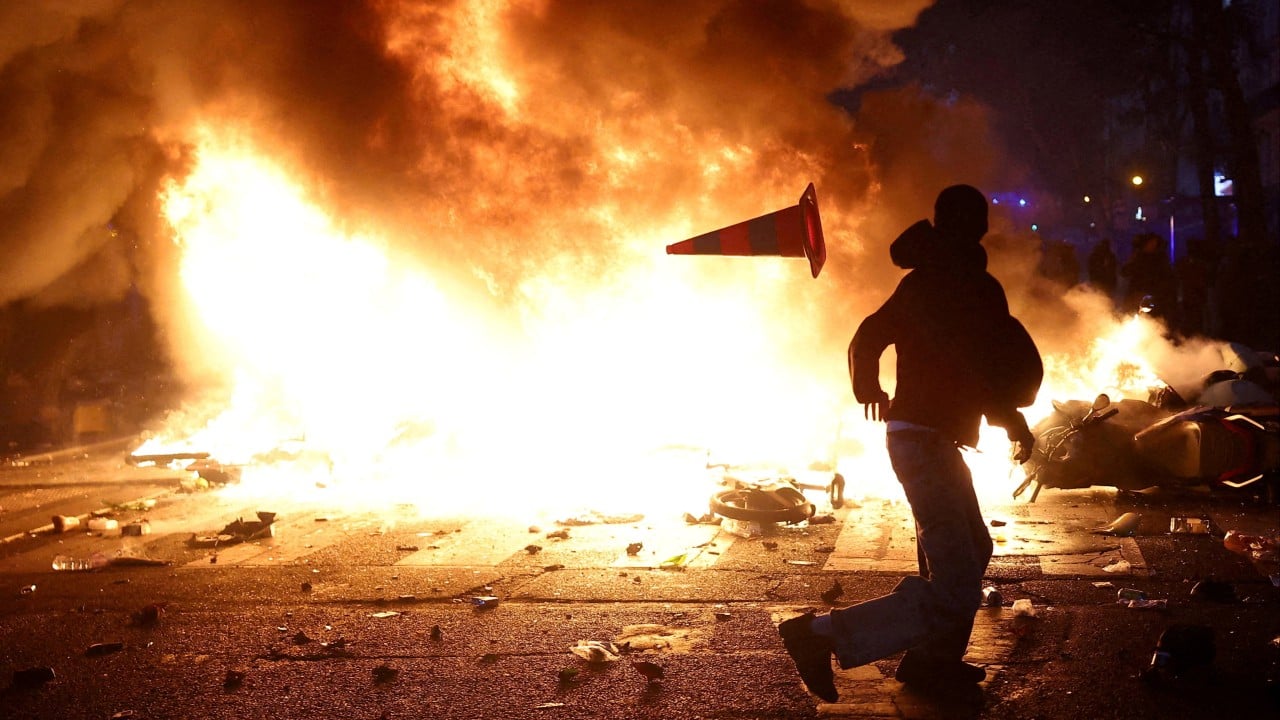
Mainstream reporters love a helpless victim narrative. Whenever tear gas drifts across the Place de la République or the metro lines grind to a halt, foreign correspondents rush to find international students to play the part of terrified bystanders. The resulting copy writes itself. The headlines paint Chinese students in Paris as fragile, bewildered onlookers trapped in a chaotic Western metropolis, stockpiling instant noodles and trembling behind locked apartment doors.
That framing is lazy, condescending, and completely divorced from reality.
Having spent years working across cross-border higher education and international student mobility in Europe, I have watched this exact media cycle repeat during the Yellow Vests movement, the pension reform strikes, and every major labor walkout in between. The narrative never changes because the editors never actually ask the right questions. They assume that moving from a highly ordered, low-friction society like urban China to a strike-prone European capital induces pure paralysis.
It does not. For the vast majority of Chinese students in Paris, mass protests are neither a novel trauma nor a reason to hide under the bed. They are a logistical puzzle, an economic inconvenience, and—most importantly—a live, unvarnished seminar in how a Western social contract actually operates when pushed to its breaking point.
The Myth of the Fragile International Student
To buy into the "hunkering down" trope, you have to believe that the tens of thousands of Chinese nationals studying at institutions like Sciences Po, the Sorbonne, and HEC Paris arrived in France without doing basic due diligence.
These are not naive tourists who accidentally wandered into a manifestation on their way to the Louvre. The modern Chinese student cohort in France is hyper-connected, fiercely pragmatic, and plugged into real-time information networks that make traditional local news look glacial. Before a single CGT union banner hits the pavement, students are already cross-referencing RATP transit alerts on WeChat groups, tracking prefecture perimeter closures on Xiaohongshu, and adjusting their commutes accordingly.
When a student decides to stay home on a Thursday afternoon because Line 1 and RER B are running at twenty percent capacity, that is not "hunkering down" in fear. That is basic time management. Nobody wants to spend three hours crammed onto a replacement bus to attend a ninety-minute lecture that the professor is probably going to cancel anyway. Calling rational commute avoidance "hunkering down" is like saying New Yorkers are "fleeing for their lives" when they work from home during a blizzard.
The Real Friction Isn't the Tear Gas
If you want to understand what actually stresses out Chinese students during Parisian unrest, stop looking at the riot police and start looking at the French administrative apparatus.
A burning trash can on Boulevard Saint-Germain is loud, dramatic, and photogenic. It is also entirely avoidable if you walk two blocks north. What you cannot avoid is the préfecture closing its doors during a strike, delaying a titre de séjour (residence permit) renewal by four months, and leaving a student legally stranded in France without the ability to travel home or start an internship.
That is the real crisis nobody writes about because bureaucratic gridlock does not make for compelling cable news footage. When public sector workers walk out, the administrative machinery that governs every aspect of a non-EU student's legal existence freezes solid. Bank accounts get locked because residence permit receipts expire. Housing subsidies from CAF stall in limbo. Exam schedules get pushed back, threatening graduation timelines and visa compliance.
Students are not sitting in their apartments worrying about stray paving stones. They are sitting at their desks refreshing government appointment portals at three in the morning, trying to outsmart a system that was already struggling before the unions called a general strike.
The Clash of Social Contracts
To grasp why Western media misreads the Chinese student reaction, you have to look at the structural contrast between the two societies they are navigating.
In major Chinese cities like Shanghai, Shenzhen, or Beijing, public infrastructure is built around predictability, speed, and uninterrupted service delivery. If a subway line breaks down, heads roll. Urban governance prioritizes frictionless daily life above almost all else. When a student leaves that environment and lands in Paris, they are stepping into a political culture built on the exact opposite premise—one where disruption is not a system failure, but the primary political currency.
French political theory, heavily shaped by thinkers from Jean-Jacques Rousseau to Pierre Bourdieu, treats public space as an arena of continuous negotiation between the state and the citizen. In France, the strike (la grève) is a constitutionally protected mechanism for forcing the government to the bargaining table. Without the ability to halt commerce, block transit, and disrupt daily life, labor unions and student syndicates have zero leverage.
Watching this unfold in real time creates a fascinating cognitive dissonance for Chinese students, and their reactions break down into distinct, sharp-eyed observations rather than passive panic:
- Skepticism of the Efficiency Cost: Coming from an economy obsessed with productivity and rapid execution, many Chinese business and engineering students view prolonged strikes as a form of economic self-harm. They see small businesses smashed, tourism revenue evaporating, and public infrastructure degraded, and they struggle to reconcile the immediate material destruction with the abstract political goals of the protesters.
- Recognition of Institutional Power: At the same time, students in the humanities, law, and political science—particularly those at institutions like Sciences Po—quickly recognize the sheer institutional weight of French civil society. They witness firsthand how a relatively small percentage of unionized workers in energy, sanitation, and transport can bring a G7 economy to its knees within forty-eight hours.
- The Street-Smart Adaptation: Within a single semester, the vast majority of these students develop an instinct for Parisian geography that rivals local journalists. They learn the exact anatomy of a protest route—usually Bastille to République to Nation—and understand that two streets away from a televised clash, people are calmly drinking espresso on a terrace.
Is Paris Actually Unsafe for Chinese Students During Protests?
Let us dismantle the most common search query surrounding this topic: the idea that mass political protests turn Paris into an active warzone where foreign students are specifically targeted.
It is an absurd premise. French political demonstrations—whether over pension ages, labor laws, or agricultural subsidies—are fundamentally domestic disputes aimed at the Élysée Palace and the National Assembly. Protesters are angry at Emmanuel Macron, corporate tax structures, or inflation. They are not looking for international students to harass.
Does that mean Paris carries zero risk for Chinese nationals? No. Any honest assessment has to separate political protest risk from everyday urban crime, because conflating the two is journalistic malpractice.
Chinese students and tourists in Paris do face genuine security threats, particularly opportunistic pickpocketing, bag snatching, and targeted theft in transit hubs and high-end shopping districts. Criminal networks frequently assume that East Asian visitors carry large amounts of cash or luxury goods. During mass protests, when municipal police resources are heavily concentrated around demonstration perimeters and government buildings, opportunistic petty crime in outer arrondissements and unguarded metro stations can spike.
Notice the distinction. The danger does not come from the union worker marching with a flare and a megaphone. The danger comes from the vacuum left behind when law enforcement is pulled off regular patrol beats to manage crowd control.
The Downside of the "Nothing to See Here" Attitude
Of course, swinging too far in the opposite direction—treating Parisian unrest as harmless street theater—carries its own set of traps.
I have seen plenty of overconfident international students treat a major demonstration like a free photography workshop, wandering right up to the front lines of a Black Bloc standoff to get footage for their social media feeds. That is a catastrophic mistake. French riot police (the CRS) do not pause to check your student ID before deploying tear gas canisters or launching a baton charge to clear an intersection. If you stand between a row of shattered bank windows and a phalanx of armored police, you are going to get caught in the crossfire regardless of your passport.
Similarly, assuming that strikes are merely a brief inconvenience can wreck an academic year if a student fails to build redundancy into their schedule. Relying on a single train line to reach an exam hall on a declared journée d'action (day of action) is academic suicide.
How Smart International Students Actually Navigate Parisian Unrest
If you are living, studying, or managing student programs in Paris during a wave of mass protests, forget the passive advice to "stock up on groceries and stay indoors." You cannot put your education, career, or life on pause every time the unions call a strike. You need an operational playbook built for a city where disruption is a permanent feature of the calendar.
1. Decouple Your Commute from the Rail Network
The RATP metro and RER systems are the first casualties of any coordinated union action. When the rail operators walk out, Paris immediately fractures into isolated neighborhoods.
- Ditch the underground: Invest in a reliable electric bike or sign up for the Vélib' municipal bike-share program before the strikes begin. Paris has spent years aggressively expanding its protected bike lanes (pistes cyclables), and during transit strikes, cycling is routinely faster than driving, taxis, or walking.
- Map the dead zones: Know the traditional protest corridors—specifically the axis connecting Place de la Bastille, Place de la République, Place de la Nation, and Place d'Italie. Never route a bike commute through these nodes between noon and eight in the evening on a strike day.
2. Front-Load All Administrative Deadlines
Never assume French bureaucracy will work on your timeline, especially when political tensions are high.
- The three-month rule: Submit every visa renewal, housing certificate, and university registration document at least ninety days before the official deadline. When protests escalate, administrative backlogs compound exponentially.
- Document everything: Keep physical and digital copies of every submission receipt (récépissé), email confirmation, and postal tracking number. If a strike prevents you from attending an in-person appointment, immediate, timestamped proof of your attempt to comply is the only thing that will protect your legal status.
3. Filter Your Information Diet
Panic thrives in information vacuums and sensationalist echo chambers. Social media algorithms reward the most violent ten-second clip of a burning barricade while ignoring the fact that ninety-eight percent of the city is functioning normally.
- Use primary local sources: Rely directly on the official RATP app for live transit line statuses and the Paris Prefecture of Police feed for exact street closures.
- Ignore viral panic loops: WeChat and Xiaohongshu are invaluable for peer-to-peer logistical tips, but they are terrible at assessing macro-level safety. When a video of a single riot goes viral, verify the exact street intersection before assuming the entire city is on fire.
4. Leverage the Disruption Academically and Professionally
The biggest mistake an international student can make in France is treating their host country as an obstacle course to be endured rather than an environment to be understood.
- Observe the mechanics: If you are studying economics, sociology, business, or public policy, these protests are primary source material. Read the union demands alongside the government's fiscal projections. Compare how French media outlets like Le Monde and Le Figaro frame the exact same demonstration.
- Build local credibility: French employers and professors respect adaptability. Showing up to a seminar on time via bicycle while half the class is stranded at a closed metro station sends an immediate signal about your resourcefulness and grit.
Stop Infantilizng International Students
The next time a headline warns that Chinese students in Paris are "hunkering down" in the face of mass protests, recognize it for what it is: a projection of Western media anxieties onto a demographic that is far more resilient, adaptable, and clear-eyed than the reporters covering them.
Yes, the tear gas stings. Yes, the train cancellations are infuriating. Yes, the administrative delays are a nightmare.
Yet nobody is cowering in the dark. The students who choose to build their futures in Paris are out there navigating broken transit grids, decoding complex political battles in a second or third language, and learning firsthand how a messy, loud, uncompromising democracy argues with itself in the streets. They do not need your pity, and they certainly are not hiding.