The key weighs heavy in the palm. It is small, cold, and notched with teeth that no longer unlock peace.
Consider Mateo. He is thirty-four years old, wears a collared shirt that has been ironed three times too many, and lives in a bedroom that smells faintly of damp masonry and old books. The room is not his. It belongs to an elderly woman named Carmen three neighborhoods away, who smiles when she collects his rent in cash every month. Mateo works fifty hours a week designing logistics routes for a multinational delivery firm. He can optimize the transit of heavy cargo across an entire peninsula, yet he cannot find a single flat in Madrid that costs less than eighty percent of his monthly salary.
He is not alone.
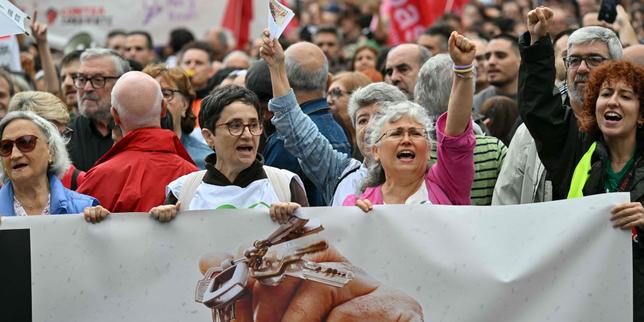
On a crisp Sunday afternoon, the asphalt of the Spanish capital shuddered. It was not an earthquake. It was the collective footfall of thousands upon thousands of citizens who had grown entirely weary of breathing arithmetic instead of air. From Gran Vía to the Puerta del Sol, banners fluttered above the crowd like captive birds trying to escape. A house is a home, not a stock portfolio. Lower the rent or watch the cities die.
To understand why a nation marches, one must first look at the arithmetic of despair.
Over the past decade, urban centers across Spain have undergone a quiet, violent transmutation. The doorways where children once played hopscotch have been scrubbed clean and refitted with smart-lock keypads. The corner bakeries have given way to artisanal matcha bars designed for digital nomads holding remote-work visas paid in euros earned three thousand miles away.
Housing, once treated as a fundamental shelter against the elements, became an asset class.
The mechanics of this shift are deceptively simple and utterly merciless. When tourism transforms residential neighborhoods into open-air hotels, supply contracts. When institutional investors buy up entire city blocks to fractionalize them into investment trusts, prices detach entirely from local wages. In Madrid and Barcelona, average rental costs have climbed past the threshold of human endurance, devouring two-thirds or more of the typical earnings of a young worker.
The state watched this happen through spreadsheet columns. The citizens experienced it through evictions.
Mateo walked in the protest not because he believed a single march would rewrite the laws of supply and demand, but because silence felt like an endorsement of his own quiet erasure. He walked beside nurses who commute two hours each way because they cannot afford to live within the administrative boundaries of the hospitals where they save lives. He walked beside teachers whose chalk-dust-covered hands trembled with exhaustion—not from grading papers, but from calculating whether they could afford groceries or electricity this month.
The crisis is architectural, but its victims are flesh and blood.
When a society prices its own working class out of its geography, something foundational snaps. A city ceases to be a living community of shared memory and mutual friction. It becomes a theme park for the affluent, staffed by ghosts who vanish at five o'clock to catch long-distance trains back to the neglected periphery.
Governments respond with policy papers. They announce housing plans that promise ten thousand units by the year 2035, as if Mateo could sleep inside a PDF document tonight. They debate caps on tourist apartments while loopholes yawn wide enough to drive a fleet of SUVs through them.
Yet the streets tell a different story.
The sheer scale of the demonstrations in Madrid, Valencia, Málaga, and beyond revealed a sudden, fierce awakening. For years, housing precarity was treated as an individual failure—a personal budget miscalculation, a lack of hustle, bad timing. The mass mobilizations shattered that illusion. People looked to their left and their right and realized their private shame was actually a collective structural design.
The key in Mateo's pocket still turns the lock to Carmen’s spare room.
He goes home after the march, hangs his ironed shirt in the small wardrobe, and sits on the edge of the narrow cot. Outside his small window, the streetlights hum against the Madrid dusk. Far below, the city continues its relentless churn, an engine that feeds on the exhaustion of its inhabitants.
But something has shifted in the air. The asphalt is still cooling from the footsteps of the multitude. The banners are folded in closets, waiting. And the math, for the first time in a very long time, is beginning to feel afraid.