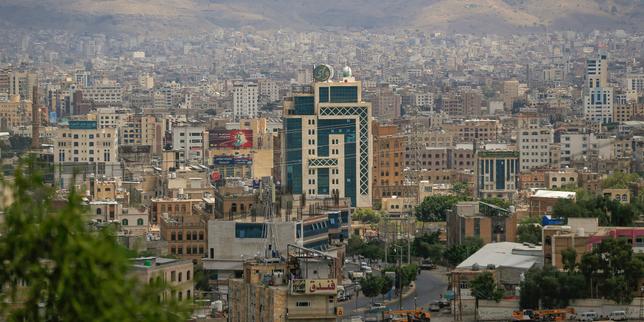
The tea in the glass had stopped rippling. That was usually the first sign.
Before the sound arrived—that tearing, metallic scream that bends the air and rattles loose teeth—there was only the silence of a Saturday afternoon in Sanaa. The kind of heavy, sun-baked quiet where time seems to fold in on itself, broken only by the distant clatter of a tin shutter or the call to prayer drifting lazily across the ancient mud-brick towers.
Tariq was sitting on a low concrete stoop, watching his youngest daughter chase a stray cat through the dust. He had lived through enough years of fractured stone and shattered glass to know the grammar of war. He didn't need a radar screen or a state-controlled broadcast to tell him what was coming. He felt it in the pressure drop behind his ears.
Then came the first strike.
It did not sound like thunder. Thunder belongs to the sky; this belonged to the machinery of distant men who had never smelled the dust of the old city. It was a dry, cracking concussion that punched the breath straight out of the lungs. The glass in the window frames shivered once, twice, and then cascaded onto the dirt in a million glittering shards.
By the time the smoke began to curl over the horizon, blurring the jagged silhouette of the mountains, the tally had already begun in the cold arithmetic of command centers hundreds of miles away. Twenty-six. That was the number whispered through crackling radios and flashed across trembling phone screens. Twenty-six airstrikes slicing through the afternoon air over the capital, shattering the fragile illusion of an ordinary weekend.
The Anatomy of a Broken Horizon
To understand what happened on that Saturday, you have to strip away the sterile vocabulary of geopolitical briefings. You have to forget terms like strategic assets, escalation ladders, and kinetic actions.
Instead, look at it through the lens of a kitchen table in the old quarter.
When the Houthi authorities released their statement claiming the massive assault, they spoke in the measured, defiant tone of an entrenched power under siege. They named the culprit with absolute certainty: Saudi Arabia. They pointed to the smoke billowing over military installations, checkpoints, and neighborhood fringes, framing it as a brutal escalation in a conflict that has already bled a generation dry.
And they were right about the smoke. The air above Sanaa turned the bruised purple of a fading bruise.
Yet numbers like twenty-six are slippery things. In the architecture of modern conflict, a statistic is rarely just a count; it is a weapon. For the authorities in Sanaa, every single raid recorded is a brick in the wall of their narrative—proof of relentless external aggression, justification for continued mobilization, a rallying cry etched in soot and rubble. For the coalition across the border, these operations are viewed through a very different lens: a calculated necessity, a defensive posture against persistent cross-border threats, a grim chore in an endless security dilemma.
Meanwhile, Tariq is sweeping glass from his front porch.
He does not care about the strategic doctrines of Riyadh or the propaganda broadcasts of the capital. He cares about the broom in his hand, the jagged edges hidden in the dirt where his daughter plays, and the cold knot in his stomach that tightens every time a cloud passes overhead.
The Weight of Invisible Lines
Borders are drawn on maps with clean, elegant ink, but they are lived in the dirt.
For years, the war in Yemen has danced a terrible tango of fragile truces and sudden explosions. It is a conflict born of local grievances, hijacked by regional ambitions, and sustained by an industrial-scale appetite for destruction. When the sky over Sanaa erupts in fire, it is not an isolated incident. It is the latest tremor along a fault line that has been grinding against itself for over a decade.
Consider what happens next in a city like this.
The immediate shock gives way to a familiar, exhausting routine. People step out into the streets, dusting off their clothes not with panic, but with a weary, practiced resilience that is heartbreaking to witness. They inspect the craters. They count the dead in whispered rumors before the official tolls arrive. They check on their neighbors.
It is a community knit together by shared survival, holding fast against forces far larger than themselves.
The Houthi movement, governing the capital with an iron fist and an unyielding ideological core, absorbs the blow and immediately begins calculating the response. Retaliation is not a hypothetical concept here; it is an anticipated schedule. The cycle of action and reaction spins like a relentless wheel, crushing whatever hope remains for a lasting peace.
The Human Cost of Abstraction
We talk about Yemen as a humanitarian crisis, as if poverty and hunger are weather patterns that simply rolled in from the sea. We use passive voice. Aid is needed. Infrastructure has collapsed. Negotiations are stalling.
As if no one is doing the collapsing. As if no one is holding the pen that stalls the talks.
When twenty-six raids pound a capital city in a single day, the impact goes far beyond the immediate blast radius. Water treatment facilities stutter and die. Power grids, already held together by spit and copper wire, wink out of existence. Hospitals, operating on the fumes of dwindling fuel reserves, scramble to triage patients under emergency generators that cough and sputter in the gloom.
Imagine lying on a cot in one of those hospitals, listening to the concussions ripple through the foundations. Imagine being a doctor who has not seen a regular paycheck in months, stitching a wound by the light of a mobile phone because the main breaker blew out three hours ago.
This is the reality behind the dry news ticker. This is what twenty-six raids actually look like when they hit the ground. They do not just strike military targets; they erode the fragile scaffolding of human life. They turn ordinary days into endurance tests.
The Long Shadow
As the sun began to set over Sanaa, turning the plumes of black smoke into towering pillars of gold and crimson, the streets grew strangely quiet.
It was not the peace of a resting city. It was the silence of people holding their breath, waiting to see if the night would bring another wave of fire.
Tariq finished sweeping the glass into a rusted dustpan. He dumped it into the bin, wiped his palms on his trousers, and looked up at the darkening sky. The stars were beginning to punch through the haze, indifferent to the chaos below them, shining down on a city that refuses to die, yet can barely afford to live.
The war goes on, fed by an endless supply of grievances, weapons, and geopolitical chess moves. And somewhere in the dark, another glass of tea sits untouched, waiting for a ripple that never comes.