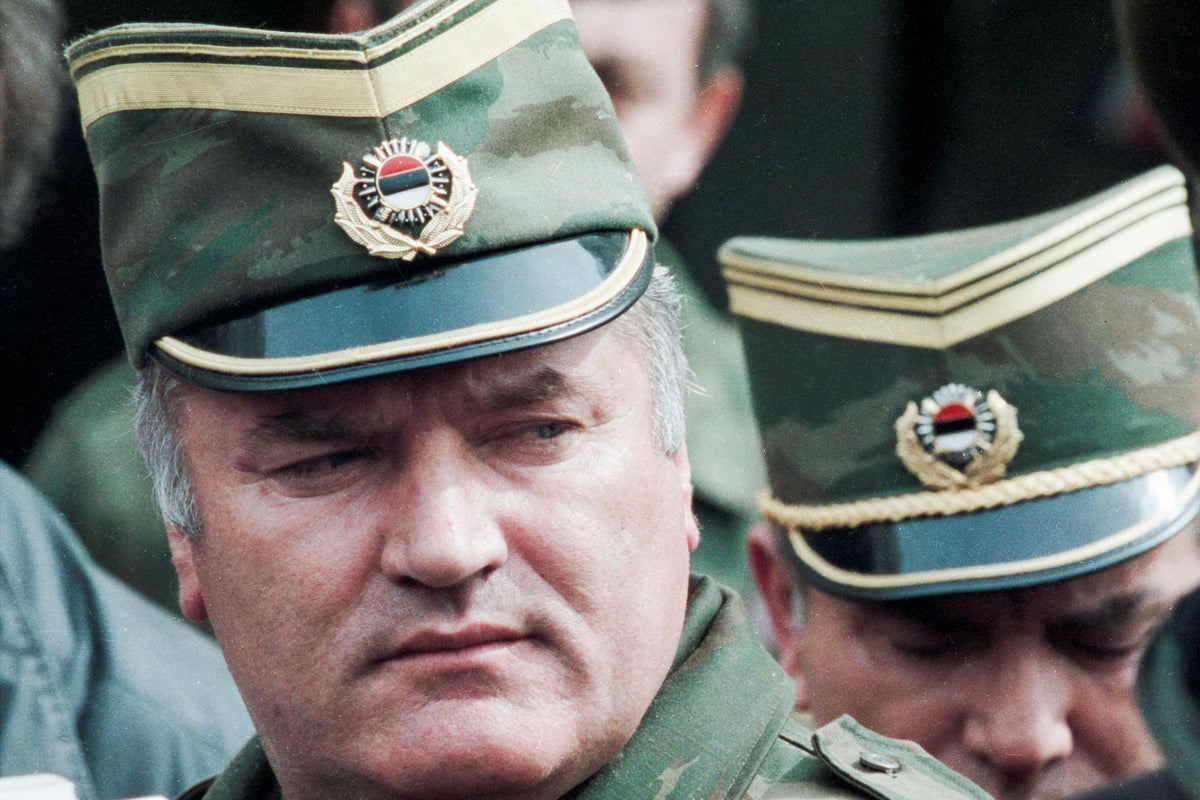
Former Bosnian Serb military commander Ratko Mladic, the convicted war criminal known as the "Butcher of Bosnia," has died at age 84 in a United Nations prison hospital in The Hague. Serving a life sentence for genocide, war crimes, and crimes against humanity, Mladic passed away following years of declining health, ending the life of the man who orchestrated the worst atrocities on European soil since World War II.
His death closes a biological chapter. It leaves open a massive, unhealed wound across the Western Balkans, where his ideological legacy continues to divide a fractured region. Read more on a connected issue: this related article.
The System Behind the Slaughter
To understand Ratko Mladic is to understand how professional military infrastructure can be weaponized for systemic annihilation. Born in 1942 in the Bosnian village of Bozinovici, Mladic was trained within the rigid hierarchy of the Yugoslav People’s Army (JNA). When Yugoslavia collapsed in the early 1990s, he did not merely join a rogue militia. He inherited heavy artillery, sophisticated logistics, and thousands of career soldiers, transforming ethnic hatred into an efficient machine of destruction.
Between 1992 and 1995, Mladic commanded the Army of Republika Srpska (VRS). His tactical focus relied on brutal attrition rather than standard territorial control. More journalism by NBC News highlights related views on the subject.
During the nearly four-year siege of Sarajevo, his forces positioned heavy weaponry on the surrounding hills, systematically bombarding civilians, targeting hospitals, markets, and water lines. His command to his gunners was documented on radio intercepts: "Scorch their brains."
The campaign culminated in July 1995 at Srebrenica, a town designated as a United Nations "safe area." Over several days, units under Mladic's direct command separated Bosnian Muslim men and boys from their families, executed more than 8,000 of them, and buried them in mass graves. The International Criminal Tribunal for the former Yugoslavia (ICTY) later ruled this act an explicit, deliberate genocide.
Sixteen Years of Protection
The world watched Mladic operate with impunity long after his indictment in 1995. For sixteen years, he evaded international arrest warrants, living not in remote caves, but in plain sight.
His survival on the run exposes the complicity of regional state apparatuses. Throughout the late 1990s and 2000s, elements of the Serbian military and intelligence networks actively sheltered him. He attended public sporting events, dined in Belgrade restaurants, and resided in suburban apartments guarded by former security personnel.
It was only when Serbia’s geopolitical ambitions required closer integration with Western Europe that the political will shifted. In May 2011, Serbian special police arrested an ailing, fragile old man living under an alias in the northern Serbian village of Lazarevo.
His trial at The Hague lasted five years, featuring testimonies from hundreds of witnesses and mountains of forensic evidence. In 2017, the court delivered its verdict: guilty on 10 of 11 counts, including genocide, extermination, murder, and terrorizing the civilian population of Sarajevo. The sentence was life imprisonment.
The Persistent Myth of the Patriot Commander
While international tribunals established his guilt beyond legal doubt, the ideological battleground remains intensely active. Mladic died without expressing remorse. During his trial, he frequently interrupted proceedings, mocked victims' relatives, and maintained that his actions were purely defensive maneuvers to protect the Serb population.
That rhetoric remains alive in parts of the region today. Across the Republika Srpska—the Serb entity within Bosnia and Herzegovina created by the 1995 Dayton Accords—and parts of Serbia, murals of Mladic in full uniform are painted on city walls. Politicians routinely deny the genocide at Srebrenica, framing Mladic not as a mass murderer, but as an honorable soldier who stood against historical adversaries.
"Today, a major war criminal died," said Munira Subasic, president of the Mothers of Srebrenica association, reflecting on the news. "I am sorry that he died and did not suffer for a little while longer... but while we carry the pain in our souls, we are still listening to how he was a hero."
This institutional denial highlights a fundamental limitation of international legal justice. Courts can incarcerate the perpetrators of mass atrocities, but they cannot force a society to confront its history.
International Justice and Its Limitations
The death of Mladic marks the practical end of the ICTY’s era, a groundbreaking institutional experiment that sought to demonstrate no military leader is above international law.
Yet the court leaves behind a complicated, incomplete legacy.
- Documentation vs. Reconciliation: The tribunal compiled millions of pages of evidence, preserving a detailed historical record that prevents bad-faith actors from erasing the facts. However, it largely failed to foster genuine reconciliation among the post-war generations in the Balkans.
- Delayed Accountability: Justice arrived decades after the crimes occurred. By the time Mladic faced sentencing, he was an old man battling severe cognitive and physical decline, prompting his defense team to repeatedly demand his release on medical grounds.
- Deterrence Unmet: The tribunal was intended to serve as a global warning to future warlords. The ongoing emergence of state-sponsored war crimes across modern global conflicts shows that legal precedents alone are insufficient to deter aggressive autocrats when enforcement mechanisms remain politically constrained.
Ratko Mladic died in a cell thousands of miles away from the mass graves he ordered dug. His victims' families continue to dig up bones from scattered sites across the Bosnian countryside, searching for fragments of missing sons and fathers. The commander is dead, but the dark nationalistic framework he weaponized remains unexploded ordnance in the heart of Europe.