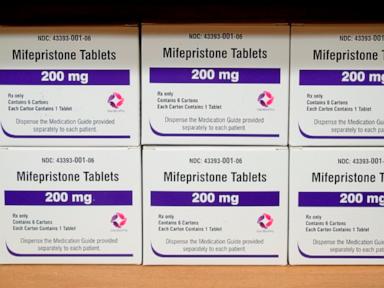
The envelope is unremarkable. It is a standard white mailer, the kind that usually holds a monthly utility statement or a new credit card you didn't ask for. But inside this specific envelope sits a small blister pack containing a single tablet of mifepristone. For a woman sitting on a bathroom floor in a rural town two hours from the nearest clinic, this tiny object is the difference between a life she chose and a life she is forced to inhabit.
It is a chemical sequence. A molecular blockade. By stopping the hormone progesterone, it tells the body to cease a process it has already begun. Simple. Clinical. Yet, this 200-milligram pill has become the most scrutinized piece of matter in the American legal system. You might also find this similar coverage insightful: Redistricting Lawsuits are a Public Relations Scam to Hide Failing Political Brands.
The Supreme Court just hit the pause button.
In a brief order that offered more relief than clarity, the justices extended a temporary stay. This means that, for now, the status quo remains. Women can still receive this medication through the mail. They can still use it up to ten weeks of pregnancy. The regulatory walls that a lower court tried to rebuild—requiring three in-person doctor visits and stripping away mail-order access—have been kept at bay. As discussed in latest coverage by Reuters, the results are notable.
The tension, however, is not gone. It is merely vibrating.
The Geography of a Waiting Room
Consider Sarah. She is a hypothetical composite of the thousands of women who navigate this landscape every week. Sarah lives in a state where the local legislature has effectively shuttered every reproductive health center within a 200-mile radius. She works an hourly job. She has a toddler.
For Sarah, the Supreme Court's "temporary extension" isn't a headline. It is a lifeline. If the Court had allowed the lower court’s restrictions to take effect, Sarah’s path would have vanished. She would have needed to find childcare for two days, secure a reliable car, and drive four hours round-trip—three separate times—just to swallow a pill that has been FDA-approved for over twenty years.
The legal battle isn't really about the safety of the drug. The data on that is boringly consistent. Mifepristone is statistically safer than Tylenol. It is safer than Viagra. It is safer than getting your wisdom teeth pulled. When lawyers argue in mahogany-rowed courtrooms about "administrative procedure" and "standing," they are using a specialized language to mask a very visceral goal: making the process so logistically exhausting that it becomes impossible for people like Sarah to complete it.
The clock is the primary weapon.
The Ghost of the Comstock Act
To understand why a 19th-century law is suddenly haunting 21st-century medicine, we have to look at the cracks in the legal foundation. The challengers of the pill didn't just argue about side effects. They reached into a dusty trunk of Victorian-era morality and pulled out the Comstock Act of 1873.
This law was the brainchild of Anthony Comstock, a postal inspector who viewed himself as a soldier against "obscenity." It prohibited the mailing of anything "intended for the prevention of conception or procuring of abortion." For decades, this law was considered a relic, a dead letter rendered obsolete by modern privacy rulings.
But legal relics have a way of being reanimated when the political wind shifts.
The Fifth Circuit Court of Appeals utilized a logic that felt like a time machine. They suggested that the FDA’s decision to allow mail-order delivery of mifepristone ignored this ancient postal ban. If that logic eventually prevails at the Supreme Court level, it wouldn't just affect one pill. It would turn the United States Postal Service into a federal pregnancy warden.
Every package becomes a potential crime. Every delivery driver becomes an unwitting accomplice.
The Invisible Stakes of the FDA
If you strip away the politics, what remains is a direct assault on the concept of expertise. The FDA is the gold standard. Its scientists spend years—sometimes decades—reviewing clinical trials to determine if a drug is safe for the public.
When a single judge in Texas, who is not a doctor, decides that he knows more about molecular biology than the FDA’s entire regulatory board, the precedent set is terrifying. It creates a world where any medication could be pulled from the shelves if a motivated group of plaintiffs finds a sympathetic judge.
Imagine a group that decides vaccines are "morally objectionable" and finds a court willing to stay their approval. Imagine a challenge to contraception, or HIV medication, or gender-affirming care. If the Supreme Court eventually decides that the FDA’s approval of mifepristone can be unwound by judicial fiat, the entire infrastructure of American medicine begins to crumble.
Trust is a fragile thing. It takes twenty years to build a reputation for a drug and twenty minutes for a court order to dismantle it.
The Silence in the Room
The Supreme Court's current intervention is a "stay." It is a legal "hold please." It doesn't mean the justices have decided that the pill is safe or that the challengers are wrong. It simply means they recognize that changing the rules in the middle of the game would cause "irreparable harm" to the healthcare system.
But "temporary" is a cold word when you are the one waiting for a package.
There is a specific kind of silence that accompanies this waiting. It is the silence of a woman looking at a tracking number on her phone, wondering if the law will change before the mail carrier reaches her porch. It is the silence of a doctor who wants to provide the best possible care but has to check a fluctuating legal map before writing a prescription.
We are currently living in the gap between the gavel and the mailbag.
The Court will eventually have to hear the full merits of the case. They will have to decide if the FDA has the final word on science or if the judiciary has the right to override it. They will have to decide if a woman in a rural town has the same right to modern medicine as a woman in a city with a clinic on every corner.
Until then, the white envelope remains in transit.
It travels through sorting facilities, onto trucks, and into the hands of people whose lives are being debated by men in robes who will never meet them. The pill itself is tiny. It weighs almost nothing. But as it sits in that blister pack, it carries the entire weight of a nation’s divided conscience.
The status quo holds, but the breath is still being held along with it.
The mail will run tomorrow. The prescriptions will be filled. The cars will stay in the driveways for one more week, or one more month. But the uncertainty has already done its work. It has introduced a flicker of fear into a process that should be governed by medicine alone.
In the end, this isn't just about a tablet. It is about the distance between a person and their own body, and who gets to decide how that distance is measured.
The envelope is on the porch. For now, she is allowed to open it.