The reality of Glasgow city centre rarely matches the civic brochures printed by tourist boards. Beneath the sandstone facades and the polished commercial corridors of Buchanan Street lies an urban core strained to its absolute limits by open drug use, recurring street violence, and a toxic undertow of far-right agitation. When surface-level reporting merely scratches at the symptoms—filming a street brawl or counting police sirens—it misses the systemic mechanical failure underpinning Scotland’s largest city. This is an investigation into how public neglect, structural economic decay, and imported extremist politics collided in a single week on Glasgow's streets, transforming civic spaces into flashpoints of social fracture.
The Anatomy of Urban Decay
Walk down Argyle Street or linger near Central Station after dark, and the open secret of Glasgow's street economy becomes immediately visible. Open-air drug transactions are no longer confined to hidden alleyways or marginalized housing schemes; they happen in broad daylight under the gaze of CCTV cameras. Prescription benzodiazepines, street valium, and high-purity cocaine move through hands with casual impunity.
Drug deaths in Scotland have long outpaced the rest of Western Europe, a grim statistic that is merely the statistical shadow of a hollowed-out social safety net. When local addiction services face chronic underfunding and third-sector support organizations are pushed to the brink of insolvency, the streets absorb the casualties.
Police Scotland officers find themselves caught in an impossible loop. They are deployed as reactive band-aids on a gushing wound, moving individuals from one block to the next without the judicial or medical tools required to interrupt the cycle. Arrests do not treat substance dependence, and dispersal orders merely shuffle vulnerable populations into darker, more dangerous corners of the city centre.
When Ideology Meets Anarchy
Yet drugs and routine antisocial behavior are only half of the equation. Over the past year, Glasgow city centre has increasingly functioned as a stage for ideological theatre, where imported culture wars and native bigotry intersect with devastating velocity.
Far-right factions, often organized under loose banners mimicking anti-immigration movements elsewhere in the UK, have repeatedly attempted to stake a claim on public spaces like George Square and Buchanan Street. These groups do not organically emerge from local working-class grievances; they are amplified and coordinated by digital networks that trade in manufactured outrage.
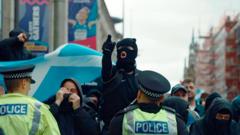
When these groups gather, carrying inflammatory slogans, they are inevitably met by anti-racist counter-demonstrations. The resulting clashes paralyze the city centre, forcing local businesses to lock their doors and stranding shoppers in a sea of hostility.
Consider a hypothetical afternoon during one of these flare-ups: a family visiting from the Highlands steps off a train into a corridor blocked by riot police, flanked by shouting factions hurling sectarian and racial abuse. The civic trauma inflicted by these recurring spectacles is immeasurable. It hollows out public trust in the city's ability to maintain basic safety and order.
The Institutional Blind Spot
The response from local authorities and national politicians has been characterized by defensive communication and delayed transparency. When violent disorder erupted following flashpoints linked to wider UK-wide unrest, Police Scotland took nearly an entire day to issue a comprehensive public accounting of the arrests. In an era of instantaneous social media dissemination—where unverified clips of street beatings travel globally in seconds—institutional silence acts as gasoline on an open fire.
This hesitation stems from a deeper institutional fear. To speak candidly about the concentration of crime, drug markets, and racial tensions in the city centre is to risk inviting political exploitation from populist actors on both extremes. Consequently, city leaders often default to euphemisms, describing systemic failures as "isolated incidents" or "petty antisocial behavior."
This linguistic evasion protects institutional reputations at the expense of honesty. Business owners along the Golden Z retail corridor report a quiet exodus of foot traffic after dark, replaced by a pervasive sense of lawlessness that insurance underwriters and commercial landlords can no longer ignore.
Beyond the Flashpoints
Fixing Glasgow city centre requires abandoning the comforting illusion that these issues are temporary aberrations. They are the cumulative product of chronic mental health provision gaps, criminal justice stagnation, and a failure to protect public spaces from being weaponized by extremist fringes.
Decent housing, well-resourced drop-in addiction hubs, visible and accountable community policing, and a zero-tolerance baseline for racial intimidation are not radical proposals. They are the non-negotiable prerequisites of a functioning metropolis. Until Glasgow's leadership confronts the interconnected realities of its street economy and its polarized public squares, the city will remain trapped in a recurring loop of crisis, condemnation, and quiet decay.