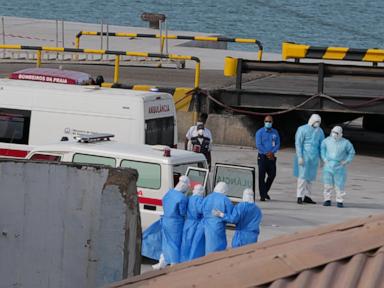
The phone rings in a quiet office in Santa Fe, or perhaps a clinical hub in Montana. It is usually late afternoon. On the other end of the line is a lab technician with a voice that has gone flat—the kind of professional neutrality that masks a brewing storm. They have a positive result. It isn’t the flu. It isn’t a common pneumonia. It is hantavirus.
By the time that call is placed, the patient is often already fighting for breath in an ICU, their lungs filling with fluid as their immune system wages a desperate, disorganized war. But while the doctors focus on the body in the bed, a different kind of soldier begins to move. These are the disease investigators. Their job isn’t to heal the patient, but to trace the ghost of a virus back to a single moment of inhalation—a dusty shed, a long-forgotten cabin, or a woodpile moved on a sunny weekend.
They are mapping the invisible.
The Dust and the Breath
To understand the stakes, you have to understand how hantavirus moves. It doesn’t travel like the seasonal sniffles. It is a hitchhiker. It lives in the gut of the deer mouse, a tiny creature with large ears and black eyes that looks entirely too innocent for the payload it carries. The virus is shed in droppings, urine, and saliva. It waits. When that waste dries, it becomes brittle. A broom stroke, a footfall, or a gust of wind kicks it into the air.
One breath. That is all it takes.
The investigators start with a blank map and a timeline. They sit with the family of the infected, asking questions that feel like an intrusion but are actually a lifeline. Where did they go? Did they clean out the garage? Did they go camping? Did they see mice?
Imagine a hypothetical investigator named Sarah. She isn’t wearing a hazmat suit yet. She is sitting at a kitchen table, looking at photos of a family’s recent vacation. She is looking for the "exposure event." She knows that the incubation period is a cruel window—anywhere from one to eight weeks. She has to reconstruct two months of a human life, hour by hour, looking for the moment a microscopic particle met a lung.
The Genetic Fingerprint
Public health officials don’t just rely on memories. They use science that feels like something out of a forensic thriller. When a victim is identified, teams often head into the field to trap rodents in the areas the patient frequented. They aren't just looking for any mice; they are looking for the specific strain of hantavirus that matches the patient.
Every geographic pocket has its own viral signature. A virus from a cabin in the high desert of Arizona looks different under a microscope than one from a damp valley in Washington. By sequencing the viral RNA, investigators can prove exactly where the infection happened.
This isn't about assigning blame. It’s about prevention. If the virus came from a specific campsite or a popular trailhead, the stakes jump from a single tragic case to a potential public health crisis. The map starts to glow.
The Social Web
Once the "where" is established, the "who" becomes the priority. This is where the term "contact tracing" takes on a heavy, emotional weight.
With many viruses, we worry about who the patient coughed on. Hantavirus is different. It doesn't spread person-to-person. You can’t catch it from a handshake or a kiss. So, the investigators aren't looking for people the patient breathed on—they are looking for people who breathed the same air at the same time.
If the patient spent a weekend cleaning an old barn with three friends, those three friends are now living under a countdown. Sarah, our investigator, has to call them.
"You were there," she tells them. "You might have inhaled it too."
The fear on the other end of the line is a physical thing. There is no cure for hantavirus. There is no vaccine. There is only "supportive care," which is a clinical way of saying the hospital will try to keep you alive long enough for your body to win the fight. The investigators become counselors. They tell these contacts what to watch for: the fever, the muscle aches in the large groups like thighs and hips, the sudden, crushing fatigue.
They tell them: If you feel a chill, don't wait. Go to the ER. Tell them you were exposed.
The Burden of the Search
There is a psychological toll to this work that rarely makes the evening news. Contact tracers are often the ones who have to tell a mother that her son’s weekend chore might have been a death sentence. They have to explain to a business owner that their warehouse is a biohazard.
The work is meticulous. It requires a blend of high-level biology and old-fashioned detective work. They look at weather patterns—did a wet spring lead to a "mousy year" with more tall grass and seeds? They look at home construction—is there a gap under the door the size of a pencil? That’s all a mouse needs to enter.
They are fighting an enemy that is both everywhere and nowhere.
Critics sometimes wonder why we spend so much energy on a disease that affects relatively few people each year compared to the flu or heart disease. The answer lies in the math of mortality. Hantavirus Pulmonary Syndrome has a fatality rate of around 35 percent. It targets the young and the healthy. It takes people in the prime of their lives and turns their own lungs against them in a matter of days.
When an official traces a contact and gets them into a hospital 24 hours before their lungs begin to fail, they aren't just filling out a spreadsheet. They are snatching a life back from the dust.
The Ghost in the Walls
We like to think of our homes as fortresses. We seal the windows and lock the doors, believing we have separated the "wild" from the "civilized." But hantavirus is a reminder of how thin those walls actually are.
Public health officials aren't just bureaucrats; they are the people who stand at the breach. They are the ones who walk into the dark, dusty corners of our world to find the tiny, invisible threads that connect a mouse in a wall to a man in a ventilator.
The process is slow. It is grueling. It involves hours of phone calls, miles of driving to remote locations, and the constant, nagging pressure of a ticking clock. But as they piece together the map—linking a mouse, a shed, and a breath—they create a shield for the rest of us.
The next time you see a news report about a "rare viral outbreak," remember the investigators. They are out there right now, in the quiet hours, asking the hard questions, trapping the small creatures, and staring at the genetic code, all to ensure that a single breath of dust doesn't become the end of a story.
Somewhere, Sarah is hanging up the phone and marking a circle on a map. She has found the source. She has called the contacts. Now, she waits and hopes that the warnings were fast enough.
The sun sets over the mountains, casting long shadows across the sheds and barns of the rural West, where the mice are beginning to stir in the insulation, and the investigators are already preparing for the next call.