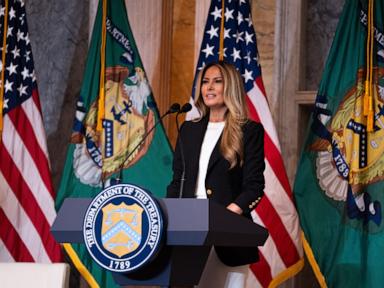
The traditional framework for mitigating economic vulnerability among youth aging out of state custody relies on reactive, short-term transfer payments. On June 11, 2026, First Lady Melania Trump and Treasury Secretary Scott Bessent introduced a structural alteration to this model: Fostering the Future Accounts. This mechanism functions as a specialized branch of the broader Trump Accounts program, engineered to address capital accumulation disparities among children in the foster care system. By authorizing child welfare agencies to act as legal guardians for the purpose of asset enrollment, the federal policy attempts to circumvent the structural barrier of absent parental authorization, establishing an automated mechanism for early-stage capital growth.
The program addresses a population of approximately 330,000 children within the United States foster care system, a demographic defined by compressed economic mobility metrics. Data from the National Foster Youth Institute demonstrates that 20% of individuals face homelessness immediately upon aging out of the system, and only 50% achieve gainful employment by age 24. Fostering the Future Accounts counter these outcomes by establishing a baseline capital reserve through a market-facing vehicle.
The Operational Mechanics of the Capital Vehicle
The financial architecture of the Fostering the Future Account depends on a combination of a one-time federal capital injection, compound market returns, and a temporary eligibility window. The program operates under a distinct financial function governed by the following operational constraints:
- Primary Sovereign Endowment: The United States Treasury deposits a one-time principal of $1,000 into an account established for an eligible child.
- Temporal Boundaries: Eligibility is restricted to United States citizens born between January 1, 2025, and December 31, 2028.
- Asset Deployment Mechanism: The capital is outsourced to private investment firms, which deploy the funds directly into equity markets rather than low-yield cash equivalents or sovereign debt instruments.
- Liquidity Restrictions: The principal and accrued capital gains are legally locked, preventing any liquidity drawdowns until the beneficiary reaches 18 years of age.
The White House Council of Economic Advisers projects specific asset trajectories based on these variables. Assuming nominal market returns, a $1,000 principal deposited for a newborn in 2026 is modeled to accumulate to $5,800 by age 18. If the beneficiary delays liquidation for another decade, the balance is projected to reach $18,100 by age 28.
The underlying thesis of this approach is the exploitation of a long-term investment horizon. By investing early in the lifecycle of the beneficiary, the asset accumulation curve offsets the absence of generational wealth transfers.
Eliminating Legal Custody Bottlenecks
The primary operational innovation of the initiative is not the financial endowment itself, but the removal of the legal friction that historically blocked vulnerable populations from accessing state-sponsored savings programs. Traditional Trump Accounts require a parent to initiate enrollment, a requirement that structurally excludes children under state wardship.
The new federal guidance resolves this through an administrative proxy framework. Local child welfare agencies are granted the explicit administrative authority to act as guardians solely for account creation. This structural shift decouples asset building from biological or adoptive family structures.
To execute this enrollment framework at scale, the program relies on state-level implementation. At the time of the announcement, 23 state governors had committed to integrating their child welfare infrastructure with the federal enrollment system. Because domestic child welfare systems are highly decentralized and managed primarily at the state and county levels, the speed and efficiency of capital distribution will depend on the operational readiness of these local agencies.
Public-Private Capital Matching and Philanthropic Inflows
The $1,000 federal endowment functions as a baseline capital floor rather than a maximum ceiling. The strategic framework relies heavily on secondary capital inflows from corporate and philanthropic entities to scale the total asset volume.
[Federal Seed Capital: $1,000] ──> [State Welfare Agency Enrollment]
                                            │
                                            ▼
[Corporate/Philanthropic Matches] ──> [Private Asset Management (Equities)]
                                            │
                                            ▼
                              [Maturity Horizon: Ages 18–28]
This matching structure is modeled after private sector corporate benefits, where employers match 401(k) contributions. In the broader Trump Accounts ecosystem, large-scale philanthropic commitments have already established precedents for localized or national capital scaling. For instance, the Michael & Susan Dell Foundation committed $6.25 billion to matching programs, while billionaire investor Ray Dalio and his wife, Barbara, pledged $75 million specifically targeting children under 10 in Connecticut.
Fostering the Future Accounts aim to direct similar private sector capital pools toward foster youth. The addition of private capital changes the growth equation; any secondary contribution made during the early years of a child's time in foster care shortens the time needed to reach meaningful capital self-sufficiency upon aging out.
Structural Bottlenecks and Systemic Risk Factors
While the financial modeling indicates significant capital growth on paper, the strategy faces three distinct operational and market bottlenecks that could limit its real-world efficacy.
Market Volatility and Sequence of Returns Risk
Because the accounts are invested in equity markets via private management firms, they are exposed to market cycles. A beneficiary who turns 18 during a severe macroeconomic contraction faces a compromised asset base compared to one who reaches maturity during an expansion. Because the program enforces a hard liquidity restriction until age 18, beneficiaries cannot reallocate assets to capital-preservation vehicles (such as short-term Treasury bills) if a market downturn occurs right before their eligibility date.
Administrative Execution Disparities
The reliance on state-level child welfare agencies creates geographic inequality in how the program is rolled out. States without streamlined digital tracking for foster youth will likely experience significant delays in account creation. A delay in enrollment shortens the compounding runway, directly reducing the total value of the asset at maturity. Furthermore, tracking highly mobile youth across state lines or through multiple foster placements introduces a risk of data fragmentation and unclaimed accounts.
Inflationary Erosion of Purchasing Power
The White House Council of Economic Advisers’ projections of $5,800 at age 18 and $18,100 at age 28 represent nominal figures rather than real, inflation-adjusted purchasing power. Assuming a standard long-term inflation target of 2% to 3%, the actual purchasing power of $5,800 two decades from now will be lower than it is today. While this capital pool still provides a far better cushion than the current baseline of zero dollars, it may not fully cover major transitions like a security deposit on an apartment, reliable transportation, or higher education expenses.
The Long-Term Macroeconomic Play
The Fostering the Future Accounts program shifts the policy approach from short-term public assistance to direct asset ownership. By turning public welfare agencies into financial facilitators, the initiative attempts to alter the post-custody outcomes of foster youth.
The strategic play for governors and corporate leaders is to build regional matching funds that augment the federal $1,000 seed deposit. States that quickly integrate their child welfare systems into this financial portal will give their foster youth a distinct economic advantage, directly reducing the long-term strain on state-level adult public assistance programs.