When Canadian Prime Minister Mark Carney publicly demanded that the White House stop throwing shade and quit posting memes, he fundamentally misunderstood how modern political warfare operates. You don't tell an administration fueled by viral optics to log off. You hand them fresh ammunition.
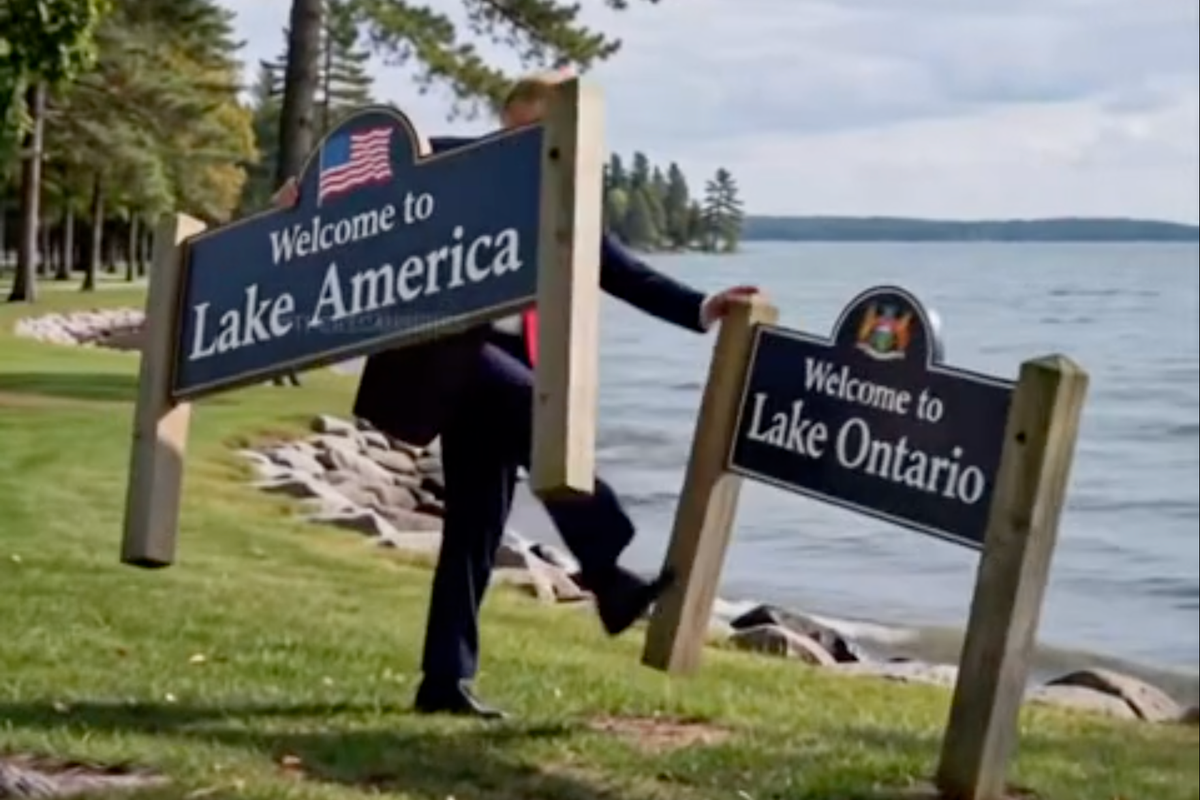
Trade talks between Washington and Ottawa collapsed last month, sparking an aggressive economic and digital standoff. Instead of quiet diplomatic channels, the feud spilled directly onto social media feeds. The escalation reached a surreal apex when President Donald Trump reposted an artificial intelligence-generated clip on Truth Social showing himself booting down a "Welcome to Lake Ontario" sign, replacing it with a fresh marker reading "Lake America," and breaking into his signature dance to the Village People's "Y.M.C.A." If you found value in this article, you should read: this related article.
Carney’s plea for seriousness didn't calm the waters. It poured jet fuel on a digital fire.
The Breakdown Behind the Border Feud
To understand why a fictional lake renaming and a couple of AI videos have hijacked international news, you have to look at the underlying economic crash. Trade negotiations blew up on August 21, leading Washington to slap 50 percent tariffs on billions of dollars in Canadian exports. Ottawa quickly promised dollar-for-dollar retaliatory levies. With zero active negotiations happening, both sides retreated into their respective corners. For another look on this development, refer to the recent coverage from The New York Times.
Carney addressed reporters to push back against the pressure. He laid out Ottawa's baseline for returning to the table with a very specific complaint.
"When the Americans stop doing memes, stop throwing shade and stop trying to be tough, and start being serious about having those discussions, we can have those discussions," Carney told the press. He added that while it isn't constructive, it's simply how American democracy functions.
Naming a specific online behavior as a barrier to formal diplomacy is a massive tactical error. In the current media ecosystem, telling your opponent that their digital trolling hurts your feelings guarantees you will get trolled twice as hard.
How Washington Weaponized Artificial Intelligence
The meme offensive didn't start with a sign-kicking video. Earlier in the week, the administration leaned heavily into synthetic media and internet satire to mock Canadian sovereignty claims over the Great Lakes.
Trump shared a bizarre video featuring an army of mutant Canada geese equipped with automatic rifles patrolling the border on his behalf. Shortly after Carney's public plea to halt the memes, the Lake Ontario replacement clip dropped.
This strategy bypasses traditional press briefings entirely. By utilizing synthetic video clips that merge absurd visual concepts with real-world geopolitical disputes, the messaging captures immediate algorithmic attention. Traditional diplomats draft carefully worded statements expressing deep concern. Modern populists render a 15-second video of themselves kicking a sign and dancing to disco music. Guess which one dominates feeds worldwide within minutes.
Commerce Secretary Howard Lutnick pointed out that Canadian leadership is navigating internal political pressures, including upcoming elections, which complicates compromise. Yet, leaning into public humiliation through digital content changes the incentive structure. It forces Canadian officials to respond to obvious fiction as if it were formal policy.
The Trap of Taking the Bait
Carney wants a return to traditional statecraft where economic threats are met with sober communiques and closed-door bargaining. That world is gone. When you publicly demand that a political opponent abandon their most effective engagement tool, you validate its power.
By treating the memes as a legitimate political obstacle, Ottawa elevates internet jokes to the status of international incidents. Trump didn't need to issue a formal white paper outlining territorial grievances regarding the Great Lakes. A synthetic video of a shoreline makeover accomplished the exact same objective with exponentially higher reach.
Until actual economic pressure forces a breakthrough behind closed doors, expect more digital provocation rather than less. Complaining about the internet is the fastest way to become its primary punchline.
Trump's 'Donald Ducks' At 'Lake America' Mocks Canada & Carney? Internet Agrees | Vantage | 4K
This video explores how internet users turned Trump's controversial push to rename Lake Ontario into viral memes involving patriotic ducks.
http://googleusercontent.com/youtube_content/1