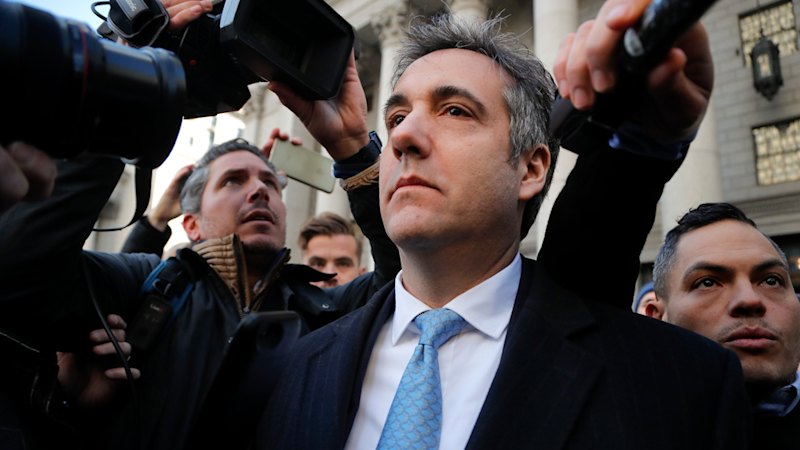
The transformation of Donald Trump’s former personal attorney and chief fixer, Michael Cohen, from loyal lieutenant to federal inmate and state’s witness, is frequently framed as a classic narrative of moral recovery. In this standard media script, an operative complicit in high-level corruption realizes the error of his ways, breaks ranks, serves his time, and emerges into the public square as an ardent truth-teller. Redemption, however, is rarely a neat theatrical arc. For Cohen, the path has not been a straight line toward absolution, but a grueling exercise in permanent displacement. He remains a man trapped in the machinery he helped construct, searching for a place of permanent safety that the American political and legal systems simply do not manufacture for figures of his specific provenance.
Understanding the reality of Cohen’s post-prison existence requires looking past the daily churn of podcast appearances and courtroom appearances. Long before he was standing on a Manhattan witness stand detailing hush-money payments, Cohen was the blunt instrument of an empire built on non-disclosure agreements, intimidation, and aggressive legal posturing. He was not an accidental participant in proximity to power; he was the architect of its insulation. When that insulation failed, the legal reckoning was swift. Federal prosecutors, congressional investigators, and New York bar disciplinary committees dismantled his professional life piece by piece, resulting in a three-year prison sentence and permanent disbarment.
The concept of the turncoat or cooperating witness occupies a strange, contradictory space in public consciousness. Prosecutors rely on insiders to pierce the inner sanctums of white-collar crime, recognizing that conspiracies of silence cannot be cracked from the outside. Yet the public and the political ecosystem struggle to reward the betrayer. To the political movement he once served, Cohen is an absolute pariah, a historical footnote turned traitor whose every public statement is dismissed as the fabrication of a desperate opportunist. To many of those who oppose that same movement, he is viewed with profound suspicion—a witness of necessity rather than a champion of virtue.
This dual rejection creates a distinct kind of purgatory. Cohen cannot return to the corporate sphere that once sustained him, nor can he seamlessly integrate into the traditional anti-Trump resistance as an unblemished moral authority. His entire public identity is bound up in opposition to the man he spent a decade protecting. That opposition is lucrative in the media landscape, measured in digital clicks, book sales, and streaming views, but it lacks institutional permanence. It is a transactional existence built on the very volatility that upended his life in the first place.
Consider the mechanics of legal cooperation in high-stakes federal investigations. When an operative flips, the transaction is strictly utilitarian. The government offers reduced exposure or a measure of protection in exchange for testimony that can reach higher targets. The system does not offer spiritual restoration or social rehabilitation. It offers a docket number and an exit from a prison gate. What happens to the individual afterward is of little concern to the courts. They are cast into a social wilderness where their credibility is perpetually litigated by defense attorneys and partisan commentators alike.
Every time Cohen steps before a microphone or publishes a commentary, he runs headfirst into his own ledger of past falsehoods. His guilty plea for lying to Congress remains an anchor weight around his public reputation. Defense lawyers weaponize that admission in every context imaginable, reminding judges, juries, and the public that a witness who admitted to serial dishonesty under oath cannot easily shed that history simply by changing sides. This is the central tragedy of the fixer turned informant. The skills that made him valuable to a powerful boss—the absolute willingness to bend reality, absorb liability, and execute grey-area tasks—are precisely the attributes that destroy his credibility when he decides to tell the truth.
The search for redemption is further complicated by the legal maneuvers that continue to swirl around him. Even after completing his federal sentence and surviving a brief, highly controversial stint of retaliatory confinement during the COVID-19 pandemic, his efforts to leverage the civil courts against his former employer have largely hit dead ends. Judicial bodies have repeatedly closed doors on his attempts to seek damages for actions tied to his imprisonment, signaling that the legal system views him as the author of his own misfortune. He remains legally radioactive, a status that deters traditional corporate employers and keeps him tethered exclusively to the attention economy.
The broader lesson of Cohen’s trajectory extends far beyond one man's personal grievances. It exposes how modern political loyalty functions as a totalizing system. Those who enter the inner circle of high-level political operations understand implicitly that protection flows inward only as long as utility remains high. The moment the utility shifts from defense to exposure, the apparatus turns its formidable resources against the defector. Cohen discovered this reality not through abstract theory, but through federal indictments, asset pressure, and the sudden, chilling realization that loyalty in transactional environments is entirely a one-way street.
Observers often look for a clean moral resolution to stories of political corruption and betrayal. They want the bad actor to find peace through confession, or they want the system to cleanly discard them into irrelevance. Reality is far messier. Cohen continues to inhabit a hyper-visible space where he is simultaneously central to historic legal milestones and fundamentally isolated from mainstream civic life. He is neither fully redeemed nor entirely cast out, vibrating instead within the narrow frequency of perpetual conflict.
The path he traveled did not lead to a quiet retirement or a restored reputation. It led straight into an endless public trial where the verdict is never finalized and the sentence is never truly served.