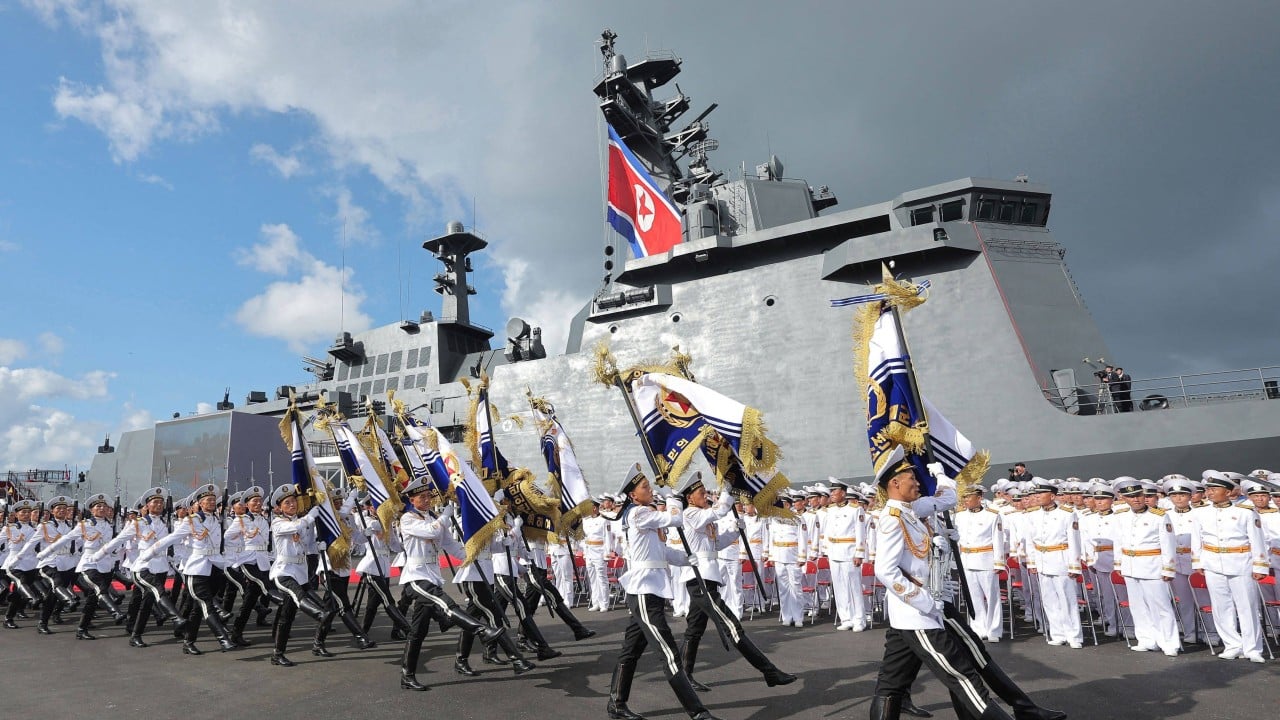
For decades, the Korean People's Navy was basically an afterthought. It relied on rusty, diesel-powered coastal submarines from the 1960s and small patrol craft that could barely venture past the shoreline without breaking down. But Kim Jong Un is spending massive political capital to change that narrative. The recent commissioning of 5,000-ton destroyers like the Choe Hyon and the Kang Kon marks a radical break from the past. These aren't just cosmetic upgrades for state TV. They represent a calculated bid to project power into surrounding waters and back up Pyongyang's aggressive maritime claims.
The Reality Behind the Choe Hyon Class
If you look past the standard propaganda broadcasts, the launch of these large surface combatants tells a fascinating story about shifting military priorities. Displacing roughly 5,000 tons, the Choe Hyon and its sister ship are by far the largest warships ever built domestically in North Korea.
They feature vertical launch systems designed to house cruise and ballistic missiles. Kim Jong Un has made it clear that these platforms are intended to plug directly into the country's state nuclear response system.
Key Capabilities Highlighted by State Media:
- Multi-role combat platforms configured for anti-air, anti-ship, and anti-submarine missions.
- Integration with tactical nuclear-capable missile delivery systems.
- Designed to extend operational reach well beyond traditional coastal defense zones.
Building ships of this scale is no small feat for a heavily sanctioned economy. In fact, the program has faced major public humiliations. Last year, the second hull of this class—later named the Kang Kon—suffered a botched launch at Chongjin, partially capsizing on the slipway in front of frustrated officials. Western analysts wrote it off as a total loss. Yet, through aggressive salvage and repair work, Pyongyang managed to refloat, fix, and ultimately commission the vessel. That turnaround speed highlights an industrial resilience that outsiders frequently underestimate.
Shifting Tides in the West and East Seas
Geography dictates strategy here. The lead ship, the Choe Hyon, was assigned to the West Sea Fleet to operate in the Yellow Sea, while the Kang Kon was turned over to the East Sea Fleet.
This deployment pattern addresses a major strategic vulnerability. The waters surrounding the Korean Peninsula are heavily monitored by South Korean and United States naval assets. By fielding ships equipped with modern sensors and heavy missile loads, Pyongyang wants to contest the Northern Limit Line (NLL) and normalize its own naval patrols in disputed areas.
You have to understand the political timing, too. Kim Jong Un has formally abandoned peaceful reunification, pushing a "hostile two-state" doctrine. Pushing that hostility into the maritime domain requires more than land-based artillery and underground missile silos. It requires steel hulls cutting through contested waves to prove that the regime can defend its maritime sovereignty.
Can North Korea Sustain a Naval Arms Race?
Skepticism from defense experts is entirely justified. Modern naval warfare is intensely technological and punishingly expensive. South Korea operates a sophisticated fleet of advanced destroyers and aegis systems backed by robust industrial supply chains. North Korea simply cannot match that tonnage or technological depth over the long haul.
Furthermore, warships cannot hide inside tunnels or beneath mountainous terrain the way mobile ballistic missile launchers do on land. Once a 5,000-ton destroyer leaves port, it becomes a visible, trackable target for modern satellite reconnaissance and submarine warfare.
Even so, writing these ships off as mere floating parade floats is a mistake. They serve an internal and external purpose. Domestically, they give the ruling regime a massive prestige project that cements Kim's legacy far beyond what his father or grandfather achieved at sea. Externally, they complicate alliance planning in Tokyo, Seoul, and Washington by forcing naval commanders to account for unpredictable platforms carrying potential nuclear payloads.
Expect more hulls to slide down these upgraded slipways over the next few years. Pyongyang has already signaled plans to move toward even larger 10,000-ton strategic warships. Whether those designs ever materialize at scale remains an open question, but the era of the purely defensive North Korean coastline is officially over.