The Viral Trap of the Tarmac Crunch
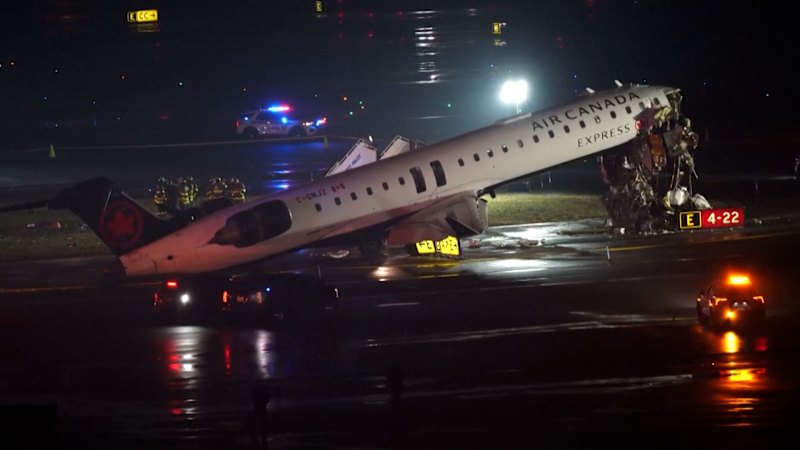
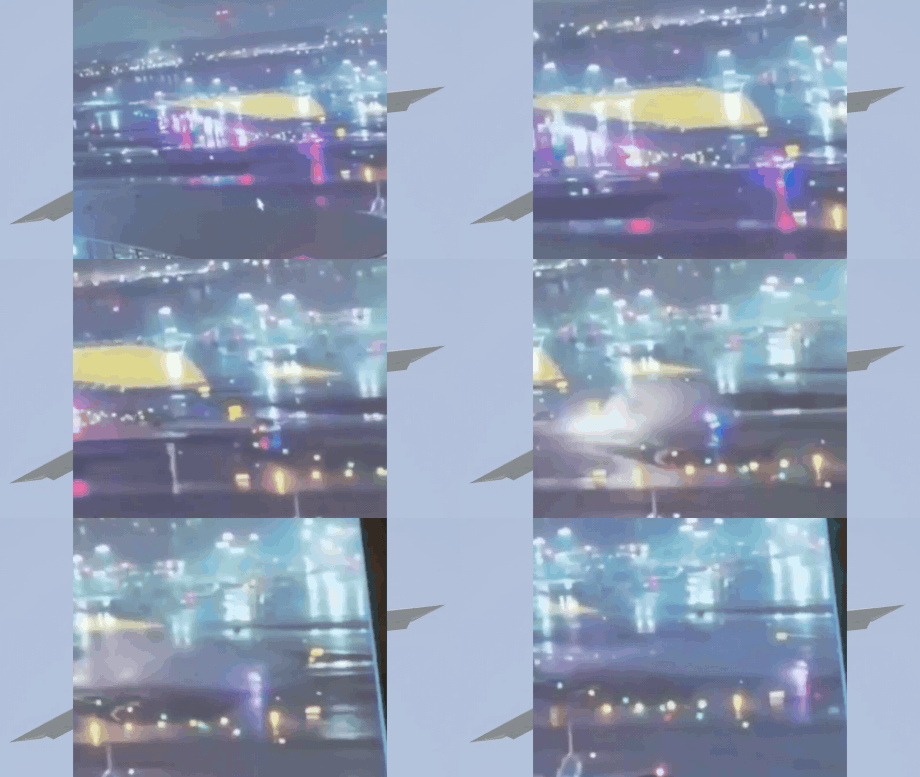
The footage of an Air Canada plane clipping a fire truck at LaGuardia is doing exactly what it was designed to do: trigger your lizard brain. You see $100 million in precision engineering crunching against a utility vehicle and you think "system failure." You think "incompetence." You probably think you’re lucky you wasn’t on that flight.
You are wrong.
The media loves these "ground rash" clips because they are visual, easy to understand, and provide a convenient villain—usually a distracted tug driver or a miscommunicating pilot. But if you actually want to talk about aviation safety, focusing on a low-speed fender bender at LGA is like obsessing over a paper cut while you have stage four heart disease. These collisions aren't the problem; they are the inevitable exhaust of a system pushed to a level of density that defies human logic.
The "lazy consensus" screams for more sensors, more cameras, and more automated warnings. But adding tech to a crowded tarmac is often just adding noise to an already deafening environment. We don't have a "collision" problem. We have a "spatial greed" problem that no amount of AI-assisted braking is going to solve.
The Myth of the Sterile Tarmac
Standard reporting treats the airport apron like a laboratory floor. It’s not. It is a high-velocity industrial zone where the margin for error is measured in inches, yet the participants are operating on 1970s-era visibility standards.
When that Air Canada wingtip met the fire truck, the "experts" started chirping about "situational awareness." This is a garbage term used by investigators to blame a human for failing to do something a human isn't evolved to do. A pilot sitting 40 feet in the air cannot see their own wingtips. They rely on "wing walkers" and ground marshals who are often overworked, underpaid, and navigating a literal maze of catering trucks, fuel pits, and emergency vehicles.
The Physics of the Blind Spot
Let’s look at the math. A Boeing 737 or an Airbus A320 has a wingspan of roughly 115 to 118 feet. When you are taxiing through the tight corridors of an aging infrastructure nightmare like LaGuardia, you are essentially driving a building through a narrow alleyway.
The formula for kinetic energy, $E_k = \frac{1}{2}mv^2$, tells us that even at a "crawl" of 5 knots, a 150,000-pound aircraft carries enough force to shear through steel like it’s wet cardboard. The issue isn't that the pilot "hit" something; it's that we still expect humans to navigate these dimensions by eyeballing them.
We’ve automated the flight—the part where the plane is thousands of feet in the air with miles of empty space—but we leave the most cramped, dangerous, and variable part of the journey to a guy looking out a side window.
Stop Asking if it’s Safe and Start Asking Why it’s Slow
People ask, "Is it safe to fly out of crowded airports?"
Wrong question.
The question is: "Why are we still using airports designed for the Douglas DC-3 to handle 1,200 flights a day?"
The LaGuardia incident is a symptom of Infrastructure Denialism. We want the cheap fares and the 15-minute Uber ride to the terminal, but we refuse to acknowledge that the physical ground space hasn't expanded to match the flight volume. When you jam more objects into a fixed container, the probability of contact approaches 100%.
- The Competitor Narrative: "A freak accident occurred."
- The Reality: This was a statistically certain event.
If you run enough sorties in a confined space, the "Swiss Cheese Model" of accident causation dictates that eventually, the holes will line up. The fire truck was where it shouldn't have been, or the plane was where the truck didn't expect it. But the root cause wasn't the truck—it was the density.
The High Cost of "Safety" Theater
Every time one of these videos goes viral, the FAA or the airline issues a statement about "reviewing protocols." This is corporate code for "we’re going to give everyone a 30-minute PowerPoint presentation on looking both ways."
It does nothing.
If we actually wanted to stop ground collisions, we would do two things that the industry—and you, the passenger—would hate:
- Mandate Hard Separation: No vehicle movement within 150 feet of a moving aircraft. This would crater airport efficiency. Your "quick" taxi would turn into a 45-minute ordeal.
- External Tug Taxiing: Planes should not move under their own power near terminals. They should be hooked to automated, GPS-guided tugs that follow a digital rail.
Airlines won't do this because the "turn time" (the time it takes to land, swap passengers, and take off) is the only metric that matters for their bottom line. A plane on the ground is a liability; a plane in the air is an asset. They would rather eat the insurance cost of a clipped wing once every 500,000 movements than add 10 minutes to every single flight's ground time.
The "Human Error" Lie
I’ve spent years looking at hangar floors and cockpit telemetry. When a company blames "human error," they are usually hiding a "design error."
In the Air Canada case, the fire truck was likely responding to a different issue or performing a routine check. In a modern airport, the radio frequencies are a chaotic mess of ATC, ground control, company channels, and emergency bands. Expecting a driver and a pilot to perfectly synchronize their movements in a three-dimensional puzzle is a fantasy.
We have the technology to prevent this. It’s called ADS-B (Automatic Dependent Surveillance-Broadcast), and while it's required for planes in the sky, we don't strictly mandate it for every "follow-me" car, fuel truck, and baggage tug on the field. Why? Because it costs money.
We would rather have the occasional viral collision than spend the capital to digitize the tarmac.
The Brutal Truth for the Passenger
You aren't in danger during a ground collision. You’re just inconvenienced. The real danger is the "fix" that comes after these incidents.
When the public demands "action" over a minor scrape, regulators often implement "cautious" procedures that actually increase risk elsewhere. For example, if you make taxiing so slow and bureaucratic that pilots are distracted by paperwork and checklists while moving, they are less likely to notice the actual runway incursion—which is the thing that actually kills people.
Ground collisions are a tax we pay for a high-volume, low-cost aviation "landscape" (to use a word the suits love, even if I hate it). We accept the friction because we demand the frequency.
Stop Watching the Wingtip
The next time you see a video of a plane hitting a truck, don't tweet about how "scary" it is. It isn't scary. It’s boring. It’s an insurance claim.
The real story isn't that two things touched; it's that we are trying to run a 21st-century global transport network on 1950s concrete. If you want to be outraged, be outraged at the fact that your local airport spends more on "luxury" terminal shopping malls than it does on the digital infrastructure required to keep 100-foot wings from hitting 10-foot trucks.
The "collision" is just the physical manifestation of a system that has run out of room to breathe.
Stop looking at the dent in the aluminum. Look at the gridlock that caused it. The industry isn't "failing" when a plane hits a truck; it's just reaching the physical limit of its own greed.
Buy a window seat, watch the wing, and realize that the only thing keeping you from a four-hour delay is a 22-year-old on the ground with two orange flashlights and a prayer. If that doesn't sit well with you, start advocating for the automation of the apron, or prepare to keep seeing these "freak" accidents every time the wind blows the wrong way at LGA.
There is no "safety protocol" that can fix a lack of space. There is only the choice between slower flights or more crunched metal. Pick one.