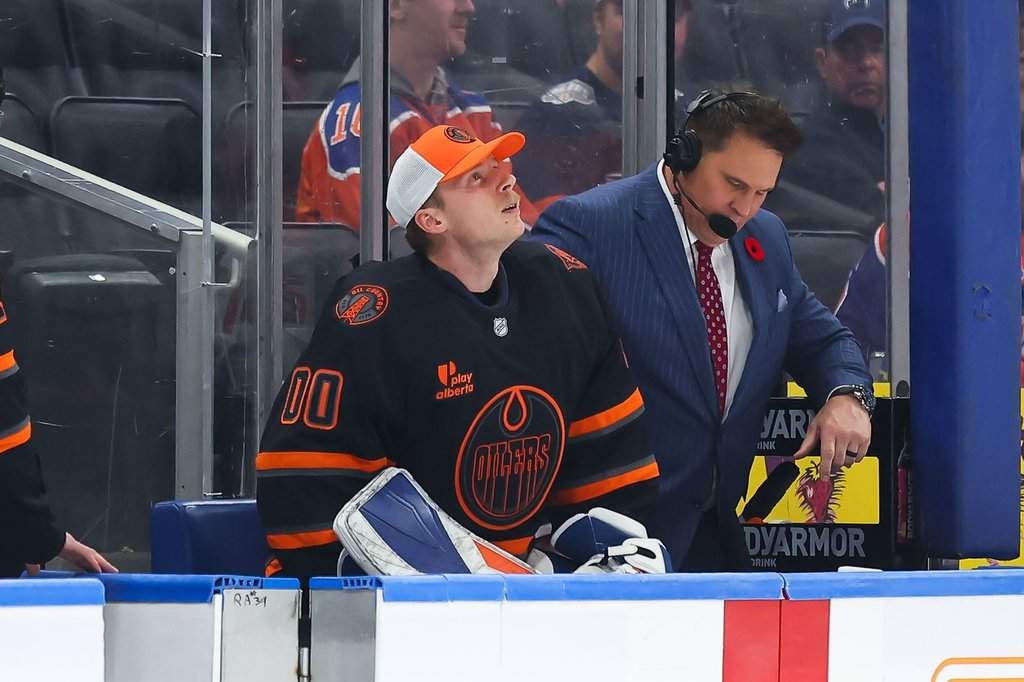
Hockey media loves a novelty story, and the Edmonton Oilers just handed them a shiny new toy. By becoming the first NHL franchise to employ a full-time Emergency Backup Goaltender, Edmonton has been showered with praise for forward-thinking innovation, roster security, and proactive risk management.
Every beat writer and talking head is nodding along to the exact same lazy consensus. They argue that eliminating the chaos of pulling a beer-league accountant out of the press box is pure genius.
They are completely wrong.
Edmonton didn't solve a roster crisis. They just burned real organizational resources to insure against a black swan event that happens less frequently than a Zamboni driver scoring an empty-net goal. Worse yet, they signaled a fundamental misunderstanding of NHL salary cap mechanics, goalie development, and probability.
The Illusion of Risk Management
Let’s look at the actual math of the Emergency Backup Goaltender position. In the modern NHL, an EBUG enters a game roughly once or twice across an entire 1,312-game regular season. You are talking about a probability hovering around 0.1 percent per team, per year.
When David Ayres stepped into the net for the Carolina Hurricanes in 2020, or when Scott Foster shut the door for the Chicago Blackhawks in 2018, the hockey world lost its collective mind. Those moments made for phenomenal television. They also broke the brains of risk-averse front offices.
In professional sports management, reacting to outliers is how you lose margins. I have watched front offices across major leagues waste millions of dollars trying to plug microscopic leaks while ignoring the gaping holes in their hull. When you dedicate a full-time salary, travel logistics, practice ice, and coaching bandwidth to a third-string emergency insurance policy, you are falling victim to availability bias. You remember the viral highlight of an amateur taking the ice, so you overpay to prevent it.
The Collective Bargaining Agreement already provides a clean, cost-free mechanism for emergencies. Under NHL rules, a team can sign an amateur tryout player for zero cap hit when both regular goaltenders are incapacitated. Does that amateur give you a great chance to win if he has to play forty minutes? No. Does a full-time EBUG give you a meaningfully better chance to win against Connor McDavid or Nathan MacKinnon? Also no.
What an EBUG Actually Is (And What Edmonton Pretends It Is)
Let’s clear up a massive misconception immediately. Fans hear "full-time EBUG" and picture a legitimate NHL-caliber netminder sitting in the rafters, ready to step in and steal a playoff game.
That is not how the NHL Collective Bargaining Agreement works.
A true EBUG is not a contracted NHL player on your 50-contract limit. If they were, they would be subject to waivers, salary cap accounting, and roster limits. You cannot simply stash a capable AHL starter in the press box on a full-time basis without burning a contract slot and navigating the waiver wire.
Therefore, a dedicated, full-time EBUG is still a non-roster asset—typically a retired minor leaguer, a goalie coach, or a former NCAA standout who is no longer competing at an elite professional level.
Edmonton hasn't acquired a secret weapon. They have hired a glorified practice goalie and given him a shiny title.
Let’s examine what happens when you put a non-active, full-time EBUG into a real NHL game during a tight Western Conference race:
- Game Speed Shock: There is an astronomical gap between taking shots at an optional morning skate and tracking pucks through triple-screens at 100 miles per hour during a power play.
- Conditioning Deficits: Practice drills last thirty seconds. NHL shifts in the defensive zone can trap a team for two minutes straight without a whistle.
- Mental Rust: Goaltending is entirely rhythmic. A keeper who hasn't faced live, consequential game action in six months will get exposed on east-west passes within three shifts.
Paying someone full-time to stay "ready" without ever playing in actual games is a contradiction in terms. You cannot simulate NHL game speed in a morning skate.
The Hidden Opportunity Cost in Edmonton
Every dollar and every minute in an NHL organization is zero-sum. Even if a full-time EBUG's salary doesn't count against the upper limit of the salary cap, it counts against the owner's operating budget and the coaching staff's daily bandwidth.
Edmonton’s historical weakness over the last decade hasn't been a lack of warm bodies in the press box. It has been glaringly obvious: inconsistent goaltending development, porous defensive structure, and terrible cap efficiency at the top of the lineup.
When a franchise like the Oilers—a team built around generational superstars in their absolute prime—spends energy pioneering a full-time EBUG role, you have to ask where their focus lies.
Imagine a scenario where the Oilers use that exact same budget to hire an additional full-time biomechanical analyst, an extra pro scout dedicated exclusively to European free agents, or a second developmental goaltending coach stationed permanently with their AHL affiliate in Bakersfield. Those investments actually move the needle on winning a Stanley Cup. They improve the players who actually step onto the ice for eighty-two games.
Instead, Edmonton opted for security theater. They bought a luxury umbrella for a desert.
Dismantling the "Practice Efficiency" Defense
Whenever I push back on this move in front of hockey insiders, they immediately pivot to their fallback argument: practice utility.
"Having a dedicated third goalie keeps the starter and backup fresh," they claim. "He takes the extra shots during morning skates so the main guys don't burn out."
This is half-true and entirely lazy. Yes, load management for NHL goaltenders is vital. Top-tier goalie coaches like Mitch Korn and Ian Clark have preached for years about protecting a starter's hips and groin during non-game days. Nobody wants Stuart Skinner taking two hundred meaningless shots from fourth-liners on a Tuesday morning in November.
However, every NHL city already has a deep pool of local college goaltenders, junior players, and retired pros who will gladly show up to morning skates for free just for the thrill of facing NHL shooters. Teams in Toronto, New York, Vancouver, and Edmonton have utilized local practice goalies for decades without putting them on a full-time payroll or traveling them across North America.
By turning a local practice perk into a permanent, traveling staff position, the Oilers inflated the cost of a free resource. They institutionalized something that worked perfectly well as an informal arrangement.
Are Fans Asking the Wrong Question?
If you look at what hockey fans are searching for right now, the questions are predictable: How much does a full-time EBUG make? Who is the Oilers' new EBUG? Will other NHL teams copy Edmonton?
Every single one of those questions misses the real story. The question you should be asking is: Why is a Stanley Cup contender managing its roster from a place of fear?
Championship organizations operate with aggressive efficiency. Look at how the Tampa Bay Lightning, Florida Panthers, and Vegas Golden Knights have managed their rosters over the last five years. They push the salary cap to the absolute legal limit. They weaponize Long-Term Injured Reserve. They treat their 50-contract limit like sacred real estate, constantly churning bottom-of-the-roster depth to ensure their AHL call-ups are hardened, game-ready professionals.
When Vegas ran into catastrophic goalie injuries during their 2023 Cup run—cycling through Logan Thompson, Robin Lehner, Laurent Brossoit, Adin Hill, and Jonathan Quick—they didn't survive because of an emergency backup plan. They survived because they had systematically built a pipeline of legitimate, active NHL and AHL goaltenders under contract.
A full-time EBUG is a band-aid for a lack of organizational depth. It is what you do when you don't trust your pipeline.
The Uncomfortable Truth About My Own Take
To be entirely fair, there is one narrow scenario where Edmonton's move looks smart.
If an NHL team plays in a geographically isolated market with a terrible local hockey ecosystem—say, a non-traditional market with zero nearby universities or junior programs—finding a competent body on two hours' notice during a snowstorm is a genuine logistical nightmare. In that specific case, having a vetted, background-checked, equipment-ready goalie on retainer makes practical sense.
Edmonton is not that market. Edmonton is one of the most hockey-saturated cities on planet Earth. You could throw a rock outside Rogers Place and hit three former Western Hockey League goalies before it touches the pavement.
If there is any city in the National Hockey League that does not need to pay a full-time salary to ensure a competent puck-stopper is in the building on game night, it is Edmonton, Alberta.
What Smart Front Offices Should Do Instead
If general managers around the league are looking at the Oilers and wondering if they need to follow suit, they need to stop immediately. Copying bad process just because a high-profile team did it is how mediocrity spreads across a league.
Here is what smart hockey operations departments should actually do to insulate themselves against goaltending chaos:
- Carry Three Waiver-Exempt or Cheap NHL-Ready Goalies on Your 50-Contract List: Use your contract slots on actual prospects and reliable AHL veterans who play 30 to 40 real games a year. Game sharpness beats practice readiness every single time.
- Maintain a Vetted Local Call List: Keep four local, high-level amateur or retired goalies in every home market on an informal rotation for morning skates. Rotate them so they stay sharp, keep their gear on file with the equipment staff, and pay them per skate.
- Invest in Sports Science and Recovery: Put the money you saved on a full-time EBUG directly into soft-tissue recovery, sleep analytics, and workload tracking for your top two goalies so they don't get injured in the first place.
- Exploit Emergency Recall Exceptions: Master the CBA's emergency recall rules. If your starter tweaks a groin during warmups on a road trip, know the exact flight schedules to get your AHL starter into the city before the puck drops the next night.
The Verdict on Edmonton's Experiment
The NHL is a copycat league, which means at least three or four insecure general managers will probably announce their own "full-time EBUG" hires over the next twelve months just to look proactive to their ownership groups.
Don't fall for the press releases.
Winning in the modern NHL requires ruthless prioritization. Every resource has to serve the singular goal of outscoring the opponent when the games actually matter in May and June. Hiring a full-time emergency goalie doesn't make your team faster, heavier, deeper, or harder to play against. It just gives the broadcast crew a neat talking point during a television timeout in the second period.
Let the Oilers pay a full-time salary for a guy to sit in the press box and eat free popcorn. Smart teams will spend their money on players who actually cross the boards.