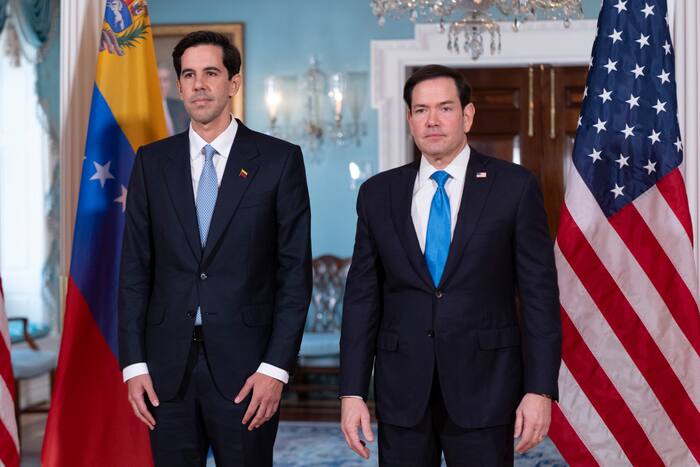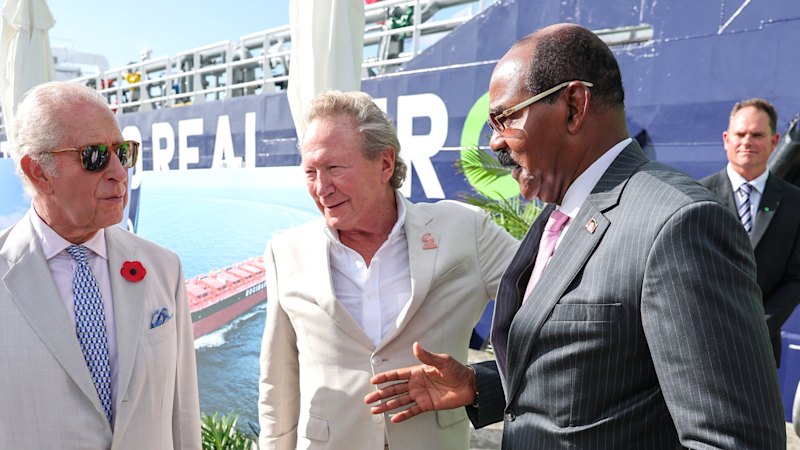
Everyone saw the photo op in Sydney Harbour. King Charles III, Australian Prime Minister Anthony Albanese, and mining billionaire Andrew Forrest standing side by side on the deck of a bright blue vessel. Most news outlets treated it like a standard royal tour handshake with a green twist.
They missed the real story entirely.
That ship wasn't just a floating stage for polite diplomatic small talk about the weather. It was the Green Pioneer, a converted offshore supply vessel owned by Fortescue, and its presence in Sydney Harbour represented a high-stakes bet on the future of global shipping. When King Charles stepped aboard alongside Albanese and Forrest in October 2024, the three men were standing on top of a massive industrial gamble that could either reshape global trade or become an expensive dead end.
If you want to understand why this specific meeting mattered, you have to look past the royal protocol and examine the fuel sitting in the tanks below their feet.
Why King Charles, Albanese, and Forrest Were Really on That Boat
Let's get the facts straight first. During his first visit to Australia as monarch, King Charles III prioritized climate action and sustainability, a theme he's championed for over five decades. On October 22, 2024, he joined Prime Minister Anthony Albanese and Fortescue Executive Chairman Andrew Forrest aboard the Fortescue Green Pioneer in Sydney Harbour.
The vessel is a 75-meter former offshore supply ship that Fortescue retrofitted to run on a dual-fuel system combining ammonia and diesel. Earlier in 2024, in Singapore, it became the world's first ocean-going vessel to successfully use ammonia as a marine fuel in a trial overseen by the Maritime and Port Authority of Singapore.
So why bring the King of England onto a retrofitted workboat?
For Andrew Forrest, it was pure strategic validation. Forrest has spent years aggressively pivoting Fortescue from a traditional iron ore giant into a green energy and green technology company, often facing fierce skepticism from financial markets and traditional energy executives. Getting the British monarch and the Australian Prime Minister onto his flagship vessel in front of the world's press was the ultimate stamp of legitimacy.
For Anthony Albanese, the optics were just as calculated. His government has been walking a tightrope between Australia's massive fossil fuel export economy and its ambitious net-zero targets, including its "Future Made in Australia" industrial policy. Standing on an Australian-backed green ammonia vessel alongside the King allowed Albanese to project an image of clean-energy leadership without directly alienating traditional mining interests—because Forrest is a mining titan.
And for King Charles? It was a chance to use his soft power to spotlight heavy industry decarbonization, one of the hardest climate problems to solve.
The Brutal Reality of Green Ammonia in Global Shipping
Here's what the mainstream press releases won't tell you. Decarbonizing global shipping is an absolute nightmare.
Right now, international shipping accounts for roughly 3% of global greenhouse gas emissions. That might sound small, but if shipping were a country, it would be one of the top ten emitters on the planet. Massive container ships burn heavy fuel oil—basically the thick, toxic sludge left over at the bottom of the barrel after refining crude oil.
You can't just slap a giant lithium-ion battery onto a 400-meter container ship crossing the Pacific. The batteries would weigh so much and take up so much cargo space that the ship wouldn't be economically viable. Hydrogen takes up too much volume unless you cool it to minus 253 degrees Celsius, which requires absurd amounts of energy.
That leaves green ammonia as one of the leading contenders for long-haul maritime fuel.
Ammonia ($NH_3$) doesn't contain any carbon, meaning when you burn it in an engine, it doesn't emit carbon dioxide. You can store it as a liquid at relatively manageable temperatures and pressures compared to liquid hydrogen. On paper, it looks like a slam dunk.
In practice, it's tricky. Really tricky.
Ammonia is acutely toxic. A major fuel leak on a vessel or in a busy port like Sydney or Singapore isn't just an environmental headache—it can be fatal to the crew and anyone nearby. It also burns poorly compared to diesel, requiring a "pilot fuel" (like diesel or biodiesel) to ignite properly, and if combustion isn't tightly controlled, it can produce nitrous oxide ($N_2O$), a greenhouse gas nearly 300 times more potent than carbon dioxide.
When King Charles toured the Green Pioneer, he wasn't looking at a finished, off-the-shelf solution. He was looking at a floating laboratory trying to prove that engineers can safely handle a toxic, corrosive fuel at sea without blowing up budgets or putting sailors in danger.
How the Media Coverage Got the Angle Wrong
Most outlets covered the Sydney Harbour event as a feel-good human interest piece. They focused on the King's recovery from cancer treatment, his warm reception in Australia, and a few soundbites about protecting the oceans.
That framing completely flattens the tension in the room.
Andrew Forrest isn't a passive philanthropist; he's one of the most aggressive industrial disruptors in the Southern Hemisphere. Just months before the royal visit, Fortescue scaled back its ambitious target to produce 15 million tonnes of green hydrogen a year by 2030, citing high energy costs and slow policy support. Wall Street and the Australian Financial Review had spent months questioning whether Forrest's green pivot was burning too much cash.
Meanwhile, the International Maritime Organization (IMO) has set targets to reach net-zero greenhouse gas emissions from international shipping by or around 2050, with strict checkpoints in 2030 and 2040. Shipowners are currently ordering billions of dollars' worth of new vessels, and they're paralyzed by uncertainty. Should they order methanol-ready ships? LNG ships? Ammonia-ready ships?
If they guess wrong, they end up with stranded assets worth hundreds of millions of dollars.
By stepping onto the Green Pioneer, King Charles and Albanese weren't just admiring a boat. They were signaling political and institutional backing for green ammonia at the exact moment the maritime industry needed confidence to invest.
What Actually Happened Aboard the Green Pioneer
During the visit, Forrest walked the King and the Prime Minister through the ship's engine room and bridge, explaining how Fortescue's engineers converted four-stroke engines to run on ammonia alongside diesel.
Let's be honest about the technical achievement here. Retrofitting an existing engine to handle ammonia is much harder than building a brand-new one from scratch. Ammonia is corrosive to copper, brass, and certain plastics, meaning seals, fuel lines, and injectors have to be completely re-engineered. Safety systems have to detect leaks down to parts per million and scrub any escaping gas before it reaches the crew.
Fortescue's team in Perth actually built and tested this propulsion system themselves after established marine engine manufacturers told them it would take too long. That's a detail worth remembering. The Green Pioneer exists because an iron ore company got tired of waiting for traditional maritime suppliers to move faster.
King Charles, who has spent years convening business leaders through his Sustainable Markets Initiative, spent significant time asking technical questions about the fuel supply chain and regulatory hurdles. He knows that a single ship proves technical feasibility, not commercial viability.
The Economics Nobody Wants to Talk About
You can build all the ammonia-powered ships you want, but if green ammonia costs three to four times more than conventional marine fuel, shipping companies won't buy it unless regulators force them to.
Today, almost all commercial ammonia is "grey" ammonia, made from natural gas through a process that emits massive amounts of $CO_2$. Making green ammonia requires using renewable electricity (wind or solar) to split water into hydrogen via electrolysis, and then combining that hydrogen with nitrogen from the air using the Haber-Bosch process.
It is an energy-intensive, expensive chain.
For green ammonia to compete with heavy fuel oil, two things have to happen simultaneously:
- Carbon pricing has to bite. The IMO is actively negotiating a global maritime carbon levy or fuel standard. Until burning dirty bunker fuel carries a steep financial penalty, green ammonia remains a luxury product for early adopters and PR campaigns.
- Renewable electricity has to get dirt cheap. Producing green molecules requires massive, dedicated renewable power plants. Australia has the sun and wind to pull this off, which is why Albanese wants the country to become a "renewable energy superpower," and why Forrest is betting his fortune on it.
Without those two pieces locking into place, ships like the Green Pioneer remain impressive prototypes rather than the standard for global freight.
Why Australia Is the Battleground for This Transition
It's not a coincidence that this meeting happened in Sydney rather than London or Rotterdam.
Australia is one of the largest exporters of coal and liquefied natural gas in the world. Its economy has relied on digging up carbon and shipping it to Asia for decades. If the world actually decarbonizes, Australia's traditional export model faces an existential threat.
The pitch from both Albanese and Forrest is simple: instead of exporting fossil fuels, Australia should use its vast solar and wind resources to produce green hydrogen and green ammonia, and export that to energy-hungry neighbors like Japan, South Korea, and Singapore.
But there's fierce pushback at home. Critics argue that subsidies for green hydrogen and green manufacturing waste taxpayer money on unproven technologies when Australia should focus on stabilizing its domestic power grid or sticking to its core mining strengths. Even within the mining sector, competitors like BHP and Rio Tinto have taken a much more cautious approach to green hydrogen than Fortescue.
When King Charles stood between Albanese and Forrest, he stepped right into the middle of Australia's biggest economic debate. His presence gave international weight to the argument that the transition away from fossil fuels isn't optional—and that Australia can't afford to sit on the sidelines.
What You Should Watch Next in Green Shipping
If you're tracking clean energy, maritime logistics, or green investments, don't get distracted by celebrity photo ops or vague 2050 pledges. Watch the concrete milestones that will determine whether the Green Pioneer was a turning point or a footnote.
First, keep an eye on the International Maritime Organization's Marine Environment Protection Committee (MEPC) meetings. The exact structure of the global maritime fuel standard and carbon pricing mechanism will decide whether shipping giants like Maersk, MSC, and CMA CGM commit to green ammonia or pivot entirely to bio-methanol and LNG.
Second, watch port infrastructure investments in Singapore, Rotterdam, and the Pilbara region of Western Australia. A ship running on ammonia is useless if there are no bunkering facilities available to refuel it safely. Port authorities have to finalize strict safety protocols for ammonia bunkering before commercial routes can open.
Third, track Fortescue's final investment decisions (FIDs) on its green hydrogen and ammonia projects over the next 18 months. If Forrest keeps scaling back production targets due to high power costs, it's a clear signal that the economics of green molecules are still too rough for mass adoption.
If you want to dig deeper into the actual numbers behind maritime decarbonization, pull up the latest DNV Maritime Forecast to 2050 report or check the Global Maritime Forum's annual progress reports on zero-emission fuels. Both give you raw, unfiltered data on vessel order books, fuel price spreads, and infrastructure bottlenecks without the political spin.