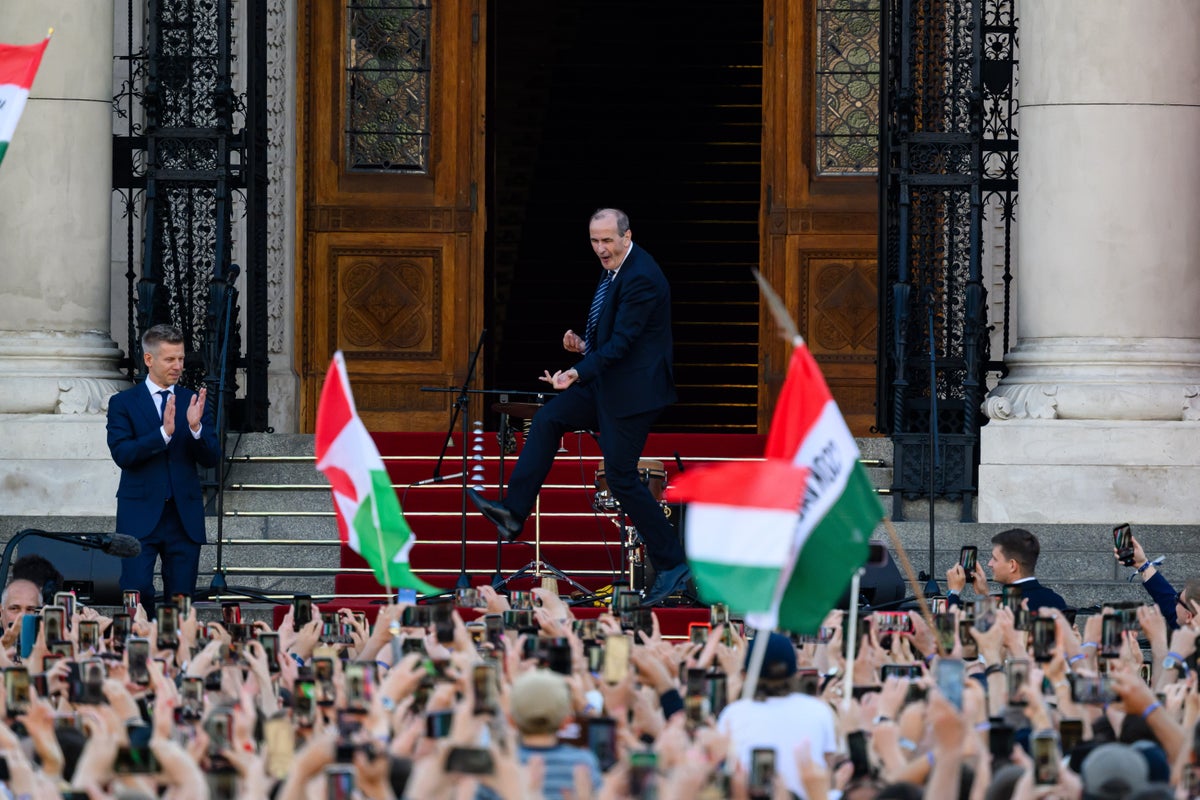
The intersection of medical professionalism and populist political theater represents a calculated strategy for voter engagement within the Hungarian Fidesz administration. Peter Takacs, the State Secretary for Health, occupies a unique position where clinical credibility meets high-energy public performance. While traditional media focuses on the optics of his "dancing" or "air guitar" at political rallies, an analytical deconstruction reveals a sophisticated branding architecture designed to bridge the gap between technocratic policy-making and the emotive requirements of Viktor Orban’s political machine.
The Dual-Identity Framework of Modern Health Governance
Takacs operates within a binary identity structure. On one axis, he maintains the rigorous credentials of an NHS-trained physician and healthcare administrator. On the second axis, he adopts the persona of a populist Everyman. This duality solves a specific political problem: the inherent friction between a government’s need to implement complex, often unpopular healthcare reforms and the need to maintain a relatable, non-elitist image.
Axis 1: The Technocratic Foundation
The legitimacy of Takacs' office rests on his background as a former hospital director and his experience within the UK’s National Health Service (NHS). This professional pedigree serves as a "competency shield." When facing criticism regarding the structural deficiencies of the Hungarian healthcare system—such as physician shortages or aging infrastructure—Takacs utilizes his medical background to frame his responses as pragmatic rather than political.
Axis 2: The Performative Populist
The viral instances of Takacs dancing or playing air guitar are not spontaneous lapses in decorum; they are strategic assets. Within the Fidesz communication ecosystem, these actions serve three primary functions:
- Humanization of the State: They dismantle the perception of the "distant bureaucrat."
- Cultural Signaling: By engaging in rock and roll aesthetics, he signals an alignment with a specific generation of voters who value traditional "rebellion" within a conservative framework.
- Media Diversion: High-visibility performances create a "noise floor" that often outweighs technical policy debates in public discourse.
Structural Pressures on the Hungarian Healthcare System
To understand why Takacs’ persona is necessary, one must quantify the environment he manages. The Hungarian healthcare system operates under a single-payer model through the National Health Insurance Fund (NEAK). The system faces a specific set of variables that create a "Efficiency Gap":
- Human Capital Flight: A significant percentage of Hungarian-trained doctors migrate to Western Europe, specifically Germany and Austria, where salaries are $3 \times$ to $5 \times$ higher.
- Infrastructure Ageing: A centralized procurement model that often results in bottlenecks for local hospital maintenance.
- Demographic Load: An aging population that increases the demand for chronic care management while the tax-paying workforce shrinks.
Takacs’ role is to manage the public’s perception of these systemic pressures. By positioning himself as a "doctor of the people" rather than a "minister of the system," he shifts the accountability of service failures away from the political executive and onto the "complexities of the transition."
The NHS Variable: Expertise Transfer and Branding
Takacs’ tenure in the NHS is frequently cited as a badge of quality. From a strategy perspective, this serves as an appeal to authority. The NHS, despite its own internal crises, remains a global benchmark for universal healthcare. By citing this experience, Takacs implies that his reforms are based on international best practices.
However, the application of NHS-style centralization in Hungary carries different implications. In the UK, the NHS operates with a high degree of clinical independence. In Hungary, healthcare reform under Takacs has trended toward increased state control over hospital management and physician contracts. The NHS "brand" provides the necessary cover for these centralization efforts, framing them as "standardization" rather than "consolidation of power."
The Cost Function of Performative Leadership
There is a measurable trade-off in the use of high-energy, performative leadership in a technical role like health. While it builds political capital, it can erode institutional trust among the professional class (doctors and nurses).
The Trust Equation
Professional trust is calculated by the consistency between public statements and resource allocation. If the "dancing minister" persona is perceived as a substitute for addressing the $1.2 billion (USD) debt held by Hungarian hospitals, the strategy reaches a point of diminishing returns.
- Internal Audience (Medical Professionals): This group requires data-driven solutions to staff shortages and equipment deficits. For them, performative optics can be interpreted as a lack of seriousness regarding the gravity of the sector’s collapse.
- External Audience (Voters): This group prioritizes relatability and the perception that "someone like us" is in charge. For them, the dancing is a signal of vitality and accessibility.
Analyzing the "Air Guitar" Rally Logic
The specific choice of "air guitar" at rallies is a semiotic tool. Unlike the polished, often sterile presentations of Western European health ministers, Takacs’ choice of a "rocker" aesthetic aligns with the Fidesz narrative of being "freedom fighters." It suggests that while he is part of the establishment, he has not been "tamed" by it.
This creates a specific psychological tether with the voter. It suggests a high level of Authenticity Projection. In an era of AI-generated messaging and hyper-curated political images, the "messy" energy of a dancing minister feels authentic to a specific demographic. This authenticity is the currency of the modern populist; it allows the leader to survive policy failures that would end the career of a more traditional, "stiff" politician.
The Mechanism of Policy Distraction
When the Hungarian Ministry of Interior (which oversees health) implements controversial changes—such as the 2023 restructuring of the on-call GP service—the media cycle is often dominated by Takacs’ latest public appearance. This is a classic "Red Herring" maneuver in communication theory.
- Step 1: Implement a complex, potentially unpopular structural change.
- Step 2: The minister engages in a high-visibility, "viral" social moment.
- Step 3: Digital algorithms and news cycles prioritize the visual content over the technical policy analysis.
- Step 4: The policy takes effect with minimal coordinated public pushback, as the opposition is forced to comment on the "behavior" of the minister rather than the "substance" of the law.
Strategic Forecast: The Sustainability of the Performer-Minister Model
The viability of Peter Takacs’ strategy depends on the stability of the Hungarian economy. Performative politics is a luxury of a system that can still provide basic services. As the "Efficiency Gap" in Hungarian healthcare widens, the "Dancing Minister" persona will face an inflection point.
The second limitation is the "Novelty Decay." Viral moments have a half-life. To maintain the same level of distraction or engagement, the performances must become increasingly eccentric. This creates a risk of "The Clown Trap," where the minister loses the "Competency Shield" entirely, and the professional credentials no longer offset the performative antics.
The government must now pivot from distraction to tangible outcomes. The centralization of the ambulance services and the digital health transition (EESZT) are the benchmarks by which Takacs will eventually be judged by his superiors. The air guitar provides the atmospheric cover, but the survival of the Hungarian health system requires a move from the stage to the laboratory.
The strategic play for Takacs involves leveraging his populist capital to push through a "Final Standardization" of the private-public healthcare divide. By framing the reduction of private practice options as a "pro-people" move against "elites," he can use his established persona to sell a move that essentially limits consumer choice but consolidates state power. The success of this move will determine whether he is remembered as a reformer who used theater to save a system, or merely as a distraction during its decline.