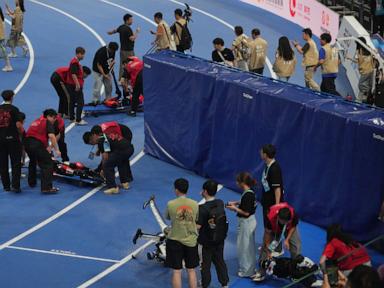
Every tech blog on the internet just lost its mind over a Chinese humanoid robot setting a new 100-meter sprint record at a showcase in Beijing. The headlines scream about athletic milestones, blinding speed, and the inevitable bipedal takeover of the track. Engineers are popping cheap champagne. Investors are wiring funds.
It is all a dangerous delusion.
I have watched venture capitalists throw billions of dollars into high-torque actuators and bipedal stabilization algorithms for a decade, and this sprint record is the peak of shiny-object misdirection. Making a two-legged machine sprint down a straight, perfectly paved 100-meter rubber track tells you precisely nothing about whether that machine can do anything useful in the real world. In fact, it tells me that the robotics industry is learning all the wrong lessons from biological evolution.
Stop celebrating the circus trick. The sprint record is a symptom of a deep architectural sickness in modern robotics.
The Kinematic Trap Of Bipedal Vanity
Let us dispense with the lazy consensus immediately. The mainstream tech narrative treats humanoid locomotion as a linear progression: first we crawl, then we walk, then we run, and eventually we do your laundry. This is cargo-cult engineering at its finest. Just because humans use two legs to move doesn't mean a commercial robot needs to run a 10-second split to be economically viable.
Biologically, running is an energy-storage problem mediated by tendons and elastic fascia. Mechanically, a bipedal robot sprinting is a thermal and electrical disaster. To achieve high-speed linear locomotion on two legs, engineers have to crank motor currents to terrifying levels, pack massive battery cells into a torso that acts as a swinging pendulum, and write brittle control loops that shatter the moment a pebble shifts under a foot.
I have seen labs burn through millions of dollars trying to damp the harmonic vibrations of a knee joint hitting peak torque at twenty miles per hour. And for what? So a PR team can release a slick thirty-second YouTube video that gets retweeted by people who have never written a line of embedded C++ or debugged a CAN bus error in their lives.
"A sprinting humanoid is an expensive solution to a problem that industrial designers solved a century ago with a set of caster wheels."
When you optimize a humanoid for sprinting, you degrade its utility everywhere else. You trade off payload capacity for lightweight carbon-fiber frames. You sacrifice battery runtime for peak acceleration. You build a glass cannon that can win a footrace in a sterile laboratory environment, but will fold like an accordion the moment a human warehouse worker drops a heavy pallet on its foot.
The Real World Does Not Run On Straight Lines
People look at a 100-meter dash and ask how long until these robots are running marathons or chasing criminals down alleys. This is asking the wrong question entirely. The real question is: why are we trying to force a humanoid form factor to solve tasks that demand zero bipedal agility?
Warehouses, construction sites, and disaster zones do not feature regulation running tracks. They feature greasy concrete floors, cluttered stairwells, hanging cables, dynamic obstacles, and unexpected loads.
Imagine a scenario where a humanoid robot is sprinting through a cluttered logistics facility at top speed, and a worker steps out from behind a shelving unit. A wheeled automated guided vehicle stops or swerves. A sprinting bipedal robot with high momentum and high-center-of-gravity control loops either careens into the worker or executes a crash-stop that fries its motor controllers and dumps its battery load.
Speed without contextual situational awareness is just high-velocity vandalism.
The obsession with human-like running speeds stems from a psychological need for validation. We want machines that look like us and move like us because we are narcissistic creators. We want the sci-fi movie to come true. But engineering reality is merciless. It does not care about your childhood dreams of a Terminator jogging beside you on the morning commute.
The Economics Of The Spec Sheet
Let us look at the hard economics. A humanoid robot capable of a high-speed sprint requires custom brushless motors, aerospace-grade gearboxes, and multi-sensor fusion arrays that cost more than a luxury sedan.
When you push those components to their thermal and mechanical limits to shave a tenth of a second off a sprint time, you exponentially accelerate wear and tear. Harmonic drives strip their teeth. Sealants fail. Thermal throttling kicks in after two runs.
If you deploy a fleet of these sprinting humanoids into a fulfillment center, your maintenance downtime will eclipse your operational uptime. The ROI equations crumble into dust. Business leaders love to quote high-level capabilities, but they forget that operational cost is a function of complexity. Every single joint degree of freedom you add to enable running is another point of catastrophic failure.
Industry veterans who know better are staying silent because hyping the robot helps the stock price. But I am telling you plainly: the companies building sprinting humanoids are building dead ends.
What To Build Instead
If you actually want to solve physical labor, throw out the track shoes.
- Embrace Hybrid Locomotion: Wheels where you can use them, legs only where you must step over debris. Stop trying to make a pure biped do the work of a forklift.
- Prioritize Payload Over Pace: A robot that walks slowly carrying five hundred pounds of structural steel is infinitely more valuable than a robot that runs like Usain Bolt while carrying a lunchbox.
- Design For Failure: Build cheap, modular limbs that can be swapped out by an un-trained worker in thirty seconds, rather than fragile masterpieces of aerospace engineering that require a cleanroom and a PhD to recalibrate.
The Beijing sprint record is a magnificent achievement in narrow control theory and hardware optimization. It is also completely irrelevant to the future of automation.
Stop cheering for the toy. Start demanding the tool.



:format(jpeg)/f/115220/700x1100/75eb3f2fde/15-minute-at-home-boxing-workout-for-beginners-infographic.jpeg)