The roar of a jet engine is a violence we have learned to accept. For decades, the soundtrack of urban ambition has been defined by decibels, by the violent churning of fossil fuels combusting in iron lungs, shaking apartment windows from Kowloon to Kennedy Town. We grew up shouting over the traffic. We accepted the haze clinging to the skyline as the unavoidable tax of progress.
Then came the quiet.
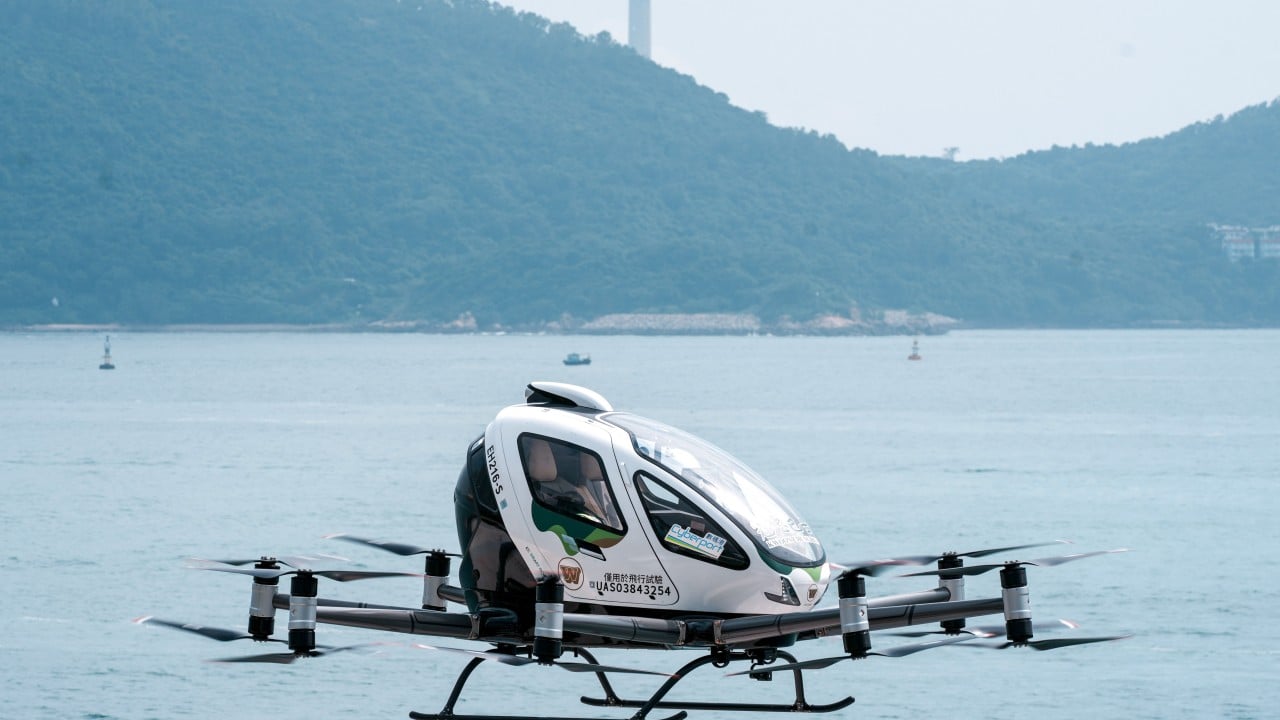
If you stood along the Victoria Harbour waterfront on that specific morning, you might have missed it entirely. There was no thunderous preamble. No frantic signal flares or dramatic countdowns echoing across the concrete basin. Instead, a sleek silhouette simply detached itself from the ground and rose. It moved with an eerie, almost insolent grace, cutting through the heavy maritime air with nothing more than the whir of distributed electric rotors.
It was an unmanned electric aircraft completing its maiden flight in Hong Kong.
And for those willing to watch closely, it was the sound of a century-old assumption finally fracturing.
The Weight of History
To understand why this small, pilotless vehicle matters, you have to remember how gravity used to dictate our lives. Heavy things stayed down. Light things flew, but they required miles of asphalt, gallons of explosive fuel, and crews of men wearing heavy boots and ear protection. Aviation was born in industry and baptized in military conflict. It was never meant to be gentle.
For generations, engineers tried to squeeze a cleaner future out of a dirty past. They built hybrid cars that still smelled like exhaust yards. They designed airplanes that burned slightly less kerosene while still requiring massive runways carved out of finite island geography. Hong Kong, a vertical metropolis squeezed between granite peaks and a restless sea, felt this spatial claustrophobia more acutely than almost anywhere else on Earth. There is simply no room left to pave.
Imagine living in a city where every square foot of earth is contested. Every road is choked. Every skyline is maxed out.
(Note: This spatial desperation is a hypothetical lens, yet it mirrors the daily reality of millions navigating the city's transit bottlenecks.)
When traditional aviation hit a wall, innovators looked upward not with more thunder, but with silence. This new breed of aerial vehicle does not care about runways. It cares about electricity. It feeds on batteries, storing electrons harvested from the grid rather than crude oil pumped from the earth. By removing the pilot from the cockpit, designers achieved something radical: weight reduction translated directly into extended range and payload capacity, turning a flying machine into a precise, autonomous tool.
The Human Element in the Cabin
Of course, an unmanned flight is a psychological hurdle.
We trust machines to route our bank transfers. We trust them to time our traffic lights and curate our newsfeeds. But stepping into an aircraft—or watching one fly overhead—without a pair of human hands on the yoke touches a primal nerve. We like our pilots to have skin. We like to imagine a human heart beating behind the windshield, sharing our fear of the drop.
I remember my first flight in a small commuter plane years ago. The engine stuttered over a mountain pass, and I watched the pilot’s knuckles turn white against the collective. That shared terror forged an unspoken bond between stranger and crew. You survived together.
Now, look up at the sky over Hong Kong. There are no knuckles. There is only a suite of redundant flight computers, LiDAR sensors, and inertial navigation systems talking to each other at the speed of light.
Is it unsettling? Absolutely. It requires a profound rewiring of trust. We are transitioning from trusting a person to trusting physics, code, and mathematics. Yet, step back and look at the alternative. Human error remains the leading cause of aviation accidents across the globe. Fatigue, distraction, vertigo—these are biological flaws. The electric bird over the harbour does not get tired. It does not look at its phone. It calculates wind shear with cold, unblinking precision.
The Physics of Quiet Ambition
To grasp how this aircraft stays aloft without waking the sleeping dragons of the city, look at the engineering philosophy at play. Traditional helicopters rely on a single, massive main rotor. If that fails, catastrophe follows. They are mechanically complex, maintenance-heavy beasts that roar with mechanical agony.
This new aircraft utilizes distributed electric propulsion. Imagine a cluster of smaller, independent rotors coordinated by a digital nervous system. If one motor stutters, the others instantly adjust their torque to compensate. It is biological redundancy applied to aerospace engineering.
The energy density of modern lithium-ion batteries has finally crossed a threshold where short-to-medium-range urban hopping is no longer science fiction. It is logistics. When the aircraft lifted off in Hong Kong, it proved that the dense, electromagnetic soup of a modern metropolis does not interfere with its guidance systems. It proved that vertical mobility can coexist with residential high-rises.
We are watching the birth of a utility, not a toy.
Beyond the Novelty
Skeptics will call it a rich man's stunt. They will point out that a single demonstration flight does not a transit network make. They are right. A maiden flight is only a promise.
The real test begins tomorrow, and the day after that, when the cameras leave and the engineers are left staring at telemetry data in fluorescent-lit rooms. Battery degradation, charging infrastructure bottlenecks, air traffic management integration, regulatory approvals—these are the unglamorous swamps where visionary ideas go to die. Hong Kong's civil aviation authorities are notoriously cautious, and for good reason. The airspace above the city is among the most congested and complex in the world, flanked by dense flight paths leading into international hubs.
Yet, necessity has always been Hong Kong's primary architect. A city built on reclaimed land and sheer human grit does not shy away from vertical solutions.
When you strip away the corporate press releases and the marketing jargon about smart cities, what remains is remarkably simple. People want to move. They want to connect. They want to do so without choking the air their children breathe.
The aircraft did not make a sound as it touched back down. The rotors spun down to a gentle halt, the carbon-composite frame cooling in the subtropical breeze. Down below, the taxis honked, the ferries churned the dark water, and the city kept arguing in a dozen different languages.
Nothing had changed. Everything had changed.