Salt crusts on the eyelashes. The wind off the Bering Sea does not merely blow; it strips the heat from your bones with a surgical, indifferent precision. Out here, a few dozen miles off the coast of Alaska, the water is a bruised, ink-black gray that refuses to reflect the sun.
Ask any longline fisherman who has hauled cod through the freezing sleet of November what he fears most, and he will not mention rogue waves or failing hydraulics. He will point a red-mittened finger toward the horizon. Toward the ghost ships.
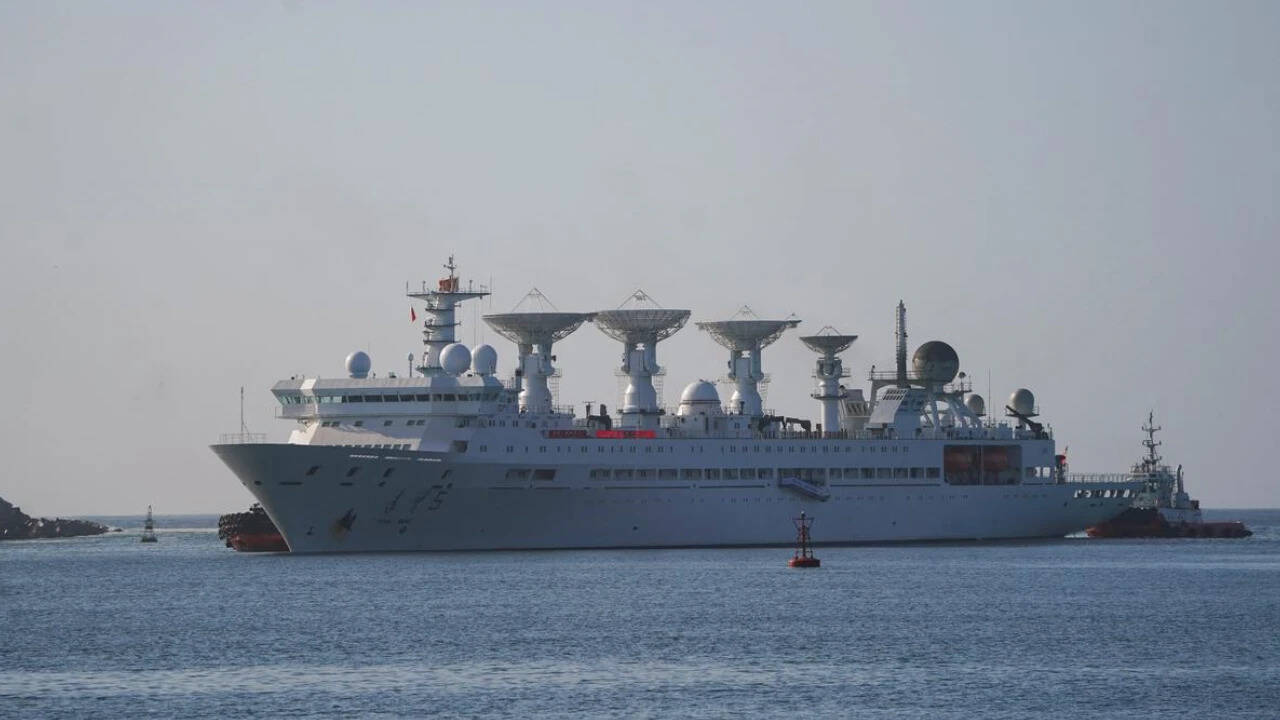
For months, the United States Coast Guard and naval analysts have tracked an unusual congregation in the high latitudes. They are sleek, painted in civilian white or utilitarian gray, riding low in the water. Officially, Beijing classifies them as scientific research vessels. Oceanographers, meteorologists, marine biologists mapping the deep. But the sensor masts tell a different story. They carry high-definition optical gear, acoustic arrays tuned to submarine frequencies, and deep-sea mapping suites capable of charting underwater topography down to the last fathom.
To understand why Washington is suddenly on edge, we must look past the bureaucratic language of dual-use technology. We must step onto the bridge of a cutter pitching through a midnight gale, watching a gray silhouette slip silently through international waters just beyond the American economic exclusion zone.
Consider what happens beneath the surface.
Water is a medium of secrets. Sound travels five times faster underwater than through air, bending through thermal layers, bouncing off trenches and abyssal plains. For decades, the Arctic was a natural fortress. A thick, shifting shield of multi-year pack ice that made submarine operations perilous, noisy, and easily monitored. The seabed was a chaotic labyrinth of underwater mountain ranges and canyons.
Now, the ice is thinning.
As the polar cap retreats, opening up new northern sea routes and exposing previously inaccessible seabeds, the Arctic is transforming from a frozen wasteland into the world's most contested high-stakes chessboard. Every fathom charted by a foreign vessel is a potential ambush point found. Every acoustic signature recorded by a trailing sensor array is a future advantage in an underwater game of cat and mouse.
This is the invisible stakes of the modern frontier. When a research vessel hovers over a strategic chokepoint near the Aleutian Islands, it is not collecting plankton samples. It is building a three-dimensional map of our vulnerabilities.
To grasp the magnitude of this shift, imagine you live in a house with a sturdy, iron-bolted front door. You feel safe. You sleep soundly. But while you were watching the door, someone spent three years mapping every crawlspace, every loose floorboard, and every unlatched window in your basement. They didn't break in. They didn't kick the door down. They simply walked around the perimeter with a blueprint in hand, noting every blind spot.
That is what is happening off the coast of Alaska.
The strategy is known in military circles as gray-zone warfare. It operates in the vast, blurry space between peace and open conflict. It uses civilian or quasi-civilian assets to achieve military objectives, daring the defender to react. If you chase them away, they cry foul, accusing you of harassing peaceful scientists. If you ignore them, they map your choke points, study your submarine transit lanes, and test your response times until the margins of error shrink to zero.
Let us be completely honest about why this feels so unsettling. We are creatures who trust the horizon. We look out at the ocean and assume the vastness protects us. We rely on distance as a buffer. But modern technology has compressed distance into a rounding error. A satellite overhead, an undersea drone skimming the shelf, a surface ship loitering outside territorial waters—together, they erase the insulation of geography.
The United States Coast Guard cutters patrolling these icy expanses are remarkably resilient, but they are chronically outnumbered and operating in one of the most unforgiving environments on Earth. When an adversary sends advanced survey platforms into America's backyard, they are sending a message written in cold ink. They are staking a claim to the future.
The warming of the north is not merely an environmental tragedy; it is a geopolitical tectonic shift. As the ice opens, the shortest maritime paths between Asia and North America become viable commercial highways. And where commerce flows, power follows. The nation that controls the underwater geography of the Arctic controls the strategic high ground of the twenty-first century.
We stand today on a precarious threshold. The ships off Alaska are turning slowly in the dark, their instruments humming, gathering data that will shape the balance of power for generations. They make no sound against the howl of the polar wind, but their presence echoes all the way to Washington.
The gray ships linger just beyond the invisible line of the horizon, waiting for the ice to clear completely.