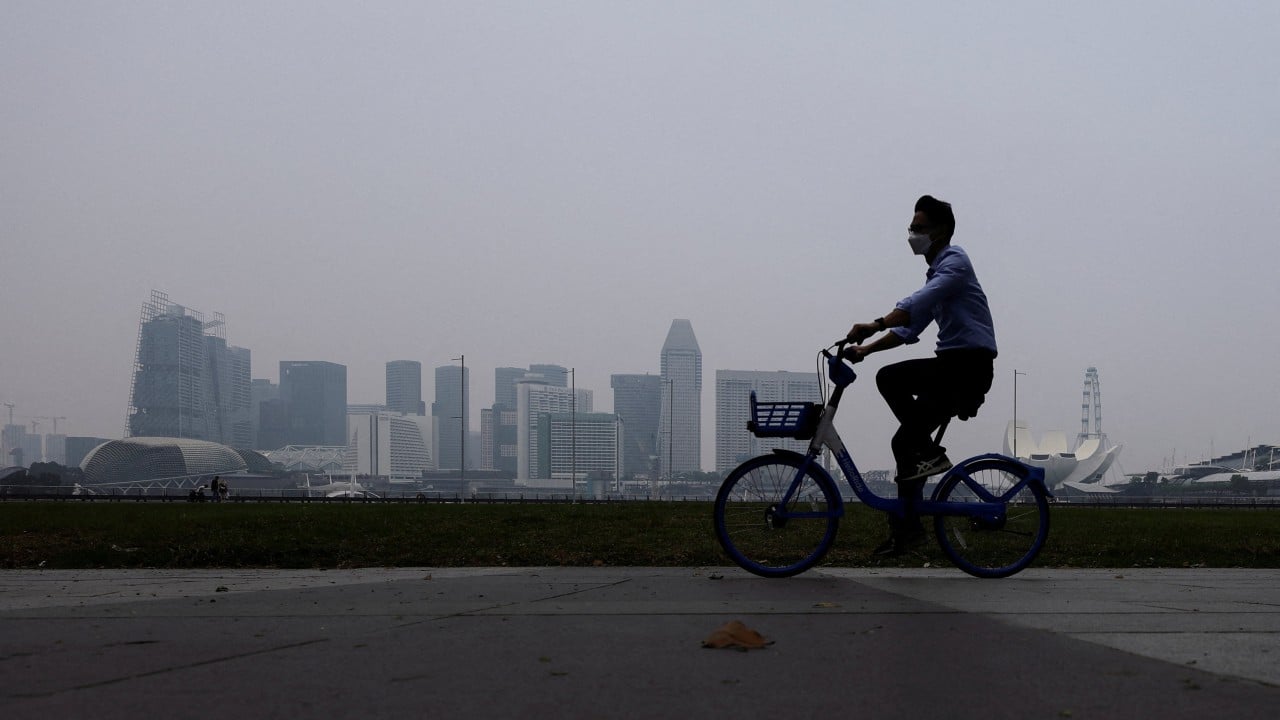
Every single time the wind shifts across the Malacca Strait, the national panic button gets jammed. The headlines write themselves with lazy predictability: Indonesian farmers are burning land, the PSI spikes into the red, masks reappear on Orchard Road, and office workers grumble about neighborly negligence. It is the ultimate comforting narrative. It places the blame squarely outside our borders, absolves local systems of any structural fault, and reduces a complex atmospheric equation to a simple story of smoke rolling in from Sumatra.
We have treated the transboundary haze as an external meteor strike for decades. That is a comforting fiction. It lets us ignore the uncomfortable reality that Singaporean urban vulnerability is an engineered product of our own zoning, density models, and interior sealing obsession. The smoke crosses the Strait, yes. But how it behaves once it hits our coastline, how our buildings absorb it, and how our public health policy reacts to it represents a massive institutional failure of local adaptation. Recently making waves in related news: Why Iceland Leaving Commercial Whaling Changes Everything for Japan.
Let us look at the mechanics of the lazy consensus. The standard argument runs like this: Indonesia fails to enforce slash-and-burn bans, the peatlands catch fire during the dry season, the southwest monsoon acts as a conveyor belt, and Singapore chokes.
This argument is factually correct in its raw components and entirely bankrupt in its strategic conclusion. Focusing solely on agricultural fires in Riau or Jambi misses the urban physics of a tropical metropolis built entirely around mechanical ventilation and glass facades. Additional details regarding the matter are detailed by NPR.
When the air quality index hits hazardous zones, the standard playbook deploys: distribute masks, advise the elderly to stay indoors, and issue stern diplomatic reminders to Jakarta. This approach treats an acute, recurring environmental baseline like a sudden thunderstorm. It assumes that if we just wait for the wind direction to flip, normalcy returns.
Normalcy is no longer a valid baseline.
The planetary climate system is shifting toward prolonged dry phases driven by El Nino oscillations. These peatland fires are not anomalies; they are permanent seasonal features of regional land use economics. If Indonesian slash-and-burn practices stopped tomorrow, shifting agricultural pressures, logging roads, and drainage canals would still leave millions of hectares of dried carbon sink primed for spontaneous combustion during severe droughts. Waiting for our neighbors to solve their structural agricultural economics so our air conditioning units can suck in pristine air is a strategy of wishful thinking.
We need to talk about how Singapore's built environment actually processes particulate matter.
Walk through any Grade-A commercial tower in Marina Bay during a severe haze episode. The glass skin gleams, the lobby smells faintly of artificial citrus, and the occupants tap away at laptops inside a hermetically sealed box. We praise this as high-tech resilience. It is actually a fragile monoculture.
Modern tropical architecture relies on centralized HVAC systems with standard MERV filters designed for dust and pollen, not sub-micron biomass smoke laden with polycyclic aromatic hydrocarbons. When ultra-fine particulates (PM2.5) blanket the island, standard building envelopes leak like sieves at the joints, curtain walls, and service shafts. Indoor air quality frequently mirrors outdoor toxicity within hours of a spike, despite the illusion of protection provided by tinted glass.
We have spent billions optimizing buildings for thermal cooling while treating air purity as an afterthought accessory managed by a few pleated paper filters shoved into a duct.
Contrast this with how public housing handles the crunch. HDB estates rely on natural cross-ventilation. It is a brilliant tropical design principle during normal months, slashing energy loads and keeping living spaces comfortable without air conditioning. The moment the haze arrives, that very design principle turns every flat into a passive smoke chamber. Residents are forced to slam their windows shut, trapping heat, driving up indoor carbon dioxide levels, and sweating through stagnant air just to avoid breathing carbon soot.
The choice presented to millions of residents is stark and unacceptable: bake in a stuffy box or inhale carcinogens with every breath.
This is where the public health apparatus stumbles. Official guidelines tell vulnerable populations to reduce physical exertion and stay indoors. This advice assumes indoor air is clean. It is rarely clean enough. Without hyper-localized indoor filtration mandates, residential air scrubbing units, and positive-pressure clean rooms in public spaces, telling people to stay inside during a severe haze event is like telling someone to stay inside a sinking ship because the water isn't as deep down in the hold.
Let us dismantle another sacred cow: the Pollutant Standards Index itself.
The PSI is an administrative convenience designed for broad public communication, not granular biological safety. It aggregates sulfur dioxide, nitrogen dioxide, carbon monoxide, ozone, and PM10 into a single number. But during Indonesian land fires, the primary villain is fine particulate matter, specifically PM2.5 and ultrafine particles under 1 volume micron.
When the PSI sits at a deceptive 120, the particle composition is vastly different from an industrial pollution spike in an urban core. Biomass smoke contains uncombusted organic compounds, heavy metals absorbed from soil, and acidic aerosols that trigger systemic inflammatory responses far beyond what standard mass concentration measurements capture. By relying on a crude, lagged index, policymakers react too slowly to micro-environmental shifts. Schools stay open when children are already breathing micro-toxins that cross the blood-brain barrier. Construction continues when outdoor laborers are absorbing chemical loads equivalent to smoking multiple packs of cigarettes a day.
We treat the haze as a visibility problem when it is a cellular toxicity crisis.
What does a real operational playbook look like? It starts by abandoning the fantasy that we can control regional weather or diplomatic outcomes in Sumatra.
First, the building code must undergo a radical rewrite. Every commercial development and public housing block built from this year forward should feature centralized micro-filtration infrastructure capable of maintaining positive indoor pressure during environmental crises. Positive pressure is the technical secret weapon: by forcing filtered air outward through building seams, you prevent toxic outdoor air from leaking inside. Hospitals use this for operating theatres; there is no technical reason modern offices and high-density residential blocks cannot adopt the same standard.
Second, retrofit the existing HDB stock. Instead of distributing disposable N95 masks that sit in landfills and fit poorly on children and the elderly, the state should subsidize decentralized, high-efficiency particulate air filtration systems in every single household, treated as critical public health infrastructure on par with clean water piping.
Third, rewrite labor laws for outdoor workers. The current system relies on voluntary guidelines and employer discretion during high-PSI events. Discretion always bends toward productivity deadlines. When particulate counts cross critical toxicity thresholds, outdoor construction, port operations, and delivery logistics must face mandatory, legally enforced halts with state-backed wage insurance. Treating human lungs as expendable collateral for GDP growth is an economic failure disguised as pragmatism.
We can no longer afford the luxury of pointing across the Malacca Strait and shaking our fists at distant fires while our own urban air systems remain vulnerable to the first shift of the wind. The smoke is a symptom of a regional climate reality that is here to stay. How we filter our air, build our homes, and protect our people determines whether Singapore remains a livable global hub or a choked glass cage waiting for the next gust.
Stop waiting for the wind to change. Fix the walls.