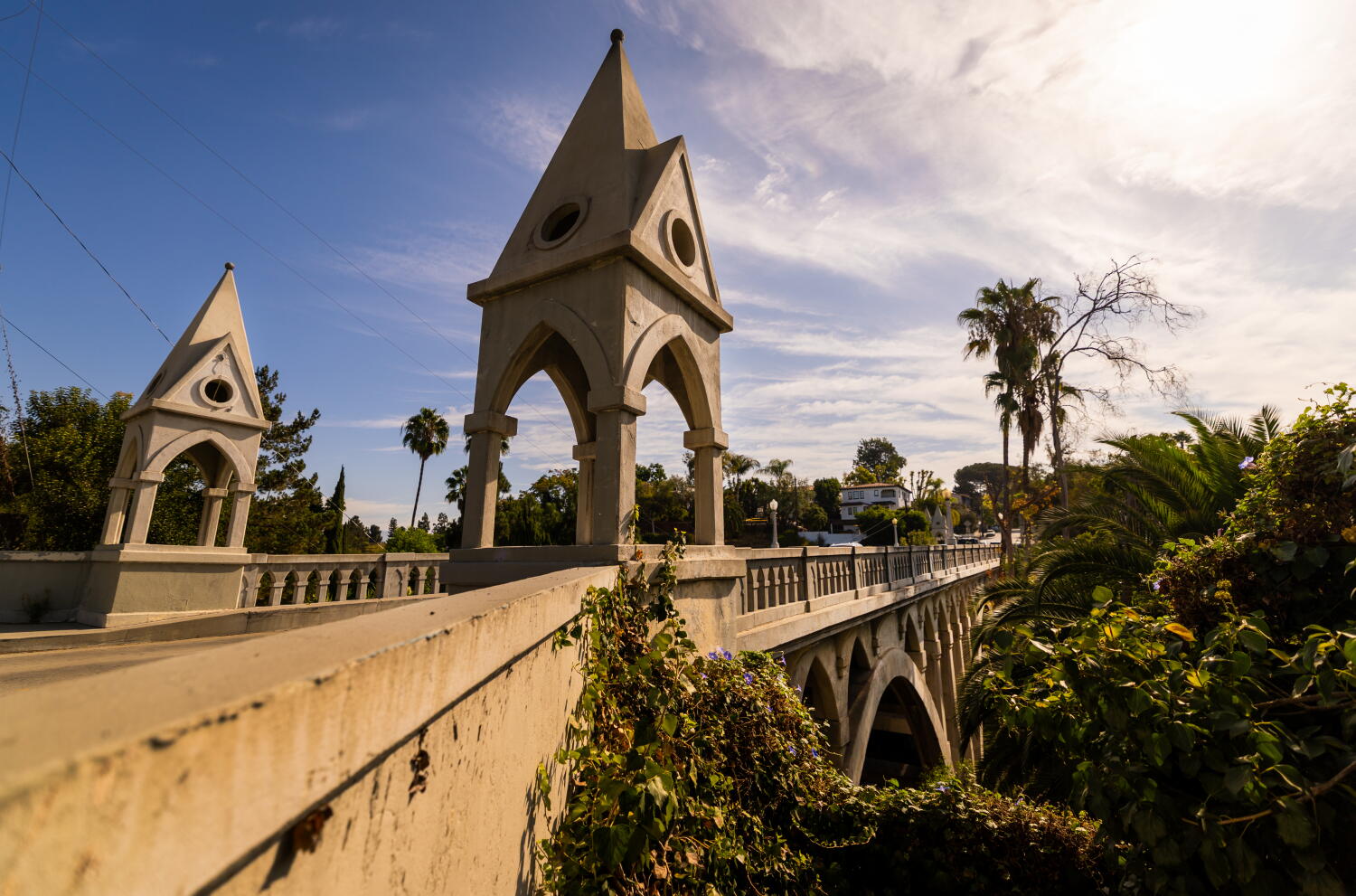
Every local architecture blog and nostalgia peddler on the internet is currently weeping tears of joy over a piece of municipal masonry hitting triple digits. The Shakespeare Bridge in Los Angeles is turning one hundred years old, and the civic commentariat is losing its collective mind. They want you to gaze up at its Gothic arches, quote the sonnets, and marvel at how a chunk of reinforced cement in the middle of a Silver Lake residential pocket somehow constitutes a poetic masterpiece.
It is absolute noise.
I have spent decades examining municipal planning failures and structural self-deception across major metros. I have watched cities blow millions on cosmetic heritage preservation while real structural decay lurks beneath the surface. When a bridge built in nineteen twenty-six gets treated like a romantic comedy protagonist, we have officially lost the plot. Let us tear down the sentimental gloss and look at what this structure actually represents: a triumph of historicist cosplay that solved a traffic problem the city immediately outgrew, wrapped in a Gothic costume that has zero architectural connection to the actual topography of Southern California.
The Myth of Organic Urban Poetry
The lazy consensus floating around cultural commentary is that Los Angeles lacks history, so we must cling desperately to whatever old concrete remains, wrapping it in literary romance to compensate for our lack of medieval cathedrals. The Shakespeare Bridge gets framed as a rare survivor, a touchstone of civic soul.
This argument collapses the moment you examine the engineering and the real estate mechanics of nineteen-twenties Los Angeles. Charles W. Jones did not design this bridge because he was channeling Elizabethan drama. He built it because real estate developers needed a way to bridge a ravine so they could sell overpriced lots in the Ivanhoe tract. The Gothic detailing—the Tudor arches, the buttresses, the faux-castle parapets—was purely ornamental marketing dressing applied to a standard municipal utility project. It was a billboard made of aggregate and rebar.
Calling it a sonnet in stone is an insult to actual poetry and a misunderstanding of urban development. It is an aesthetic lie. Gothic architecture evolved in Northern Europe to solve structural lighting and vertical thrust problems in wet, overcast climates where stone was abundant and timber was scarce. Slapping flying buttresses onto a bridge spanning a dry Los Angeles wash in a Mediterranean climate is pure structural drag. It is costuming. If a developer built a faux-Tudor strip mall today, critics would mock it as suburban tackiness. But give a piece of concrete a hundred years of exhaust fumes and suddenly everyone pretends it is Westminster Abbey.
The Real Cost of Preservation Theatre
We need to talk about the opportunity cost of treating century-old municipal infrastructure as sacred relics. When the Los Angeles Bureau of Engineering spends hundreds of thousands of dollars on specialized seismic retrofitting and historic preservation guidelines to maintain decorative turrets, that money is not going toward modern transit safety, pedestrian corridors, or climate-resilient urban planning.
Historic preservation in Los Angeles often functions as a zoning preservation tool for affluent neighborhoods. Silver Lake residents do not fight for the Shakespeare Bridge because they care about structural engineering history. They fight for it because maintaining its historic status acts as a regulatory anchor, preventing major density shifts, modern arterial redesigns, or any serious rethinking of how that corridor handles mobility. It is aesthetic NIMBYism disguised as cultural stewardship.
Let us look at the actual data on structural interventions. The bridge underwent major seismic upgrades in the nineties because it was structurally vulnerable to ground shaking. Engineers had to core through historic concrete, inject epoxy, and insert hidden steel reinforcement to keep the thing from collapsing onto Franklin Avenue during an earthquake. We spent a fortune keeping a faux-castle upright while actual modern transit infrastructure across the city crumbles from deferred maintenance.
The Architectural Identity Crisis We Refuse to Own
Why are we so terrified of owning our actual architectural history? Los Angeles was never a Gothic European city. It is a sprawling, modernist, modernist-adjacent auto metropolis shaped by light, concrete, vernacular modernism, and mid-century suburban expansion. When we force European historicism onto Southern California landscapes, we engage in a form of geographic self-loathing.
The most compelling architecture this city ever produced came from the mid-century modernists—John Lautner, Rudolf Schindler, Richard Neutra—who embraced the actual climate, the light, the topography, and the materials of the region. They did not try to hide a bridge behind fake castle walls. They built with glass, steel, and raw forms that spoke the truth of their environment.
The Shakespeare Bridge represents the exact opposite: an insecure colonial cringe that whispered we needed to fake European pedigree to be taken seriously as a real city. Celebrating its centennial without critiquing that foundational insecurity is intellectual laziness.
I have watched companies and cities waste fortunes polishing dead heritage projects while ignoring the structural evolution happening right beneath their noses. You can slap all the romantic adjectives you want onto a hundred-year-old viaduct, but at the end of the day, it is a transit link that needs to move cars and pedestrians safely without draining public coffers for cosmetic vanity.
Stop writing poetry about civil engineering. Start demanding infrastructure that actually serves the city we are today, not the medieval fantasy a nineteen-twenties real estate speculator wished he lived in.