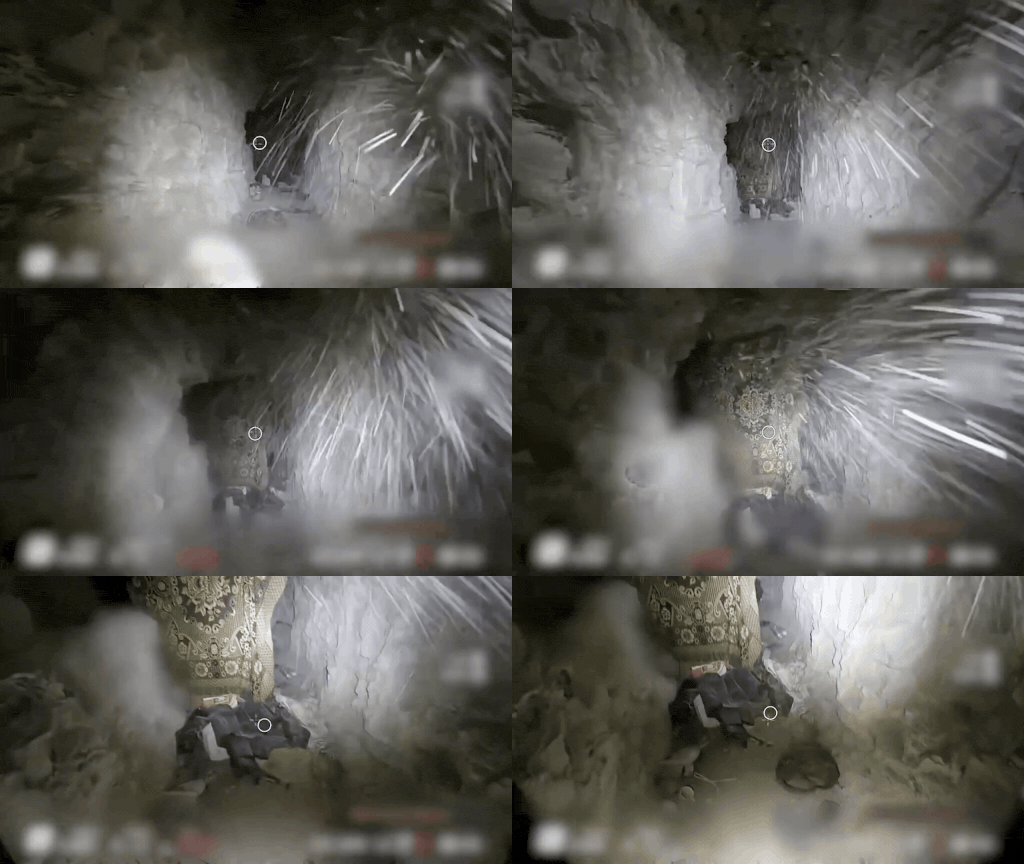
The recent visual intelligence released by the IDF documenting Hezbollah’s underground living quarters necessitates a shift from viewing tunnels as mere transit routes to recognizing them as integrated combat-sustenance systems. These structures are not temporary hideouts; they are the primary nodes of a persistent presence doctrine designed to nullify aerial supremacy and electronic surveillance. By moving the logistical tail and the command-and-control head entirely below the surface, Hezbollah has transitioned from a guerilla force to a subterranean conventional military.
The Triad of Subterranean Sustainability
To maintain a prolonged military presence under high-intensity bombardment, a tunnel network must solve three fundamental engineering and psychological constraints: atmospheric regulation, caloric logistics, and waste management. The footage reveals that Hezbollah’s architecture addresses these via a permanent infrastructure model rather than the "spider holes" seen in historical insurgencies. If you found value in this piece, you might want to look at: this related article.
- Atmospheric Maintenance and Power Generation: Subterranean environments are naturally hypoxic and prone to humidity-driven equipment failure. The presence of tiled walls and electrical wiring indicates a stabilized environment where air filtration systems and independent power grids—likely powered by concealed external venting or deep-cycle battery arrays—prevent the degradation of both personnel and ordnance.
- Caloric Density and Storage: The kitchens and food storage areas documented indicate a requirement for 30-to-90-day autonomy. This suggests a supply chain optimized for non-perishable, high-calorie intake that does not require open-flame cooking, which would consume oxygen and create thermal signatures detectable by modern multi-spectral sensors.
- Human Factors and Force Preservation: The inclusion of showers and organized sleeping quarters is a deliberate strategy to combat "tunnel rot"—the psychological and physiological breakdown of soldiers in lightless, cramped conditions. By mimicking surface-level hygiene and rest standards, the command structure ensures that when troops emerge for kinetic engagement, their combat effectiveness remains high.
The Physics of Depth and the Failure of Traditional ISR
Intelligence, Surveillance, and Reconnaissance (ISR) platforms struggle against these networks because they utilize the Earth’s crust as a natural electromagnetic and physical shield. The efficacy of this shielding is governed by the material density of the overburden.
- Signal Attenuation: Radio frequency (RF) communication from within these tunnels is impossible without external antennas or fiber-optic relays. The IDF’s discovery of wired communication lines confirms that Hezbollah utilizes a "closed-loop" network, making signals intelligence (SIGINT) nearly impossible from the air.
- Thermal Masking: The thermal signature of a platoon of soldiers is approximately 3,000 to 5,000 watts of heat energy. In a surface environment, this is a beacon for infrared sensors. At a depth of 20 meters, the soil acts as a heat sink, dissipating the signature until it is indistinguishable from the surrounding terrain.
- Kinetic Hardening: The use of reinforced concrete and tiling serves a dual purpose. While it improves habitability, it also provides structural integrity against the overpressure of near-miss bunker-buster munitions. The energy required to collapse these structures scales exponentially with depth, forcing an adversary to use larger, more expensive precision-guided munitions (PGMs) for every single node in the network.
Operational Logic of the Integrated Living Quarter
The decision to place living quarters in such close proximity to firing positions and rocket caches follows a strict logic of "Time-to-Combat" (TTC). In traditional guerilla warfare, fighters mobilize from civilian areas to a launch site, creating a window of vulnerability. In Hezbollah’s subterranean model, the TTC is effectively zero. For another look on this development, refer to the latest coverage from NBC News.
The fighter lives at the point of launch. This creates a tactical bottleneck for an attacking force: the neutralization of the weapon system requires the neutralization of the entire subterranean living complex. This integration forces the IDF into a "clear and hold" mission profile that is significantly more resource-intensive than "search and destroy."
Structural Vulnerabilities of the Networked Tunnel
Despite the advantages of subterranean persistence, this doctrine introduces specific systemic risks that can be exploited through non-kinetic and specialized kinetic means.
The first critical vulnerability is the Ventilation-Power Nexus. Every underground system requires an exchange of gases and a rejection of heat. These intake and exhaust points are the "Achilles' heel" of the complex. If these nodes are identified through high-resolution thermal mapping or acoustic sensors, the entire living quarter becomes a deathtrap. Without active ventilation, the accumulation of CO2 and the rise in ambient temperature from electrical equipment render the space uninhabitable within hours.
The second limitation is Egress Rigidity. A fighter living 20 meters underground is safe but immobile. Their movement is dictated by pre-constructed corridors. By mapping the exit points, an adversary can transform the tunnel from an asset into a cage. The footage showing narrow corridors and heavy doors suggests that rapid evacuation is not the priority; rather, the intent is to hold ground until the structure itself is compromised.
The Cost-Exchange Ratio of Subterranean Containment
Analyzing this from a strategic consulting perspective, we must look at the cost-exchange ratio. It costs significantly less to dig a tunnel with civilian-grade machinery than it does to destroy one with military-grade munitions.
- Construction Costs: Estimates for reinforced tunnel construction in this region range from $200 to $500 per linear meter.
- Destruction Costs: A single GBU-28 or similar deep-penetration bomb costs upwards of $300,000, excluding the flight-hour costs of the delivery platform.
This creates a fiscal asymmetry. Hezbollah is essentially forcing the IDF to spend millions of dollars to destroy infrastructure that costs a fraction of that to build. The strategic objective of the tunnel is not just tactical protection; it is the exhaustion of the adversary’s precision munition stockpiles and defense budget.
Future Implications for Urban and Border Warfare
The sophistication of these living quarters signals the end of the "border fence" as an effective security measure. When the theater of war moves into the third dimension (depth), the surface-level geography becomes secondary.
We are moving toward a reality where territorial control is measured volumetrically rather than by surface area. To counter this, military forces must invest in seismic sensor arrays and autonomous subterranean drones capable of navigating GPS-denied environments. The "mastery of the subsurface" is now the primary requirement for achieving long-term stability in the region.
The presence of domestic amenities—kitchens, showers, and tiled rooms—confirms that the subterranean space is no longer a transitional area. It is the primary theater of operations. Any strategy that treats these tunnels as secondary to surface-level engagements will fail to account for the core of Hezbollah’s current military capacity.
The strategic play for any force facing this architecture is the transition from "bombing the tunnel" to "severing the life support." Neutralizing the surface-level infrastructure that feeds electricity and air to these depths is more efficient than attempting to collapse the reinforced structures themselves. Disruption of the atmospheric equilibrium within the tunnels is the only way to force an entrenched subterranean enemy to the surface without engaging in a high-casualty underground war of attrition.