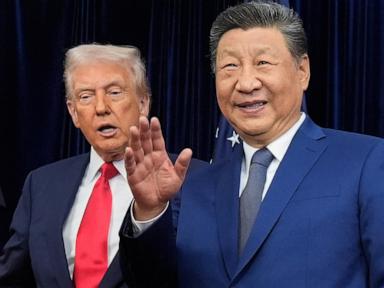
The corporate media is currently obsessed with the "high-stakes" summit in Beijing. They’re painting a picture of two titans clashing over the Strait of Hormuz, the fate of Taiwan, and the specter of a trade war that never actually ended. It’s a compelling narrative for clicks, but it completely misses the structural reality of the 2026 landscape.
Most analysts are treating the Iran conflict as a "complication" that delayed the summit. They are wrong. The war in Iran is the greatest gift both Donald Trump and Xi Jinping could have received. It provides the perfect geopolitical smoke screen to hide the fact that both leaders are currently failing to solve their internal structural crises.
The Iran War is a Mutual Exit Strategy
Traditional pundits argue that the U.S. blockade of the Strait of Hormuz has "weakened" Trump’s hand because he needs China to pressure Tehran. This is a surface-level delusion.
In reality, the energy crisis triggered by the blockade allows Trump to bypass the typical "inflation is the President's fault" narrative and blame a foreign "axis of evil." Simultaneously, it gives Xi Jinping the perfect excuse for China’s sluggish industrial output. If the global economy stumbles, they point at the Strait. If the summit produces nothing but a "joint statement of concern," they blame the "unstable regional security environment."
For Trump, the Iran conflict justifies a massive pivot back toward fossil fuel dominance and domestic energy protectionism. For Xi, it justifies the aggressive hoarding of critical minerals—a move he successfully used to force Trump into a tariff truce back in Busan. Neither leader wants the war to end tomorrow; they want the leverage of the war to persist until the November midterms and China's next five-year planning cycle are secured.
The Taiwan "Sacrifice" is Already Priced In
The most tired trope in the current coverage is the "will he or won't he" speculation regarding Taiwan. Pundits fear Trump might trade Taiwan’s security for a few million tons of soybeans or a Boeing order.
Here is the truth: The trade has already happened in everything but name.
When the administration delayed the $11 billion arms package to Taipei and allowed Nvidia to ship H200 chips to Beijing, the signal was sent. China doesn’t need to "invade" Taiwan to win; they just need to prove that the U.S. security umbrella is conditional and transactional. By shifting the conversation from "defense of democracy" to "negotiating arms sale schedules," the U.S. has already moved the goalposts into China’s favor.
Xi Jinping knows that Trump views Taiwan not as a strategic bastion, but as a depreciating asset. In Beijing, the goal isn't to force a confrontation; it’s to secure a rhetorical shift—moving from "not supporting" independence to "opposing" it. If Trump gives them that one word, he gets his "victory" in the form of agricultural purchases that appease the Midwest, and Xi gets a century-defining diplomatic concession for the price of a few cargo ships of grain.
The AI Safety Dialogue is a Cartel, Not a Treaty
Watch closely as they announce a "Historic AI Safety Framework." The media will herald this as a responsible move to prevent Anthropic’s Mythos model or Beijing’s equivalent from going rogue.
Don't buy it. This isn't about "safety." It’s about incumbency.
Both Washington and Beijing are terrified of decentralized, open-source AI that they cannot monitor or tax. This proposed "safety dialogue" is actually the beginning of an AI Cartel. By agreeing on "safety standards," both nations can effectively outlaw any smaller competitors (or smaller nations) from developing high-compute models under the guise of "global security."
- The Mythos Pretext: Claims that models can find "cyber-defense weaknesses" are the new "weapons of mass destruction." They are used to justify a closed-door monopoly.
- The Chip Swap: China wants the export controls on H200s and Blackwell-class chips lifted. Trump wants China to stop its "critical mineral" blackmail. The "AI Safety" talks provide the neutral ground to facilitate this trade without looking like a retreat for either side.
Why the "Upper Hand" Narrative is Flawed
The Council on Foreign Relations and other think tanks claim China has the "upper hand" because of their critical mineral dominance. I’ve seen this play out in the private sector for a decade: when one side has a monopoly on raw materials, the other side simply changes the chemistry of the end product.
The U.S. isn't "trapped" by China's rare earth magnets; it’s trapped by its own slow regulatory environment for domestic mining. Xi knows his leverage is temporary. Every month the U.S. feels the squeeze is another month that accelerates the decoupling of the North American supply chain. Xi isn't sitting in a position of permanent strength; he’s playing a high-stakes game of "catch me if you can" before the U.S. and its allies (Japan, Australia, India) build the infrastructure to ignore him entirely.
Stop Asking "Who Wins?"
The question is wrong. The summit isn't a game of chess; it’s a co-authored press release.
Trump needs a "win" to distract from the mounting costs of the Iran war. Xi needs "stability" to fix a domestic economy that is shivering under the weight of a property crisis and a shrinking workforce.
They aren't going to Beijing to solve the world's problems. They are going there to agree on how to divide the world's problems so they can both keep their jobs.
Expect a "Board of Trade" to be announced—a bureaucratic nothing-burger designed to give the illusion of oversight on purchase commitments that won't be met. Expect a "hotline" for the Strait of Hormuz that will be used primarily to coordinate which tankers get through and which don't.
The real disruption isn't what happens at the table. It’s the fact that for the first time in eighty years, the U.S. is no longer pretending to lead the "liberal international order." It’s just another player in a raw, mercantilist power struggle. And in that world, the only thing that matters is who owns the magnets and who owns the chips. Everything else—Taiwan, Iran, the "safety" of humanity—is just a line item on a ledger.
The summit will be called a "12 out of 10" success. Just remember: in a room where both people are lying, the one who speaks the loudest is usually the one who lost the most.
This video provides a baseline of the conventional media narrative regarding the summit, which is necessary to understand exactly what the contrarian perspective is dismantling.