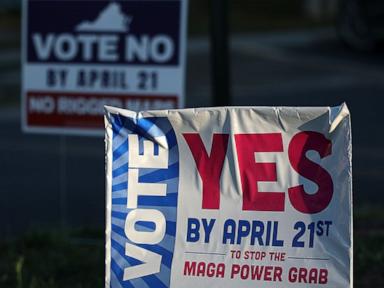
The outrage machine is currently dialed to eleven. Virginia Democrats are sprinting to the Supreme Court, screaming about the "nixing" of a redistricting vote, and the media is happy to frame this as a life-or-death struggle for the soul of the Commonwealth. It makes for great fundraising emails. It makes for gripping headlines. It is also a complete misunderstanding of how power actually functions in a post-census vacuum.
We are being sold a narrative of "suppression" when the reality is a story of procedural incompetence and the desperate clawing for a map that should have been settled years ago. The lazy consensus suggests that a single vote—or the lack thereof—is the pivot point of democracy. It isn't. The pivot point is the inability of partisan actors to accept that the clock eventually runs out.
The Myth of the Stolen Map
The competitor narrative suggests that a blocked vote is a stolen election. I’ve spent two decades watching political operatives operate in the dark, and here is what they won’t tell you: everybody loves a stalemate until they lose.
When the redistricting commission failed to produce maps, the responsibility didn't vanish. It moved. The "independent" veneer of the process was always a thin coat of paint over a structural nightmare. By the time this reached the courts, the "will of the people" had already been filtered through several layers of partisan gridlock.
The argument currently being shoved toward the Supreme Court isn't about fairness. It’s about timing. It is a Hail Mary pass thrown from the twenty-yard line with zero seconds on the clock. You don't get to ignore the rules of the game for three quarters and then demand an extra period because you don't like the score.
Why Procedural Purity is a Trap
People ask, "Shouldn't every vote count?"
Of course. But in the world of high-stakes redistricting, "procedural purity" is often used as a weapon to delay the inevitable. If you can't get the map you want, you sue to stop the map you have. The Virginia Democrats are arguing that a specific vote was improperly bypassed. What they are actually doing is trying to reset a clock that has already struck midnight.
- The Ghost of 2021: The delay in census data already pushed the Commonwealth into a constitutional gray area.
- The Commission Failure: The bipartisan commission was designed to fail. It was a compromise that satisfied nobody and ensured that the judiciary would eventually have to do the heavy lifting.
- The Judicial Backstop: When the courts take over, the "vote" the Democrats are seeking becomes a vestigial organ. It’s a phantom limb.
The Court is Not Your Campaign Manager
The Supreme Court is often treated as a Super-Legislature. It’s a convenient fiction. When parties petition the high court to intervene in state-level redistricting disputes, they are asking for a political lifeline, not a legal correction.
I’ve seen state parties blow millions on litigation that they knew was a lost cause, simply because they needed to show their donor base they were "fighting." This isn't strategy; it's theater. The Supreme Court has shown an increasing—and frankly, refreshing—reluctance to micro-manage the electoral mechanics of states that can't get their own house in order.
The logic being used by the petitioners relies on a hyper-technical reading of state law that ignores the broad reality of administrative necessity. If the Court forces a re-vote or a map overhaul now, they aren't "saving" the vote. They are guaranteed to create administrative chaos that will lead to more lawsuits, more confusion, and a legitimate crisis of confidence in the next election cycle.
The Nuance Everyone Missed
The real story isn't that a vote was "nixed." The story is that the vote became irrelevant the moment the commission missed its constitutional deadlines.
In a functioning system, deadlines have consequences. In the Virginia saga, the Democrats are arguing that deadlines are optional suggestions, provided you have a good enough reason to ignore them. But if deadlines are optional for one side, they are optional for both. That is a recipe for a permanent state of litigation where no election result is ever truly final.
Imagine a scenario where every local council or school board could sue to overturn a redistricting plan three weeks before an election because of a "procedural hiccup." We wouldn't have a democracy; we’d have a perpetual deposition.
Stop Asking for Fairness and Start Asking for Finality
The most common question in my inbox right now is: "How do we make redistricting fair?"
It’s the wrong question. "Fairness" is a subjective metric used by whichever side is currently losing. The question we should be asking is: "How do we make redistricting final?"
The current obsession with the Supreme Court intervention is a symptom of a deeper rot. We have reached a point where the losers of a process refuse to accept the outcome, labeling every defeat a "threat to democracy." This isn't just a Democrat problem or a Republican problem; it’s an institutional failure.
- The Cost of Uncertainty: When maps are in flux, candidates don't know where to run. Donors don't know where to give. Voters don't know who represents them.
- The Judiciary's Burden: By forcing the courts to draw lines, we are politicizing the one branch of government that is supposed to remain detached.
- The Illusion of Independence: There is no such thing as a non-political map. Every line drawn benefits someone.
The "contrarian" truth is that a slightly "unfair" map that is finalized and understood is infinitely better for a republic than a "perfect" map that is tied up in court for three election cycles.
The Brutal Reality of the Virginia Filing
The filing to the Supreme Court is a PR stunt. It’s an attempt to manufacture a "stolen" narrative for the next cycle. If the Court denies the petition—which they likely will, based on the principle of Purcell (the idea that courts shouldn't change election rules too close to an election)—the Democrats will scream about a "conservative takeover."
If the Court miraculously grants it, they will have set a precedent that will be used by every GOP operative from Tallahassee to Boise to disrupt future elections.
Be careful what you wish for. You might just get the intervention you asked for, and you will hate the way the next guy uses it.
The Supreme Court isn't there to fix your inability to win a commission vote. They aren't there to bail out a party that couldn't navigate its own state’s constitutional requirements. They are there to interpret the law, and the law usually favors the side that actually follows the calendar.
The Virginia Democrats aren't seeking a vote; they are seeking a do-over. In a grown-up democracy, do-overs don't exist. You play the hand you were dealt, or you change the deck before the game starts. Trying to change the deck while the cards are mid-air is just bad poker.
Accept the map. Run the candidates. Win the seats. That is the only "vote" that actually matters. Anything else is just noise designed to keep you clicking, fuming, and opening your wallet for a fight that was over before it began.
Go win an election instead of trying to litigate one into existence.