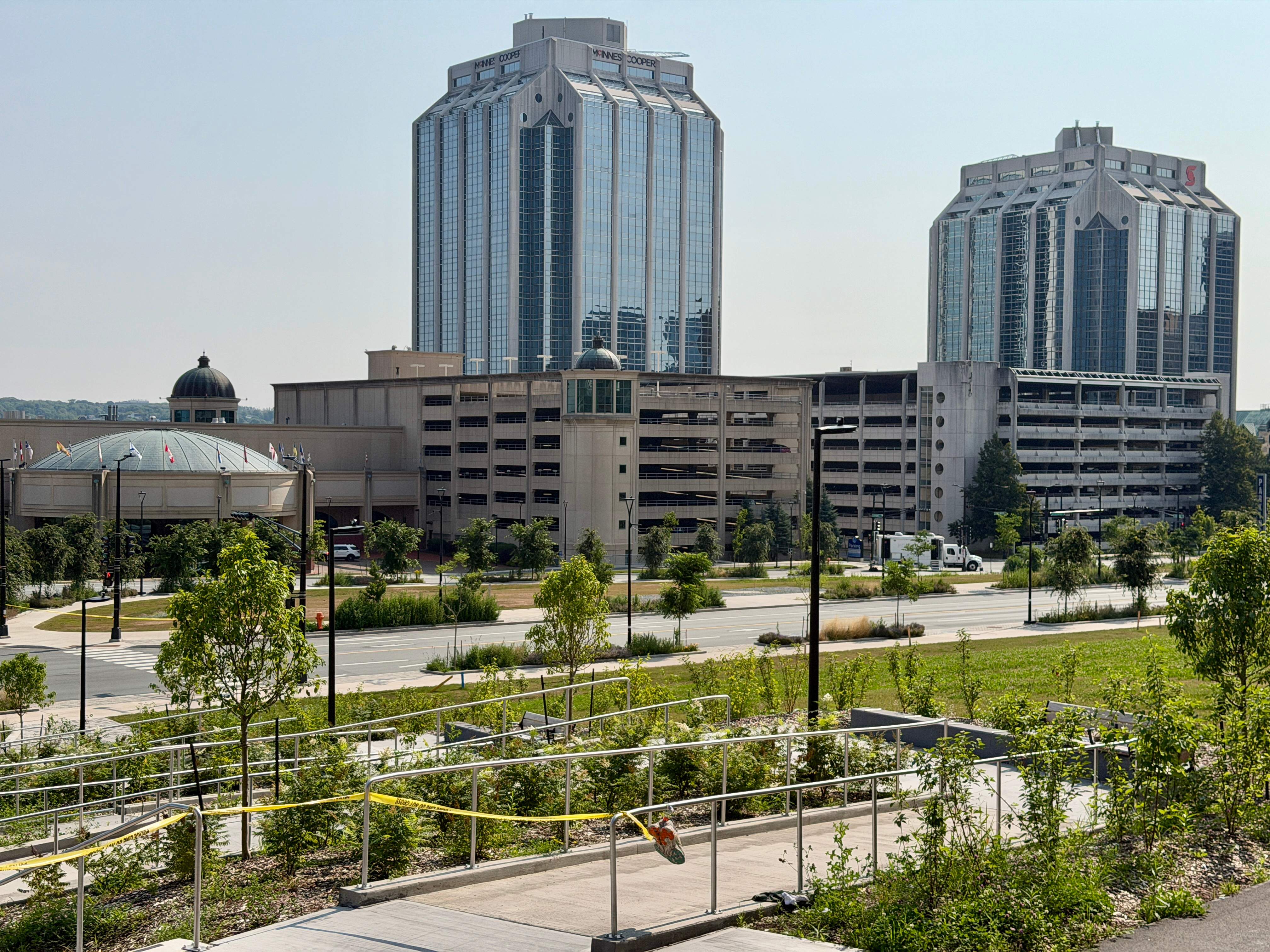
Municipal threat response frameworks operate under high-uncertainty constraints where every minute of delay multiplies economic loss and public friction. When a bomb threat targets a high-density urban core, the immediate objective of emergency services is not merely threat neutralization, but the systemic minimization of systemic vulnerability. The recent security incident in downtown Halifax, centered around the Purdy's Wharf parkade and a subsequent suspect apprehension in the Clayton Park neighborhood, exposes the operational friction points inherent in modern municipal crisis management. Deconstructing this event requires an examination of the perimeter containment mechanics, public communication channels, and the economic friction cost function that defines urban threat mitigation.
The Spatial Economics of Urban Perimeters
Emergency response protocols in commercial districts rely on concentric zones of restriction to isolate potential explosive hazards while maintaining municipal operational continuity. In the Halifax incident, law enforcement established a red-zoned evacuation perimeter alongside a yellow-zoned traffic restriction footprint, cutting off access around Upper Water Street, Barrington Street, and surrounding intersections.
The spatial mechanics of such an exclusion zone follow a distinct cost-benefit curve:
- Inner Core Containment: Direct physical mitigation of the high-risk asset, specifically the suspicious vehicle identified within the 1969 Upper Water Street parkade. Resource allocation here focuses on explosive ordinance disposal preparation and tactical containment.
- Mid-Tier Buffer Zone: Mandatory evacuation of commercial and residential structures to protect human capital from secondary blast effects or structural shrapnel dispersion.
- Outer Circulation Ring: Traffic diversion points designed to prevent vehicular congestion, thereby preserving unobstructed transit corridors for emergency response vehicles.
The primary failure mode in this layered architecture is information latency between the identification of the threat and the execution of the mid-tier evacuation. When threat vectors involve mobile suspects alongside stationary targets—such as the simultaneous containment in downtown and the eventual apprehension of a suspect on Thomas Raddall Drive—the perimeter must expand dynamically. This expansion introduces friction, trapping transients, disrupting transport schedules, and preventing individuals from retrieving essential assets or vehicles trapped behind the yellow lines.
Information Propagation and Public Compliance
Public safety during an active threat relies on deterministic communication channels. Municipalities face an optimization problem between mass-alert broadcasting and panic prevention. In this instance, emergency alerts triggered widespread evacuations via building public address systems and regional emergency broadcasts, forcing tourists, workers, and commuters into immediate exodus.
The behavioral response of the affected population divides into three distinct operational phases:
- Discovery Lag: The temporal gap between the initiation of the threat and the individual's awareness of the hazard. Evacuees frequently report learning of the evacuation through hotel alarm systems or impromptu online searches rather than direct municipal notifications, indicating a friction point in early-stage public warning systems.
- Friction and Access Denial: The physical barriers erected by police create immediate bottlenecks. Individuals with time-sensitive constraints—such as flights out of the city or scheduled commercial operations—face immediate utility loss due to restricted access to localized assets.
- Normalization of Resumption: The controlled de-escalation phase. The five-hour window from initial morning containment to the 2 p.m. lifting of the order represents the operational duration required to clear the asset and verify structural integrity.
Resource Allocation Across Dispersed Nodes
A critical challenge in modern threat mitigation is the multi-node attack surface. Incidents are rarely confined to a single point of origin. The Halifax response required simultaneous management of a downtown maritime commercial center and a residential-adjacent suburban hub in Clayton Park where the suspect was ultimately taken into custody.
This dual-node requirement strains municipal staffing models. Command staff must partition tactical units between site containment and active pursuit operations. The reallocation of specialized personnel from the primary threat site to the arrest vector introduces a vulnerability window where the primary site relies purely on static defense rather than active clearance. The speed of the resolution—achieving custody and containment by mid-morning and lifting restrictions by early afternoon—suggests an effective threshold of inter-agency communication, yet it highlights the heavy footprint required to secure even a localized threat vector.
Strategic Systemic Calibration
To eliminate the inefficiencies observed in urban threat responses, municipal command structures must transition from reactive perimeter scaling to predictive containment modeling.
- Automated Micro-Geofencing: Deploy automated digital exclusion zones that push localized evacuation directives directly to mobile devices within the precise polygon of risk, eliminating the reliance on secondary media searches or building alarms.
- Asset Recovery Corridors: Establish managed, time-windowed corridors within the yellow-zone traffic filter to allow stranded individuals to retrieve vital documentation, transport, or medical supplies without compromising the inner containment ring.
- Decentralized Command Redundancy: Maintain dedicated tactical reserves for secondary arrest vectors to ensure primary zone clearance operations do not experience resource starvation during multi-site incidents.