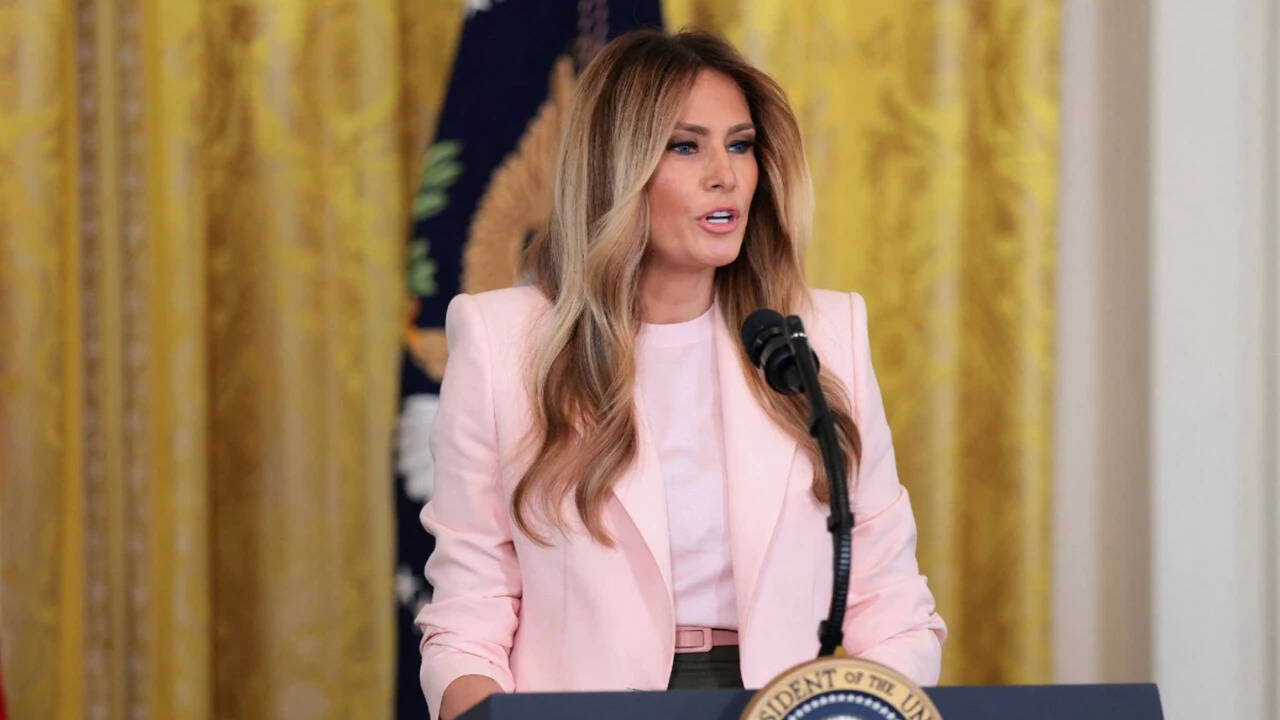
The beltway press corps is hyperventilating over a single press release.
They see headlines about Melania Trump hosting Russian and Ukrainian officials at the White House to discuss an Oleshky ceasefire, and they immediately reach for the fainting couch. The pundit class calls it a breach of protocol. Foreign policy traditionalists call it amateur hour. Cable news panels spend endless blocks debating whether a First Lady has the constitutional standing or the diplomatic pedigree to mediate a localized truce on the left bank of the Dnipro River.
They are asking the wrong question entirely.
While legacy outlets obsess over diplomatic etiquette, they miss the cold, structural reality of modern Track II and soft-power diplomacy. Hosting rival delegations under the roof of the East Wing is not a naive blunder or a vanity project. It is a calculated, asymmetric maneuver designed to bypass the deadlocked institutional machinery that has failed to secure a single square kilometer of lasting peace in southern Kherson.
The Protocol Trap and the Illusion of Traditional Diplomacy
Traditional foreign policy analysts worship at the altar of process. They believe peace happens in sterile conference rooms in Geneva or Vienna, mediated by career diplomats carrying three-ring binders and speaking in carefully hedged communiqués.
I have watched dozens of high-stakes international negotiations stall out for years because the primary actors refused to step outside standard diplomatic channels. When formal bilateral talks carry the full weight of state recognition, neither side can blink without looking weak to their domestic base. Every handshake becomes a concession. Every seating arrangement becomes a crisis.
The standard media coverage of the Oleshky gathering treats the First Lady's involvement as an anomaly that threatens serious statecraft. That reading ignores centuries of diplomatic history. Soft-power hosting—often categorized under the umbrella of Track 1.5 diplomacy—deliberately lowers the political temperature by shifting the venue from a formal treaty table to a humanitarian or cultural forum.
- Formal State Department summits lock negotiators into rigid, maximalist positions because every word enters the official diplomatic record.
- East Wing humanitarian convenings create plausible deniability for both Moscow and Kyiv, allowing mid-level envoys to test trade-offs without triggering immediate domestic backlash.
- Localized ceasefire frameworks, like a targeted halt to shelling around Oleshky, require granular, tactical trust rather than grand ideological alignment.
When a First Lady hosts warring factions under the banner of humanitarian relief, civilian protection, or cultural preservation, she gives both sides an off-ramp. Russian officials can claim they are attending out of respect for non-partisan humanitarian concerns rather than capitulating to Western pressure. Ukrainian officials can engage without signaling that they are trading away sovereign territory under duress.
Why Oleshky Matters More Than the Pundits Realize
Most commentators treat Oleshky as a random dot on a map—just another ruined town across the river from Kherson city. That geographic illiteracy ruins their analysis.
Oleshky sits at a critical chokepoint on the Russian-occupied left bank of the Dnipro. Following the destruction of the Kakhovka Dam and years of grueling amphibious skirmishes, the corridor stretching from the Antonivka Bridge approaches through Oleshky has become an ecological, humanitarian, and tactical meat grinder. Neither army can easily mount a decisive armored breakout across the flooded marshlands and ruined infrastructure, yet artillery duels and drone strikes keep the civilian population trapped in an uninhabitable gray zone.
In conflict resolution theory—specifically the work of William Zartman on mutually hurting stalemates—localized ceasefires rarely begin where victory is within reach. They begin where the cost of continued friction outweighs any plausible territorial gain.
Consider the tactical reality on the ground in Oleshky:
- Logistical Exhaustion: Supplying forward positions on the exposed left-bank riverbanks drains manpower and precision munitions for marginal tactical value.
- Infrastructure Collapse: With water, power, and medical networks pulverized, managing the remaining civilian population becomes an expensive liability for occupying forces and a continuous tragedy for Kyiv.
- Verification Feasibility: Unlike a 1,000-kilometer front line stretching from Kharkiv to the Black Sea, a localized ceasefire anchored around the Oleshky-Dnipro river line uses natural geographic barriers that make drone and satellite monitoring straightforward.
The competitor coverage frames the White House meeting as a distraction from "real" peace talks. In reality, micro-ceasefires are the only proven building blocks for macro-settlements. As diplomatic historian Henry Kissinger repeatedly demonstrated during the Cold War step-by-step negotiations in the Middle East, you do not solve existential territorial disputes in a single grand bargain. You negotiate narrow, verifiable disengagement zones where both militaries already want an excuse to stop bleeding.
Dismantling the Lazy Consensus on First Lady Diplomacy
Let us confront the three biggest myths dominating the commentary around this summit.
Myth 1: First Ladies Have No Business in Hard Security Negotiations
Critics argue that foreign policy belongs exclusively to the National Security Council and the State Department. This ignores the historical record of the American presidency.
Eleanor Roosevelt did not merely pour tea; she shaped the post-war human rights architecture at the United Nations while navigating intense Cold War hostility from Soviet delegates. Rosalynn Carter flew to Latin America in 1977 to conduct substantive policy discussions with military dictators on nuclear nonproliferation and human rights—briefings so rigorous that career diplomats admitted she out-prepared half the embassy staff. Nancy Reagan used back-channel relationships and personal hosting to soften the ground ahead of Ronald Reagan's nuclear summits with Mikhail Gorbachev.
Melania Trump brings a distinct, non-ideological profile to the table. Born in Slovenia, fluent in multiple European languages, and entirely detached from the Washington foreign policy blob, she carries none of the neoconservative or liberal-interventionist baggage that instantly triggers defensive posturing from Russian diplomats. To Moscow, she is not a career Cold Warrior. To Kyiv, she is a direct conduit to the Oval Office who has consistently focused on civilian welfare and family reunification.
Myth 2: A Localized Ceasefire Only Helps Russia Regroup
This is the standard hawkish objection to any pause in hostilities. The argument goes that Russia uses every localized truce to rotate troops, dig deeper trenches, and rearm.
That logic holds water during an active, high-momentum offensive. It falls apart in a static riverine stalemate like Oleshky. Both Russian and Ukrainian forces already use nightly drone warfare and electronic suppression to interdict troop movements along the left bank. A monitored humanitarian corridor and artillery freeze in Oleshky does not magically conjure Russian mechanized divisions out of thin air, nor does it strip Ukrainian forces of their high-ground artillery and drone surveillance from the right bank in Kherson.
What a localized ceasefire actually does is create a proof-of-concept mechanism. If Moscow violates a narrow, hyper-visible Oleshky truce hosted at the White House, it hands Washington indisputable diplomatic ammunition to tighten sanctions or expand weapons deliveries. If Moscow complies, it establishes a verification protocol that can be replicated upstream toward Enerhodar and the Zaporizhzhia Nuclear Power Plant.
Myth 3: Hosting Russian Officials at the White House Legitimizes Aggression
Sanctimony is not a strategy. Refusing to talk to an adversary until they surrender completely is a recipe for endless war.
During the height of the Cuban Missile Crisis and throughout the proxy wars of the 1970s and 1980s, Soviet officials regularly entered Washington. Diplomatic engagement is not a reward for good behavior; it is an instrument of national interest. By placing the meeting in the White House under the First Lady's auspices rather than holding a formal Oval Office bilateral summit, the administration achieves something remarkably shrewd: it projects absolute American centrality while denying Russian officials the visual trophy of a formal state reception with the President.
The Structural Mechanics of an East Wing Back-Channel
To understand why this setup works better than a standard State Department summit, trace how information moves inside a polarized bureaucracy.
In traditional negotiations, every proposal passes through layers of interagency clearance. By the time a draft ceasefire memo survives the Pentagon, the intelligence community, the State Department's European bureau, and the National Security Council, it is loaded with poison pills designed to appease domestic critics rather than solve the battlefield problem.
Imagine a scenario where a mid-level Ukrainian envoy and a Russian deputy minister need to agree on a simple, brutal trade-off: Russia halts grad rocket fire into residential Kherson from Oleshky, and Ukraine halts FPV drone strikes on civilian water trucks and power repair crews inside Oleshky.
If you put that proposal on a formal State Department agenda, it dies immediately. Hardliners in Kyiv will scream that it implicitly recognizes Russian administrative control over Oleshky. Hardliners in Moscow will scream that it restricts Russian military freedom of action on territory Moscow claims to have annexed.
Put those exact same officials in an East Wing salon under the banner of a First Lady's civilian protection initiative, and the framing shifts completely. Neither side is signing a border treaty. Neither side is conceding sovereignty. They are agreeing to a humanitarian de-confliction protocol. The language shifts from sovereignty and annexation to civilian survival, medical evacuations, and infrastructure repair.
The Real Risks Nobody Is Talking About
A contrarian analysis that ignores the downside is just cheerleading. There are genuine, severe hazards baked into this unconventional approach—just not the ones cable news pundits are whining about.
First, back-channel ambiguity breeds tactical misunderstandings. When negotiations move out of formal diplomatic channels, oral assurances often replace written verification annexes. In Oleshky, where frontline units operate in tangled marshlands with overlapping fields of fire, an imprecise definition of "heavy artillery" or "buffer zone perimeter" can trigger an accidental firefight within forty-eight hours. Without granular military-to-military enforcement rules attached to the political agreement, a soft-power truce can collapse into mutual recriminations faster than it was signed.
Second, Moscow excels at weaponizing humanitarian ambiguity. Russian intelligence services routinely embed operatives inside humanitarian and cultural delegations to map interpersonal dynamics and exploit perceived daylight between different branches of the U.S. government. If Russian envoys sense any disconnect between the East Wing's humanitarian messaging and the Pentagon's operational priorities, they will attempt to play one against the other to stall weapons deliveries while offering hollow promises on the ground.
Third, domestic political polarization in Washington can sabotage implementation. Because Melania Trump is a polarizing figure to the American media establishment, any temporary hiccup in the Oleshky truce will be seized upon by political opponents as proof of incompetence, creating intense pressure on the White House to abandon the track before enforcement mechanisms have time to work.
How to Judge Whether the Oleshky Talks Actually Succeed
Stop watching the press conferences. Ignore the body language experts analyzing handshakes on the White House colonnade. If you want to know whether this unconventional diplomacy is working, track three concrete, verifiable metrics over the thirty days following the meeting:
- Artillery and Mortar Volume Across the Dnipro: Look at daily Ukrainian General Staff and independent OSINT shelling logs for the Kherson-Oleshky sector. A real agreement produces an immediate, measurable drop in cross-river tube artillery and mortar fire, even if reconnaissance drone flights continue.
- Utility and Water Corridor Access: Watch whether civilian repair crews enter Oleshky and neighboring settlements without being targeted by FPV drones. Electricity and water restoration are the true indicators of a functioning local truce.
- Prisoner and Civilian Detainee Transfers: Track whether localized humanitarian exchanges begin moving through the Oleshky-Kherson corridor. Small-scale swaps of elderly civilians, medical patients, and low-level detainees prove that local commanders on both sides are actually obeying orders from the envoys who sat in Washington.
The foreign policy establishment hates this summit because it exposes an uncomfortable truth: their polished credentials and rigid protocols have produced three years of trench warfare and diplomatic paralysis. Breaking a stalemate requires breaking the rules of engagement.
If an unconventional host in the East Wing can force Moscow and Kyiv into the same room to stop shelling civilians in Oleshky, the diplomats in Foggy Bottom should take notes instead of taking offense.


