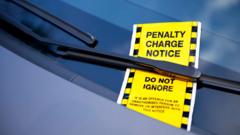
Motorists across the country are facing automated fines for simply waiting in line to buy fuel. Private parking enforcement companies, hired by landowners to deter commuters from abusing forecourt space, are using automated number plate recognition (ANPR) cameras to penalize drivers who never actually park. When a station is congested or delivery tankers block the pumps, the time spent queuing counts toward a strict grace period, triggering automatic fines that often top £100.
This is not a glitch in the system. It is a predictable outcome of outsourcing enforcement to private firms whose business models rely entirely on issuing penalties rather than managing traffic flow.
The Mechanics of the Forecourt Trap
To understand how a driver can get fined for sitting behind the wheel with their engine running, you have to look at how ANPR cameras operate. These systems are binary. They record a timestamp when a vehicle crosses an invisible camera line at the entrance, and another when it exits.
The software calculates the duration between those two points. It does not know, nor does it care, whether the vehicle was stationary in a marked bay, idling in a queue of ten cars, or waiting for a tanker to finish replenishing the underground tanks.
Private parking operators typically grant a nominal grace period, often between 10 and 20 minutes, to allow drivers to read the terms, realize they cannot park, and leave. However, during peak hours, holiday rushes, or supply disruptions, simply waiting for an available pump can easily exhaust this window. The system flags the vehicle as an overstayer, matches the plate with registration records, and automatically prints a demand for payment.
The underlying issue is structural. Petrol station operators want to keep forecourts clear to maximize turnover and ensure buying customers can access the pumps. They contract third-party parking enforcement firms to deter non-customers from leaving their vehicles overnight or walking off-site to nearby shops.
But the contracts are frequently structured in a way that creates perverse incentives. The parking enforcement company usually provides the camera infrastructure for free or at a low cost. In exchange, they keep the revenue generated from the fines.
This means the enforcement company has zero financial incentive to differentiate between a driver exploiting the lot and a driver caught in a bottleneck. A congested forecourt becomes a highly profitable asset.
The Mirage of Regulatory Oversight
Drivers who receive these charges often assume that common sense will prevail upon appeal. They assume wrong. The appeals process is heavily weighted against the motorist, governed by an industry that largely regulates itself.
In many jurisdictions, private parking operators belong to trade associations that write their own codes of practice. While these codes mandate grace periods, they rarely account for operational gridlock at the pumps. When a driver appeals a fine by pointing out that they were merely queuing, the operator routinely rejects the claim, citing the raw camera data as absolute proof of non-compliance.
Independent appeals bodies do exist, but they are bound by the strict wording of the contract posted on the station signs. If the sign says "Max stay 15 minutes across the entire site," and the driver was on site for 18 minutes, the appeal is legally difficult to win, regardless of the physical reality on the ground.
Major fuel retailers often attempt to distance themselves from these penalties. When confronted by angry customers, store managers frequently claim that the parking lot is managed by an external entity and that their hands are tied.
This defense is disingenuous. The retailer signed the lease or the service agreement. They have the power to stipulate terms that protect queuing customers, yet many choose to look the other way because the system keeps their forecourts clear of long-term parkers without costing them a dime in management overhead.
The Economic Burden on the Everyday Commuter
The financial impact of these automated fines falls squarely on people who can least afford it. A £100 charge for a routine fuel stop represents a massive, unexpected expense for a working-class family or a gig-economy delivery driver.
Consider a hypothetical example of a delivery van driver. If they enter a busy station at 5:00 PM, wait 12 minutes for a diesel pump to open, spend 4 minutes fueling, and another 5 minutes queuing inside the shop to pay because only one register is open, they have been on the property for 21 minutes. If the site has a hard 15-minute limit enforced by an aggressive operator, that driver just lost an entire day’s wages to an automated algorithm.
The problem expands during localized fuel shortages or panic-buying episodes. When lines spill out into the street, the cameras keep rolling. Drivers who manage to get onto the property are penalized for the systemic inefficiency of the station itself. The industry terms these penalties "Parking Charge Notices" to mimic official council-issued fines, deliberately using intimidating legal language to pressure motorists into paying quickly to get a 50% discount.
How Drivers Can Fight Back
Defeating an unfair forecourt fine requires immediate action and careful documentation. Drivers cannot rely on the parking operator to be reasonable. They must build a case based on evidence that disrupts the binary logic of the ANPR data.
Keep the Fuel Receipt
The receipt is the most critical piece of evidence. It proves that the driver was a legitimate paying customer and establishes a precise timeline for the transaction. If the time on the receipt shows the purchase occurred deep into the alleged violation period, it demonstrates that the driver was actively engaged in using the station's primary service, not abandoning their vehicle.
Dashcam Footage and Timestamps
If a vehicle is equipped with a dashcam, the footage should be saved immediately. Video evidence showing a long line of stationary cars or a delivery truck blocking the lanes provides undeniable proof of frustration of contract. It shows that compliance with the time limit was physically impossible due to factors within the operator’s control.
Force the Retailer to Intervene
While store managers claim they cannot help, they usually possess the administrative authority to cancel tickets through an internal portal for genuine customers. Escalating the complaint to the corporate customer service line or threatening to take fuel business to a competitor often yields results. Retailers will sacrifice a parking operator’s fee to protect a high-value, recurring fuel customer.
The Required Shift in Private Enforcement
The current model is unsustainable and erodes public trust in both fuel brands and automated systems. If private parking operators want to maintain legitimacy, the technology must evolve beyond simple entry-and-exit logging.
Modern computer vision systems are capable of tracking vehicle movement, not just license plates. Systems should be calibrated to detect whether a car is stationary in a designated parking bay or sitting in a active driving lane leading to a pump. Furthermore, parking software should be dynamically linked to the station’s point-of-sale data. If the pumps are processing transactions at a slow rate due to high volume, the grace period should automatically scale upward to reflect the real-time delay.
Until regulations force this level of technological sophistication or mandate that fines can only be issued to vehicles left completely unattended, the forecourt will remain a trap. Drivers must view every trip to a busy petrol station not just as a refueling stop, but as a rigid contractual interaction with a hidden clock ticking in the background. Check the signs at the entrance, keep every piece of paper, and do not assume that being a paying customer protects you from the machine.